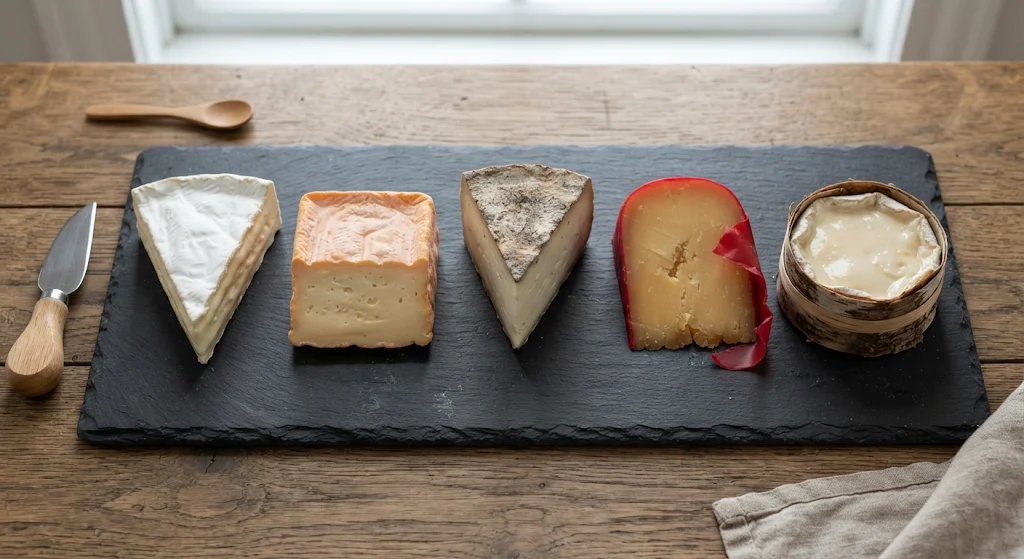
Quick Answer: There are three main rinds. Bloomy rinds (brie) grow from white mold. Washed rinds (Taleggio) come from washing the cheese, which feeds orange bacteria. Natural rinds (Stilton) dry and form on their own. All three are safe to eat. Wax, cloth, plastic and foil are not.
Pairing by hand? Pairing Card Deck $5 · printable PDF
Why cheese has a rind at all
A rind is the outside of a cheese that has met the air while it aged. It protects the inside, holds in moisture and, on many cheeses, does a lot of the ripening. The microbes living on the surface break down fat and protein from the outside in. That's why a ripe brie is runnier under the rind than in the middle.
Change the rind and you change the cheese. That's the science behind the types.
The three living rinds
1. Bloomy rinds: white, soft, mushroomy
Cheesemakers add molds such as Penicillium camemberti (also sold as P. candidum) or the wrinkly Geotrichum candidum. In a cool, humid room, the mold blooms into a white, velvety coat within a couple of weeks. Its enzymes soften the cheese underneath.
- Examples: brie, Camembert, triple-creme, Humboldt Fog, Bucheron
- Taste of the rind: mushroomy, earthy, a little bitter as it ages
- Eat it? Yes. It's part of the cheese. Some people trim it on very ripe wheels where it tastes of ammonia. See can you eat brie rind.
2. Washed rinds: orange, sticky, pungent
During aging, the cheese is wiped or washed with salt brine, sometimes mixed with beer, wine or brandy. The damp, salty surface favors Brevibacterium linens and related bacteria, which turn the rind orange and tacky and make the famous smell.
- Examples: Taleggio, Epoisses, Raclette, Limburger, Red Hawk. Firm Alpine cheeses like Gruyere are washed too, with milder rinds.
- Taste of the rind: meaty, brothy, salty, sometimes funky
- Eat it? If you like it. The paste inside is usually far milder than the smell suggests, so try them separately first.
3. Natural rinds: dry, crusty, earthy
Nothing is added. The cheese dries on the outside as it ages, and wild molds and yeasts from the cave settle on it. These rinds are thicker, firmer and often gray, brown or speckled.
- Examples: Tomme de Savoie, Stilton, Ossau-Iraty, clothbound cheddar (once the cloth is off)
- Taste of the rind: earthy, cellar-like, sometimes gritty or bitter
- Eat it? It's safe. Thin, soft ones are pleasant; thick, hard ones usually aren't worth chewing.
Coverings that are not rinds
| Covering | Found on | Eat it? |
|---|---|---|
| Wax (red, yellow, black) | Gouda, Edam, some cheddars | No. Peel or cut it off |
| Plastic coating | Many grocery Goudas and Dutch cheeses | No |
| Cloth bandage | Clothbound cheddar | No. Remove the cloth |
| Foil | Roquefort, some blues | No |
| Spruce bark strap | Harbison, Vacherin | No. It flavors the cheese; scoop around it |
| Leaves or ash | Some goat cheeses | Ash coatings are edible; leaves are usually decoration |
| Very hard aged rind | Parmigiano-Reggiano | Safe, but too hard. Simmer it in soup |
How rinds change pairings
- Bloomy rinds love acid and bubbles. Sparkling wine, cider and tart fruit lift the mushroomy coat. See why bubbles cut fat.
- Washed rinds want something just as bold: Belgian or brown ales, off-dry Riesling or Gewurztraminer, and dark bread. A delicate red gets lost.
- Natural rinds suit earthy, nutty partners: walnuts, dried figs, apples, and medium-bodied reds or port with Stilton.
How to serve rinds on a board
- Cut so every piece has some rind and some center. Wedges from the middle out keep it fair. See how to cut cheese for a board.
- Leave bloomy and washed rinds on. Removing them ruins the shape and loses flavor. Guests can trim their own.
- Take wax and cloth off before serving. Nobody should have to wonder.
- Give washed rinds their own space. A small plate or a corner of the board keeps the smell from taking over the fruit.
- Let them warm up. Rinded cheeses taste flat cold. Give soft ones 30 to 60 minutes out of the fridge. See the temperature guide.
When to skip a rind
Trim it if it smells sharply of ammonia, has pulled away from the paste, feels newly slimy or gritty, or grows fuzzy colored mold that wasn't there when you bought it. When in doubt, cut it off. If you're pregnant, check our cheese and pregnancy guide before choosing soft-ripened and washed-rind cheeses.
Sources
- Institute of Culinary Education: Can I eat the rind?
- Wisconsin Cheese: Cheese rinds
- Formaticum: Can I eat the rind?
- Cheese Grotto: Eating cheese rinds
FAQ
Which cheese rinds can you eat?
Bloomy rinds (brie, Camembert), washed rinds (Taleggio, Epoisses) and most natural rinds (Tomme de Savoie, Stilton) are safe to eat. Whether you enjoy them is personal. Don't eat wax, cloth bandages, plastic coatings or foil, and use tree bark for flavor only.
What are the main types of cheese rind?
Bloomy rinds grow from white molds such as Penicillium camemberti. Washed rinds come from washing the cheese with brine, beer or wine, which feeds orange bacteria like Brevibacterium linens. Natural rinds form on their own as the outside dries. Wax, cloth and bark are added coverings.
Why do washed-rind cheeses smell so strong?
The washing encourages Brevibacterium linens and related bacteria, which make pungent, meaty aromas on the surface. The inside usually tastes milder than it smells, so try the paste on its own first if the rind is too much.
Can you eat the rind on Parmigiano-Reggiano?
It is safe, but very hard. Instead of eating it on a board, save it and simmer it in soup, beans or risotto, where it softens and adds savory flavor. Remove it before serving.
When should you not eat a rind?
Skip it if it smells strongly of ammonia, has pulled away from the cheese, is gritty or slimy in a way that's new, or shows fuzzy colored mold that wasn't there when you bought it. When in doubt, cut it off.