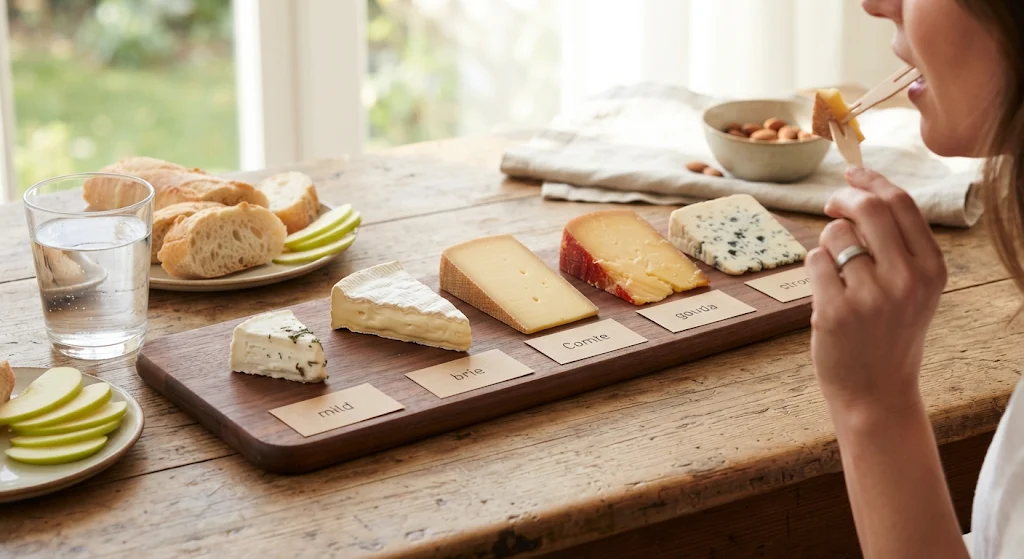
Quick Answer: Taste with your nose, on the exhale. Your tongue picks up only five tastes. The rest of a cheese's flavor (nutty, grassy, mushroomy, brothy) is smell that travels from your mouth up to your nose while you chew. So: let the cheese warm up, take a small bite, chew slowly, and breathe out through your nose. Then notice the finish.
Pairing by hand? Pairing Card Deck $5 · printable PDF
The science: flavor is mostly smell
Two ways of smelling
You smell in two directions. Orthonasal smell is sniffing: air in through your nostrils. Retronasal smell happens while you eat: aromas released in your mouth travel up the back of your throat to the same smell receptors.
Your tongue alone can only tell sweet, salty, sour, bitter and umami. Telling an apple from a pear, or Comte from Gruyere, takes retronasal smell. The neuroscientist Gordon Shepherd, who coined the word "neurogastronomy," put it simply: flavor is mostly retronasal smell.
Breathing out carries the flavor
In 2015, Shepherd's team at Yale modeled the airflow in the human throat. They found that breathing in mostly sweeps air past the mouth toward the lungs, while breathing out pulls aromas from the mouth up into the nose. In other words, the flavor of what's in your mouth arrives on the exhale.
That's the scientific reason tasters chew slowly and breathe out through the nose. It's also why food tastes flat when you have a cold.
It isn't only smell
Other researchers point out that flavor is a team effort: texture, temperature, the sound of a crunch and even what the cheese looks like all shape what you experience. A good tasting uses every one of them, which is why the steps below start with your eyes and hands.
How to taste cheese in 5 steps
- Warm it up. Take cheese out of the fridge 30 to 60 minutes before tasting. Cold mutes aroma. See the temperature guide.
- Look. Note the color of the paste, the rind, any crystals, holes or blue veins. Deeper yellow often comes from beta-carotene in grass-fed milk, though some cheeses are colored with annatto.
- Touch. Press it. Is it springy, crumbly, fudgy or runny? Texture predicts how it will melt on your tongue.
- Smell. Sniff the cut face, then the rind. First impressions count: milky, nutty, barnyard, fruity, earthy.
- Taste and exhale. Take a small bite. Chew slowly and press it against the roof of your mouth. Breathe out through your nose while you chew. Notice the first taste, how it changes, and the finish: how long the flavor lasts after you swallow. A long finish usually means a well-aged cheese.
Words for what you taste
| Flavor family | What it's like | Cheeses to find it in |
|---|---|---|
| Milky, buttery | Fresh cream, butter | Fresh mozzarella, Havarti, young Gouda |
| Tangy, lactic | Yogurt, lemon | Fresh chevre, feta |
| Mushroomy, earthy | Mushrooms, damp cellar | Brie, Camembert, Tomme de Savoie |
| Nutty, sweet | Toasted nuts, brown butter | Comte, Gruyere, Manchego |
| Caramel, butterscotch | Toffee, brown sugar | Aged Gouda, Mimolette |
| Brothy, savory | Beef stock, umami | Parmigiano-Reggiano, aged cheddar |
| Meaty, funky | Bacon, barnyard | Taleggio, Epoisses |
| Sharp, peppery | Bite at the back of the tongue | Gorgonzola, Stilton, Roquefort |
Savory and brothy notes come from umami, which builds as cheese ages. See umami on a board.
How to host a cheese tasting at home
- Pick 3 to 5 cheeses with a clear range: one fresh, one bloomy, one semi-firm, one aged hard, one blue. Our mild-to-strong list helps.
- Plan about 1 oz of each cheese per person. That's two or three bites each.
- Taste in order, mild to strong. Strong cheeses linger and drown out the delicate ones.
- Taste each cheese plain first, then with a pairing: honey, fig jam, an apple slice, a sip of wine.
- Cleanse with water and plain bread or water crackers between cheeses.
- Write one word for each. It's surprising how quickly a group starts agreeing on "nutty" or "grassy."
- Know your rinds before you start. See cheese rinds explained.
Try it in two minutes
Pinch your nose shut and take a bite of a flavorful cheese, like Comte or aged cheddar. Chew for a few seconds: you'll get salt and maybe a little sweetness, not much more. Now let go of your nose and breathe out. The flavor floods in. That rush is retronasal smell.
Sources
- Yale Scientific: How exhaling while eating affects smell and taste (2016)
- Neuroscience News: Ni et al., "Optimal directional volatile transport in retronasal olfaction," PNAS (2015)
- Spence, review of Neurogastronomy, Flavour (2012)
- Wikipedia: Retronasal smell
FAQ
How do you taste cheese properly?
Let it warm to room temperature, then look at it, feel it, and smell it. Take a small bite, chew slowly so it coats your mouth, and breathe out through your nose while you chew. Notice the first taste, how it changes, and the finish after you swallow.
Why should you breathe out through your nose when tasting?
Most of a food's flavor comes from aromas that travel from your mouth up the back of your throat to your nose, called retronasal smell. Research from Yale found airflow carries those aromas to the nose mainly when you breathe out, so exhaling while you chew brings the flavor forward.
What order should you taste cheese in?
Mild to strong: fresh cheeses first, then soft bloomy rinds, semi-firm, aged hard cheeses, washed rinds and finally blue cheese. Strong cheeses linger and can mask the mild ones if you taste them first.
What should you eat between cheeses at a tasting?
Something plain: water, plain baguette or a water cracker. A slice of crisp apple works too. Skip flavored crackers and strong spreads until after you've tasted each cheese on its own.
How much cheese do you need for a tasting?
About 1 ounce of each cheese per person for a tasting of 3 to 5 cheeses. That's enough for two or three bites each, one plain and one or two with a pairing.