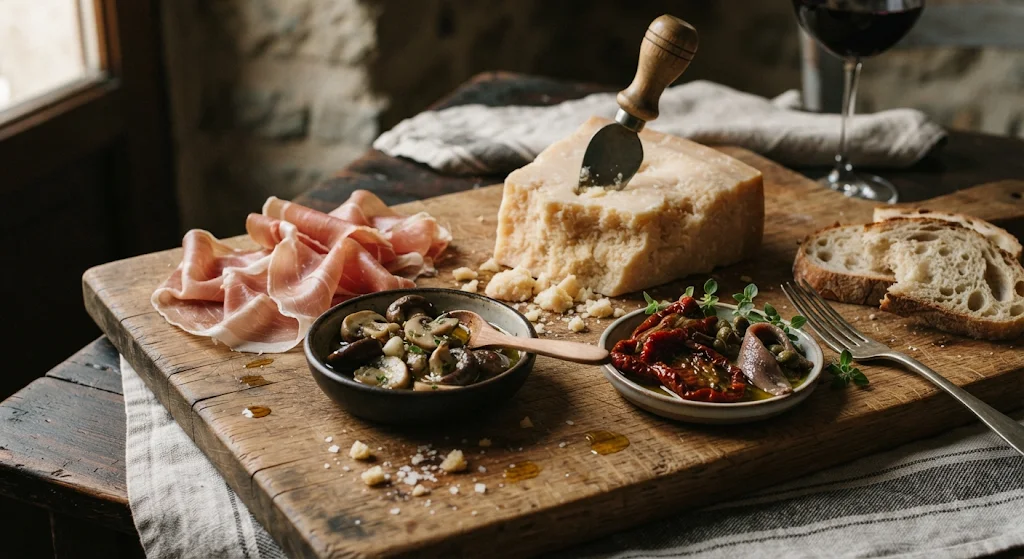
Quick Answer: Umami comes from free glutamate, and aging makes it. As cheese and ham age, their proteins break down into amino acids, glutamate among them. That's why a chunk of Parmigiano tastes far more savory than fresh mozzarella. Pair glutamate-rich cheese with cured meat or mushrooms and the savory taste gets several times stronger.
Pairing by hand? Pairing Card Deck $5 · printable PDF
The science, in three parts
1. Umami is the taste of glutamate
Your tongue has receptors for five basic tastes: sweet, sour, salty, bitter and umami, the savory one. Umami's main trigger is glutamate, an amino acid. Glutamate bound up inside a protein has no taste. Only free glutamate, loose in the food, hits the receptor.
That's the key to the whole board: anything that frees glutamate from protein makes food taste more savory. Aging, curing, fermenting and drying all do that.
2. Aging turns protein into savory flavor
Cheese starts as milk protein (casein) and fat. Over months of aging, enzymes from the milk, the rennet and the cheese's bacteria cut that protein into smaller and smaller pieces, ending in free amino acids. The numbers climb with time. These free glutamate levels come from the Umami Information Center and a white paper from the Academy of Nutrition and Dietetics:
| Food | Free glutamate (mg per 100 g) |
|---|---|
| Parmigiano-Reggiano, 48 months | 2,220 |
| Parmigiano-Reggiano, 24 months | 1,680 |
| Comte, 18 months | 1,570 |
| Cheddar, 10 years | 718 |
| Cured ham | 337 |
| Cheddar, 1 year | 173 |
| Fresh tomato | 140 to 246 |
The same cheddar has about four times more free glutamate at 10 years than at 1 year. Fresh cheeses like mozzarella and ricotta aren't aged at all, which is why they taste milky rather than savory.
Cured meat works the same way. Prosciutto and jamon spend a year or more drying, and their proteins break down too. Those little white crystals in aged cheese are also amino acids, though mostly other ones, not glutamate. Read more in why cheese has crystals.
3. Glutamate plus nucleotides multiplies umami
There are two more umami molecules, both nucleotides: inosinate, found in meat and fish, and guanylate, found in dried mushrooms. On their own they taste mild. But when glutamate meets either one, umami gets much stronger. This is called umami synergy. The Umami Information Center reports the peak at about a 1 to 1 ratio, roughly 7 to 8 times as intense as either alone.
That explains some of the oldest pairings on any board. Parmigiano (glutamate) with prosciutto (inosinate). Anchovies with aged cheese. Mushrooms with ham. Each half makes the other taste more savory.
10 umami pairings for a board
| Glutamate side | Partner | Why it works |
|---|---|---|
| Parmigiano-Reggiano | Prosciutto | Glutamate meets inosinate, the classic synergy |
| Parmigiano-Reggiano | Anchovies | The Caesar salad pairing, on a cracker |
| Comte | Speck | Alpine cheese and smoked Alpine ham |
| Aged Gouda | Marinated mushrooms | Mushrooms bring guanylate to a savory cheese |
| Aged cheddar | Beef jerky | The cheeseburger idea, dried |
| Manchego | Jamon serrano | Spain's savory pair, both long-aged |
| Sun-dried tomatoes | Burrata | Concentrated tomato adds savory depth to mild cream |
| Bottarga | Butter crackers | Cured roe is pure umami; plain butter frames it |
| Pecorino Romano | Guanciale | The carbonara pairing, served cold |
| Mojama | Marcona almonds | Cured tuna with sweet, rich almonds |
How to use it on a board
- Build an umami corner. Put aged cheese, cured ham, marinated mushrooms and sun-dried tomatoes together. Guests pair them without trying.
- Balance it. Umami-rich foods are usually salty too. Add acid (cornichons, mustard) and sweet (figs, honey) nearby so the board doesn't taste one-note.
- Cut aged cheese into rough chunks. Breaking Parmigiano with a knife tip shows off the crystals and gives a better bite than thin slices.
- Keep fresh cheese for contrast. A mild burrata or chevre next to savory meat gives the palate a rest.
- Pour something with acid or bubbles. Lambrusco, dry sparkling wine or a crisp lager suits a very savory board. See why bubbles cut fat.
- Try a wildcard. Black garlic is garlic aged slowly in warm heat until it turns soft, sweet and savory. A few cloves beside aged cheese add depth.
Try it in two minutes
Taste a piece of Parmigiano on its own. Then taste a piece of prosciutto on its own. Now eat them together in one bite. Most people find the pair tastes more savory and longer-lasting than either half. That's umami synergy, no lab required.
Sources
- Umami Information Center: Umami-rich foods, cheese
- Umami Information Center on Google Arts & Culture: What is umami
- Academy of Nutrition and Dietetics: Umami in Foods white paper (PDF)
- Cook's Illustrated: The science of umami
FAQ
What is umami?
Umami is the savory taste, one of the five basic tastes with sweet, sour, salty and bitter. It comes mainly from glutamate, an amino acid, and from two nucleotides called inosinate and guanylate. Aged cheese, cured ham, tomatoes, mushrooms and soy sauce are all rich in it.
Why does aged cheese have more umami?
As cheese ages, enzymes break its milk proteins into free amino acids, including glutamate. The longer it ages, the more free glutamate builds up. The Umami Information Center lists 24-month Parmigiano-Reggiano at about 1,680 mg of glutamate per 100 g and 48-month at about 2,220 mg.
Which cheese has the most umami?
Long-aged hard cheeses lead: Parmigiano-Reggiano, Comte aged 18 months or more, aged Gouda and very old cheddar. Fresh cheeses like mozzarella and ricotta have very little, because they are not aged.
What is umami synergy?
When glutamate is eaten with inosinate (found in meat and fish) or guanylate (found in dried mushrooms), umami tastes much stronger than either alone. The Umami Information Center reports the effect is strongest at about a 1 to 1 ratio, roughly 7 to 8 times the intensity.
Is the umami in cheese the same as MSG?
Chemically, yes. MSG is the sodium salt of glutamate, and your tongue's umami receptors respond to the same glutamate whether it comes from Parmigiano, tomatoes or a shaker.