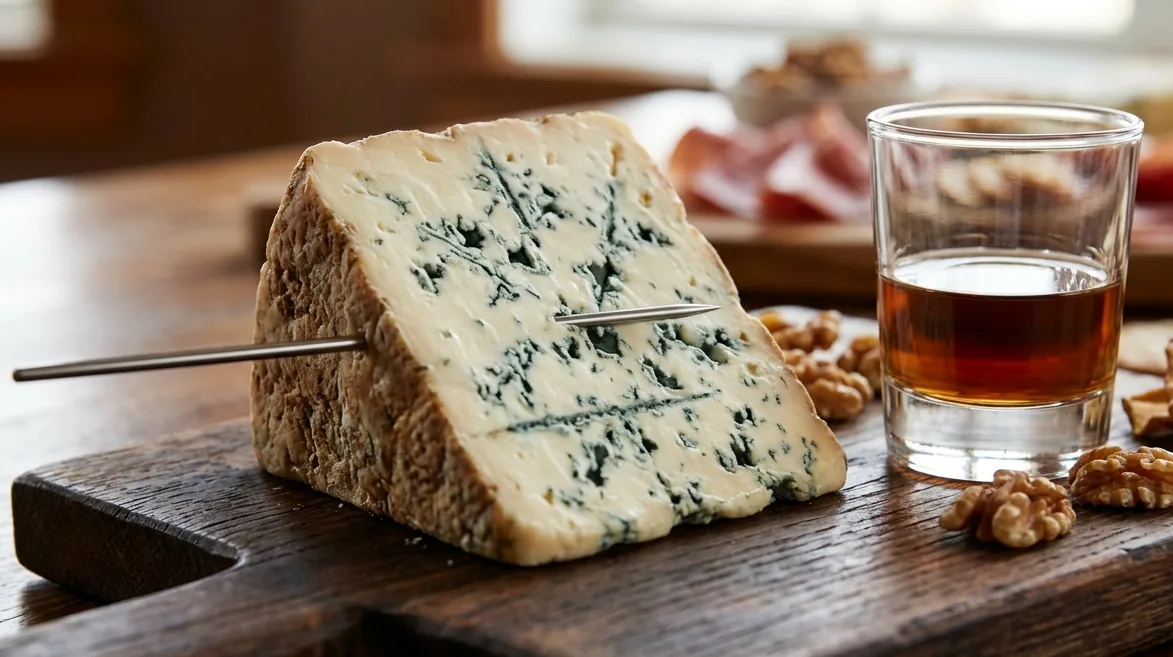
Quick Answer: Stilton is a PDO blue cheese that can only be made in Derbyshire, Leicestershire and Nottinghamshire. Take it out of the fridge 30–40 minutes before serving so it turns creamy, and pair it with Tawny Port, walnuts, pears or honey. Its dried-fruit and caramel notes match the Port's.
Of all the cheeses that appear on a charcuterie board, blue cheese generates the most divided response. Half the table reaches for it immediately; the other half avoids it entirely. Most of that divide comes from encounters with aggressive, poorly made blue cheeses — or from serving blue cheese the wrong way. Stilton, when served correctly and in the right context, is one of the most complex and board-worthy cheeses in the world. The science behind it explains why.
What Stilton Actually Is
Stilton is a PDO (Protected Designation of Origin) blue cheese produced exclusively in three English counties: Derbyshire, Leicestershire, and Nottinghamshire. Only a handful of licensed dairies can make it. The PDO designation specifies not just the geography but the production method, including the requirement that the cheese be made from locally sourced pasteurized milk.
There are two Stiltons: Blue Stilton and White Stilton. Blue Stilton is the aged, blue-veined variety that most people mean when they say "Stilton." White Stilton is the unaged, un-blued form — a milder, crumbly cheese used primarily as a base for flavored varieties (cranberry, apricot). For charcuterie purposes, Stilton means Blue Stilton.
Blue Stilton is a semi-soft, crumbly cheese aged a minimum of 9 weeks. The interior ranges from ivory to pale gold, shot through with blue-green veins of Penicillium roqueforti mold. The texture is dense and crumbly near the rind, creamier toward the center. The flavor is complex and layered: initial creaminess, followed by sharp, tangy, peppery blue mold notes, then a long finish that in well-aged Stiltons develops dried fruit, caramel, and honey undertones.
The Science: How the Blue Veins Form
The blue veins in Stilton — and in all Penicillium roqueforti blue cheeses — are not mold spreading randomly through the cheese. They are the result of a deliberate production technique: needling.
The mechanism:
When Stilton is formed, Penicillium roqueforti spores are incorporated into the curd during production. But the mold doesn't grow inside a dense, solid mass of cheese — it needs oxygen to develop. The exterior of the formed cheese wheel has enough air contact to support minimal surface mold, but the interior would remain anaerobic (oxygen-free) without intervention.
Needling solves this. Each Stilton wheel is pierced with approximately 60–70 long, thin stainless steel needles, which punch channels throughout the interior of the cheese. These channels provide oxygen pathways from the exterior into the core. The Penicillium roqueforti spores, which were distributed throughout the curd, now have air access and begin to grow along these oxygen channels — producing the characteristic blue-green veins that trace the needle paths.
The distribution of flavor: The veins are not merely visual. Penicillium roqueforti produces a specific group of flavor compounds as it metabolizes the cheese: lipases that break down fat molecules into free fatty acids (which produce the sharp, peppery blue notes), and proteases that break down proteins (which contribute to the creamy, complex base flavor). The distribution of these compounds follows the needle channels — which is why Stilton's flavor is complex throughout rather than concentrated in patches.
Why the needling pattern matters: A Stilton wheel needled too early, before the cheese has set properly, will not hold the channels cleanly and may collapse them. A wheel needled too late may have developed too much rind, preventing oxygen penetration. The timing of needling is a critical craft decision that determines whether the resulting cheese has well-distributed, even veining or irregular, concentrated patches.
Why Stilton's veining differs from Roquefort and Gorgonzola: All three use Penicillium roqueforti, but the production methods differ. Roquefort (made from sheep's milk in the Combalou caves of Roquefort-sur-Soulzon) uses a different starter culture and aging environment that produces a more intense, saltier blue. Gorgonzola Piccante uses extended aging to develop a more assertive, crumbly texture. Stilton's needling technique, cow's milk base, and English production environment produce a specific result: dense and crumbly but with a creamier center, and a flavor that tilts toward dried fruit and caramel complexity rather than pure blue intensity.
Age and the Dried Fruit Flavor Development
Stilton's most distinctive flavor characteristic — the dried fruit, caramel, and honey notes that appear in well-aged examples — comes from two parallel processes:
Proteolysis: As the Penicillium roqueforti enzymes break down proteins over weeks of aging, amino acids are released. These amino acids undergo Maillard-like reactions and further chemical transformations that produce caramel and dried-fruit-adjacent flavor compounds. This is why young Stilton (9–10 weeks) is sharper and more purely blue in character, while well-aged Stilton (older examples or longer-aged production runs) develops the complex sweetness that makes Port pairing so effective.
Fat breakdown (lipolysis): The lipase activity of P. roqueforti produces short-chain fatty acids that contribute to the characteristic blue flavor but also, at the right concentrations, produce notes of dried apricot, raisin, and fig. When these free fatty acids interact with the alcohol compounds in the cheese matrix, they can form esters — fruit-adjacent aroma compounds. This is the biochemical origin of the dried fruit character in aged Stilton.
This flavor development is why serving temperature matters enormously for Stilton. Cold Stilton suppresses these volatile compounds. A properly tempered Stilton (served at or near room temperature, having rested 30–40 minutes outside refrigeration) releases its full aromatic complexity in a way that cold Stilton simply doesn't.
Stilton vs. Other Blue Cheeses
| Stilton | Roquefort | Gorgonzola Dolce | Gorgonzola Piccante | |
|---|---|---|---|---|
| Milk | Cow | Sheep | Cow | Cow |
| Origin | England (PDO) | France (PDO) | Italy (PDO) | Italy (PDO) |
| Texture | Dense, crumbly; creamier center | Semi-soft, moist | Very soft, spreadable | Firm, crumbly |
| Flavor | Complex; blue + dried fruit/caramel finish | Intense, salty, sharp blue | Mild, buttery, gentle blue | Bold, assertive, peppery |
| Best board use | Standalone cheese with pairing | Strong blue anchor | Spreader; soft cheese element | Bold accent; pairs with honey |
| Classic pairing | Tawny Port, walnuts, dried pear | Sauternes, honey | Fig jam, light honey | Acacia honey, fresh figs |
For a board with guests who are blue cheese hesitant, Gorgonzola Dolce is the entry point. For guests who want complexity, Stilton is the destination. Roquefort is the most assertive and should be used sparingly or on a specifically cheese-focused board.
How to Serve Stilton on a Board
Temperature: Essential. Pull Stilton from refrigeration 30–40 minutes before serving. Cold Stilton is chalky and the flavor is muted. Room-temperature Stilton is creamy toward the center and the dried fruit and caramel notes emerge fully.
Cutting/presentation: Stilton is traditionally presented as a wedge and scooped from the center with a cheese spoon rather than sliced — the interior is the most prized portion. On a board, a wedge with the rind visible (showing the wrinkled brown exterior against the blue-veined interior) is visually distinctive. Provide a small spoon or spreader. Alternatively, break into irregular chunks to show the interior veining — the visual contrast of cream, blue-green, and gold reads well on a board.
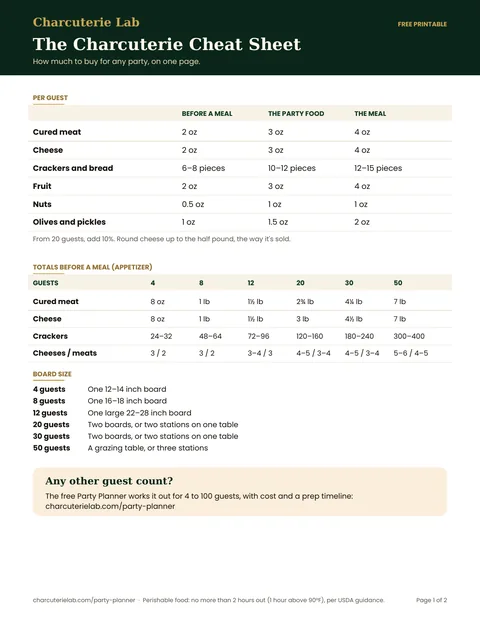
Quantity: Blue cheese registers as a strong flavor; guests typically take less than they think they want. 0.75–1oz per person is standard. Position it as one cheese among three to four, not the sole focus.
Placement: Place Stilton at one end or corner of the board, away from mild fresh cheeses. Its strong flavor can dominate adjacent elements — position the pairings that work with it (dried fruit, walnuts, Port) in its immediate vicinity.
Pairing Stilton
The Port pairing explained:
Stilton and Tawny Port is one of the most scientifically justified pairings in the charcuterie world. The mechanism: Tawny Port develops caramel, dried fig, apricot, and nutty oxidative notes during its barrel aging — flavor compounds that are produced by Maillard reactions and oxidative processes similar to those that produce Stilton's dried-fruit complexity. The result is a compound echo: caramel notes in the Port reinforce caramel notes in the Stilton; dried fig in the Port reinforces dried fig in the Stilton. Unlike tannin-based red wine pairings (where fat buffers tannin), this pairing works through flavor resonance rather than contrast.
The sugar in Port also provides sweetness that buffers the sharpness of the blue mold notes. This is why sweet wine pairings consistently work with blue cheese: the sweetness doesn't compete with the blue flavor — it rounds the sharp edges.
Cheese pairings on the board:
- Place Stilton in contrast to a mild fresh cheese (chèvre, fresh ricotta) — the contrast helps each read more clearly
- Aged Gouda alongside Stilton creates a comparison: both have caramel notes from different mechanisms (Maillard in Gouda, proteolysis/lipolysis in Stilton)
Accompaniment pairings:
- Walnuts — the tannin in walnut skins echoes Port tannin; the fat buffers blue sharpness
- Dried pear or dried fig — dried fruit notes echo the developed flavors in aged Stilton; not fresh fruit
- Dark honey (buckwheat) — assertive enough to hold against Stilton's intensity without disappearing
- Dark rye crispbread — earthy base that contrasts with Stilton's sweetness without competing with it
- Fresh pear — the exception to the fresh-fruit caution; mild sweetness and crunch provide contrast without overwhelming
Wine and drink pairings:
- Tawny Port — the classic; caramel/dried fruit compound echo
- Sauternes or Beerenauslese — noble rot sweetness cuts the blue intensity; a more elegant alternative to Port
- Oloroso Sherry — nutty, oxidative notes echo Stilton's complexity
- Stout or porter (beer) — dark malt, coffee, and chocolate notes provide contrast to Stilton's tang; a board-friendly alternative when wine isn't the centerpiece
Stilton at a Glance
| Property | Description |
|---|---|
| Milk | Pasteurized cow's milk |
| Origin | Derbyshire, Leicestershire, Nottinghamshire, England (PDO) |
| Production | Needled to create oxygen channels; Penicillium roqueforti mold |
| Texture | Dense, crumbly; creamier center |
| Flavor | Blue tang + peppery sharpness; aged notes of dried fruit, caramel, honey |
| Science hook | Needling creates airflow channels; mold grows along oxygen pathways |
| Board role | Strong flavor anchor; contrast to mild fresh cheeses |
| Classic pairing | Tawny Port, walnuts, dried pear |
| Drink pairing | Tawny Port, Sauternes, Oloroso Sherry, stout |
Get weekly ingredient science in the Charcuterie Lab Report newsletter.