Quick Answer: White crystals in aged cheese are tyrosine amino acids that precipitate during extended aging as proteins break down through proteolysis. They're completely safe, a marker of quality aging, and appear most often in Parmigiano-Reggiano, aged Gouda, and Gruyère. Calcium lactate crystals — softer and white — can also appear on the exterior of some cheeses, particularly cheddar.
Two Types of Crystals, Two Different Mechanisms
Not all cheese crystals are the same. The two types you'll encounter are tyrosine crystals and calcium lactate crystals — each forms through a different process and appears in different locations.
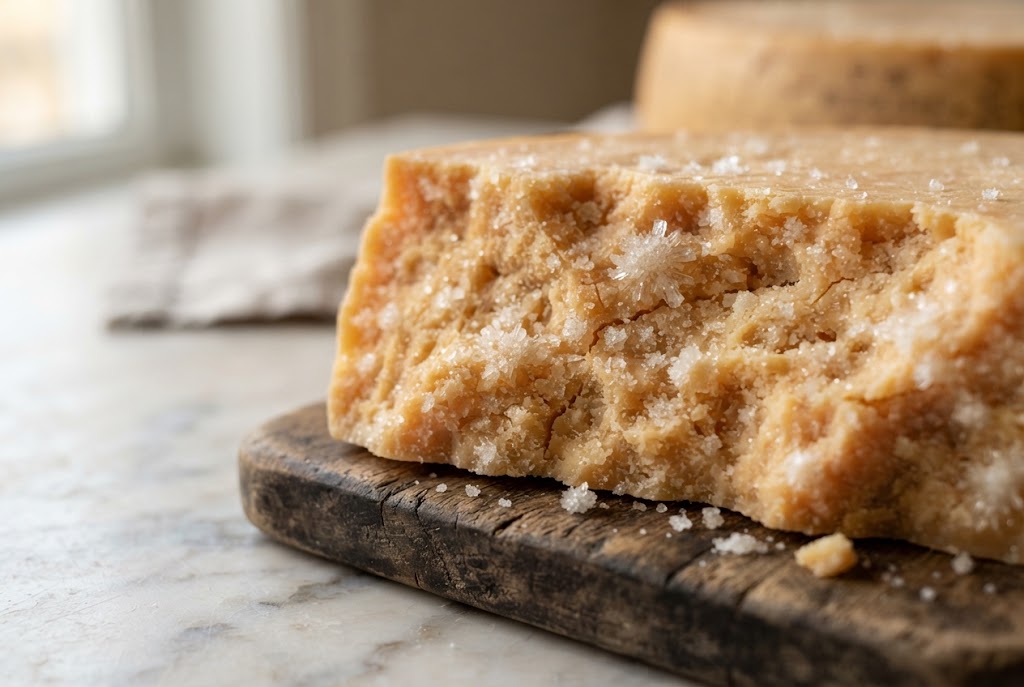
Tyrosine crystals form inside the cheese paste, typically as small, hard, white flecks or larger clusters scattered through the interior. They're most visible in cut cross-sections of very aged cheeses — a Parmigiano-Reggiano aged 36 months will have far more than one aged 18. Tyrosine is a free amino acid that precipitates out of the cheese matrix once it reaches a threshold concentration. Proteolysis — the enzymatic breakdown of casein proteins during aging — is what releases tyrosine and other free amino acids. The longer and more complete the proteolysis, the more crystals you get.
Calcium lactate crystals appear differently — they form on the exterior surface of the cheese, typically as white, powdery or frosted deposits. They're most common on aged cheddars and appear when lactic acid (a byproduct of bacterial fermentation) combines with calcium to form calcium lactate, which migrates to the surface and crystallizes. They're softer than tyrosine crystals and can sometimes be mistaken for mold — they're not mold, and they're not a quality defect.
Both are entirely safe and palatable. The tyrosine crystals contribute a pleasant crunch; the calcium lactate deposits are largely textural and flavorless.
What Crystal Formation Tells You About Aging
Crystals are a functional proxy for aging depth. Producers can't always communicate the full story of an aged cheese through a label, but a heavily crystalline cross-section tells a trained eye that the cheese received sufficient time, temperature, and enzymatic activity to develop real complexity.
Parmigiano-Reggiano is the clearest example. At 12 months, crystals are minimal. At 24, they're visible throughout. At 36 months ("stravecchio"), the interior is shot through with crystals and the paste has a characteristic gritty crunch. The crystals don't just indicate age — they also carry tyrosine, which has a subtly savory, bitter quality that contributes to the cheese's overall flavor complexity. Parmigiano's intensity at 36 months isn't just about moisture loss; it's also about the concentration of free amino acids, tyrosine included, that make every bite register as more vivid.
Aged Gouda follows the same progression. Young Gouda has none; 2-year aged Gouda has scattered crystals; 5-year aged Gouda can have a texture approaching Parmigiano in its crunchiness. This is proteolysis made visible.
How to Apply This on a Board
Understanding crystals changes how you present and sequence aged cheese.
Use crystals as a conversation anchor. If you're labeling a board, "18-month Gruyère — look for the white crystals" gives guests something to look for and creates engagement. Crystals are visually distinctive once people know to look for them.
Pair crystalline cheese with smooth condiments for maximum textural contrast. Honey drizzled over a slice of aged Gouda creates a contrast between the crunchy tyrosine and the smooth, liquid sweetness — this is textural contrast used intentionally. Fig jam works the same way. Avoid pairing crystalline cheese with crunchy crackers as the primary cracker; a smooth, thin water cracker lets the cheese's own texture be the dominant crunch.
Let crystalline cheeses breathe. Tyrosine crystals become more pronounced at room temperature. Serving an aged Parmigiano cold dulls the crunch and suppresses aroma. The 45–60 minute pull-from-refrigerator rule applies here with particular force.
The Charcuterie Lab Takeaway
White crystals in aged cheese are not a flaw, not mold, and not cause for concern. They're a quality signal — the visible evidence of deep proteolysis and extended aging. If a guest points at crystals and hesitates, the correct response is: "Those are the best part — it means the cheese was aged long enough to develop real complexity." Point them toward a crystal cluster, hand them a piece with honey, and let the texture do the persuading.
Applying the science to your board? The Charcuterie Lab ebook translates pairing science like this into 50 complete board builds with full ingredient rationale. Free at charcuterielab.com/ebook.
FAQ
What are the white crystals in aged cheese? The crunchy white deposits visible in aged hard cheeses are primarily tyrosine crystals — free amino acids that precipitate out of solution during extended aging as proteins break down through proteolysis. They're most common in well-aged cheeses like Parmigiano-Reggiano, aged Gouda, Gruyère, and extra-sharp cheddar. Are the crystals in aged cheese safe to eat? Yes — tyrosine crystals are completely safe and considered a positive indicator of cheese quality and age. They have a mild, pleasant crunch and a subtle savory note. Many cheese lovers actively seek out crystals as a sign of well-aged, complex cheese. The crystals themselves are largely flavorless but contribute to the textural experience of eating aged cheese. Why do some aged cheeses have crystals and others don't? Crystal formation depends on the degree and duration of proteolysis — the enzymatic breakdown of proteins that occurs during aging. Hard cheeses aged 18+ months with significant enzymatic activity tend to develop crystals; younger or softer cheeses don't. Environmental conditions (temperature, humidity, salt levels during aging) also influence whether and how readily crystals form. Do crystals affect pairing? Crystalline cheeses pair slightly differently than non-crystalline ones — the crunchy texture adds a physical contrast dimension to pairings that goes beyond flavor alone. Smooth condiments (honey, jam) contrast particularly vividly with crystalline cheese; crunchy crackers create textural redundancy rather than contrast. Pair crystalline cheese with smooth, spreadable elements for maximum textural interest.