Quick Answer: Choose sharp or extra-sharp cheddar aged at least a year. Long aging breaks down protein and fat, which creates the sharpness and the crunchy crystals. Break it into rough chunks instead of slicing it, and put honey or fig jam and apple slices beside it; the sweetness softens the sharp edge.
Aged cheddar is one of the most purchased cheeses in the world — and one of the most misunderstood on a charcuterie board. Most people reach for it by default, slice it into rectangles, and consider the decision made. But aged cheddar rewards intentional use. The difference between a mild cheddar thrown on a board and a two-year aged sharp cheddar placed deliberately next to raw wildflower honey and a dried apricot is the difference between filling a space and building a flavor experience.
Understanding what makes cheddar sharp — what's actually happening inside the cheese as it ages — is the fastest way to understand how to use it well.
What Is Aged Cheddar?
Cheddar is a cow's milk cheese originating in the village of Cheddar in Somerset, England, where natural caves provided the consistent cool temperature ideal for long aging. The defining production step — the one that gives cheddar its name — is "cheddaring": after the curds are cut and cooked, they're stacked and repeatedly turned in blocks, compressing the structure and expelling additional whey. This step is what creates cheddar's characteristic dense, smooth texture and distinguishes it from other hard cow's milk cheeses.
"Aged cheddar" typically refers to cheddar that has been matured for a minimum of 12 months, though the category spans from mild (2–4 months) through medium (4–12 months), sharp (1–3 years), extra-sharp or vintage (3–5 years), and clothbound aged (variable, typically 12–24+ months). For charcuterie purposes, sharp and extra-sharp are the most useful expressions.
The Lab Section: Why These Pairings Work
Cheddar's sharpness is a direct product of biochemical aging processes — specifically proteolysis and lipolysis.
Proteolysis is the breakdown of protein chains (casein) by enzymes present in the cheese. As casein breaks down into smaller peptides and free amino acids, the texture becomes more crumbly and granular (the long protein networks that give fresh cheese its smooth, elastic structure are gone), and a complex set of flavor compounds develops. Some of these amino acids are intrinsically savory; others react further to produce the flavor molecules associated with "aged" character — buttery, nutty, earthy notes.
Lipolysis is the breakdown of fat by lipase enzymes. As milk fats (triglycerides) are broken down into free fatty acids, distinct flavor compounds emerge — including some of the short-chain fatty acids responsible for the slightly sharp, almost pungent edge that distinguishes a two-year aged cheddar from a mild one.
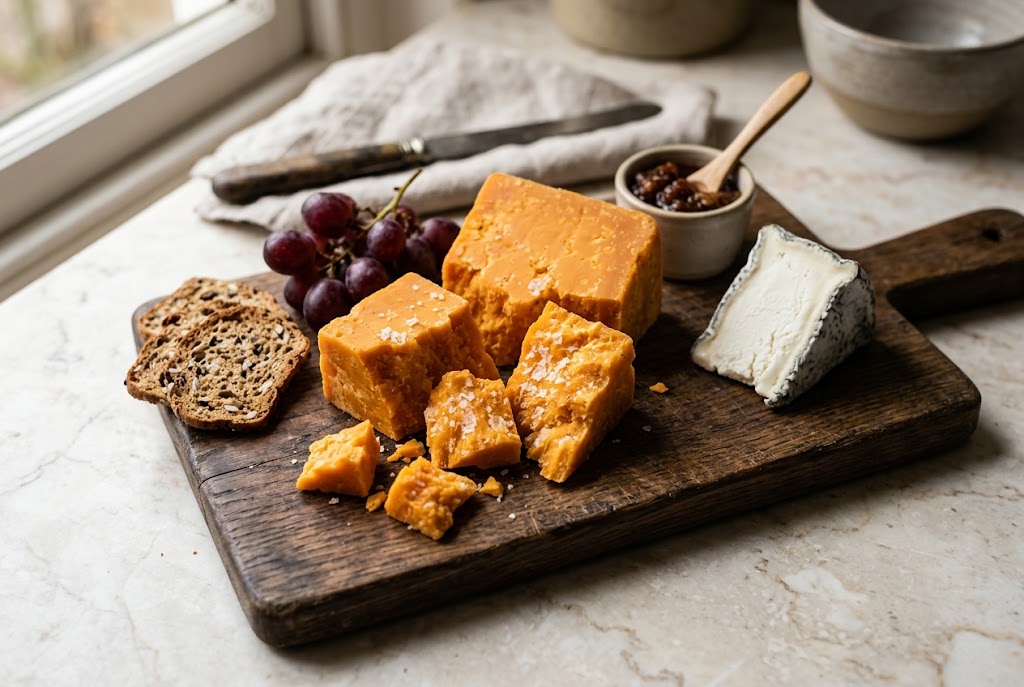
The crystalline white deposits that appear in extra-aged cheddar are tyrosine crystals — free amino acids that have precipitated out of solution during extended aging. They're a reliable visual indicator of significant age and are associated with the most complex, deeply savory flavor development. (Calcium lactate crystals — a softer, whiter deposit that can form on the surface — are a different phenomenon and don't indicate the same flavor depth.)
Choosing Aged Cheddar for Your Board
Mild/Medium cheddar (under 12 months): Smooth texture, mild buttery flavor, minimal sharpness. Not ideal for a charcuterie board — it lacks the flavor complexity to hold its own against cured meats and condiments. Best for cooking.
Sharp cheddar (1–2 years): This is the workhorse. Firm, slightly crumbly, with clear buttery and tangy notes and developing complexity. The best all-purpose choice for a charcuterie board. Accessible to all guests, holds up against medium-intensity cured meats, pairs well with honey, fruit, and both crackers and bread.
Extra-sharp/Vintage cheddar (2–5 years): Distinctly crumbly, crystalline, with intense flavor — complex, nutty, almost caramel-like in the best examples. Longer finish on the palate. The best choice when you want cheddar to be a featured element of the board rather than a supporting one. Can overwhelm mild guests unfamiliar with aged cheese; consider pairing with a stronger, more assertive sweet condiment (dark honey, fig jam) to balance.
Clothbound cheddar: Aged in cloth wrapping rather than sealed plastic, which allows the rind to breathe and the cheese to interact with its environment. Produces a more complex, terroir-influenced flavor — earthy, grassy, sometimes mushroom-like — that differs markedly from standard vacuum-sealed aged cheddar. Treat it like a featured cheese and serve in larger wedges so guests can explore the flavor gradient from rind to center.
Origin considerations: English and Irish clothbound cheddars (particularly those from Somerset, like Montgomery's or Westcombe) represent the tradition at its most complex. American-made aged cheddars (Cabot Clothbound, Grafton Village, Beecher's Flagship) produce excellent, often more approachable expressions. Both are excellent board choices; the selection depends on the overall tone of the board.
How to Present Aged Cheddar on a Board
Cutting and breaking: Sharp and extra-sharp cheddar breaks more beautifully than it slices. Instead of uniform rectangles, use a paring knife tip or cheese wire to break the block into irregular chunks — the craggy, crystalline surfaces look more inviting and create visual interest. The irregular surface area also exposes more of the cheese's interior, which means more aromatic release for the person about to eat it.
For milder aged cheddar that slices cleanly, thin rectangular slices fanned on one side of the wedge is the classic presentation.
Temperature: Remove aged cheddar from the refrigerator 30–45 minutes before serving. Cold temperature mutes flavor compounds — the fatty acids and amino acids responsible for cheddar's sharpness and complexity are most expressive at room temperature (around 65–70°F / 18–21°C). A cold piece of sharp cheddar tastes noticeably less sharp and less interesting than the same piece allowed to come up to temperature.
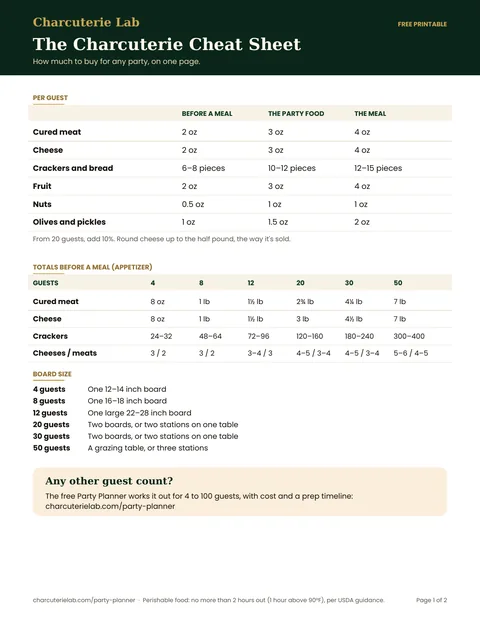
Quantity: Plan about 1 oz per person when aged cheddar is one of two or three cheeses, within the usual total of 2 oz of cheese per person before a meal (3 oz as the party food). If it's the only cheese, buy the full 2–3 oz per person.
Pairing Aged Cheddar
The salt-sweet principle in action: Aged cheddar is the most reliable demonstration of the salt-sweet pairing principle on any board. The salt in the cheese suppresses bitter taste receptors and amplifies sweetness; the sweetness of the condiment attenuates the cheese's sharp edge. The result is that both taste more complex and more complete than either alone.
Best sweet pairings:
- Raw wildflower honey — the floral complexity of raw honey interacts with cheddar's buttery sharpness in a way that processed honey cannot match. The best combination on a board at any price point.
- Fig jam — concentrated sweetness with a slight tannin note from the fig seeds; works beautifully with extra-sharp cheddar.
- Apple butter or apple slices — the malic acid in apple provides both sweetness and brightness. The acid dimension adds a clean, fresh contrast to cheddar's density.
- Quince paste (membrillo) — slightly tart and very dense sweetness; excellent with extra-sharp or clothbound cheddar.
Bread and cracker pairings:
- Whole grain or seeded crackers — the nutty, earthy notes complement cheddar's aged complexity without competition.
- Sourdough — the mild acidity resets the palate between bites, making each piece of cheddar taste as sharp as the first.
- Oat cakes — traditional pairing, particularly with English cheddars. The slightly sweet, toasty oat flavor is one of the best textural and flavor complements for aged cheddar.
Meat pairings:
- Prosciutto di Parma — the sweet, delicate fat of prosciutto is an ideal contrast to cheddar's sharpness.
- Bresaola — beef cured meat with a lean, slightly sweet profile. Less aggressive than salami, allowing cheddar's flavor to remain center stage.
- Mild salami (Genoa) — balanced fat and salt complement without overpowering.
- Avoid: very spicy or heavily spiced meats (nduja, spicy soppressata) — the heat compounds compete with cheddar's sharpness and neither wins.
Drink pairings:
- Red wine — aged cheddar is one of the few cheeses that genuinely works with tannic reds. The fat and protein in the cheese soften tannins; a fruity, medium-bodied red (Merlot, Zinfandel) is ideal.
- IPA or amber ale — cheddar and hoppy beer is a classic pairing; the bitterness of the hops and the sharpness of the cheddar create complementary contrast.
- Whisky/bourbon — aged cheddar and aged whisky share flavor compounds (caramel, vanilla, nuttiness) from similar aging processes. An underused but excellent pairing.
- Dry cider — the apple acidity in cider mirrors the apple pairing in food; very clean and bright against aged cheddar.
Aged Cheddar at a Glance
| Property | Description |
|---|---|
| Milk | Cow's milk |
| Origin | Somerset, England (now global) |
| Texture | Firm to crumbly; increasingly granular with age |
| Flavor | Buttery, tangy, sharp; nutty/caramel notes with extended aging |
| Crystals | Tyrosine (white, crunchy) = indicator of significant age and complexity |
| Rind | Natural/clothbound or wax-sealed |
| Best board role | Featured hard cheese, flavor anchor |
| Optimal age for boards | 1–3 years (sharp to extra-sharp) |
| Sweet pairing | Raw honey, fig jam, apple butter |
| Cracker pairing | Whole grain, oat cakes, sourdough |
| Meat pairing | Prosciutto, bresaola, Genoa salami |
Quick Pairing Reference
| If You're Pairing | Use This |
|---|---|
| Sharp cheddar (1–2 yr) | Raw wildflower honey + thin whole-grain crackers |
| Extra-sharp (2–5 yr) | Fig jam or dark honey + oat cakes |
| Clothbound cheddar | Apple butter + sourdough + prosciutto |
| Cheddar on a red wine board | Fig jam + bresaola + walnut crackers |
| Cheddar on a beer board | Whole grain crackers + Genoa salami + whole-grain mustard |
FAQ
How long does aged cheddar last once opened?
Wrap aged cheddar in cheese paper or wax paper — never plastic wrap — and refrigerate. Properly wrapped, it stays at peak quality for 3–4 weeks. If surface mold appears on hard aged cheddar, cut 1 inch around and below the affected area and the rest is safe to eat.
What's the difference between sharp and extra-sharp cheddar for a board?
Sharp cheddar (1–2 years) is the all-purpose board choice: firm, tangy, and accessible to most guests. Extra-sharp or vintage cheddar (3–5 years) is more crumbly and crystalline with intense, complex flavor — better as a featured cheese when you want cheddar to be the centerpiece rather than a supporting element.
Should aged cheddar have a rind?
Vacuum-sealed aged cheddar has no natural rind. Clothbound cheddar develops a natural rind that is edible, though most people prefer the interior. The rind of clothbound cheddar has a more earthy, complex character that differs from the interior — worth trying.
Can you freeze aged cheddar?
You can freeze it, but the texture suffers — the fat and protein structure breaks down during freezing, making the cheese more crumbly and prone to moisture release when thawed. Use frozen cheddar in cooking rather than on a board. Fresh is always better for charcuterie use.
Why does my aged cheddar taste less sharp when cold?
Flavor compounds in aged cheddar — the free fatty acids and amino acids responsible for sharpness — are most volatile and aromatic at room temperature. Cold suppresses their activity. Pull aged cheddar from the fridge 30–45 minutes before serving for full flavor.
Putting It on the Board
Aged cheddar earns its place at the center or near the sweet anchor of any board. Break it into irregular chunks rather than slicing it clean — let the crystalline interior show. Place raw honey or fig jam within reach of it; these are not optional additions but active pairings that change how the cheese tastes.
If you're building a board for guests unfamiliar with aged cheese, start with sharp (1–2 year) and let the honey do the teaching — one bite of aged cheddar with raw honey converts more skeptics than any explanation could.
Get weekly pairing guides in the Charcuterie Lab Report newsletter.