Quick Answer: Parmigiano-Reggiano is the protected Italian original: raw cow's milk from a small area of northern Italy, no additives, aged at least 12 months and usually 24. Grana Padano is a similar Italian hard cheese from a much bigger area, aged at least 9 months, milder and cheaper. "Parmesan" in the US is a generic name that can be made anywhere, so quality ranges from excellent to sawdust. For a board, buy Parmigiano-Reggiano and break it into chunks. For grating or a big crowd, Grana Padano is the value pick.
Are Parmesan and Parmigiano-Reggiano the same?
In Italy and the EU, yes. "Parmesan" is treated as the English name for Parmigiano-Reggiano, and only the protected cheese can use it.
In the US, no. Parmesan is a generic name. A cheese labeled Parmesan can be made in Wisconsin or anywhere else, from pasteurized milk, and US rules only require it to be aged at least 10 months. Some American Parmesans are very good; the shaker kind is a different product altogether.
The three at a glance
| Parmigiano-Reggiano | Grana Padano | US Parmesan | |
|---|---|---|---|
| Where it's made | Parma, Reggio Emilia, Modena, and parts of Bologna and Mantua | A large area of the Po Valley across five regions | Anywhere |
| Protection | DOP | DOP | None |
| Milk | Raw cow's milk | Raw, partly skimmed cow's milk | Usually pasteurized |
| Additives | Only salt and rennet | Lysozyme (a preservative from egg) is allowed | Varies |
| Minimum age | 12 months, often 24 or more | 9 months | 10 months |
| Flavor | Intensely savory, nutty, fruity | Milder, sweeter, softer | Varies, usually milder |
| Crystals | Plenty | Fewer | Few |
| Price | $$$ | $$ | $ to $$ |
How they taste
Parmigiano-Reggiano is the most intense. Long aging breaks proteins down into free amino acids, especially glutamate, the compound your tongue reads as savory. Older wheels add the little crunchy crystals (mostly the amino acid tyrosine) that people love. A 24-month wheel is the classic; 36 months and older gets sharper and more crumbly.
Grana Padano is the gentler sibling. It's aged for less time and made with partly skimmed milk, so it's softer, sweeter and less salty, with fewer crystals. Many people find it easier to eat in quantity.
US Parmesan depends entirely on the maker. A good one, aged a year or more, is a fine cheese. Anything sold pre-grated in a shaker is best kept for pasta night.
Which is better on a charcuterie board?
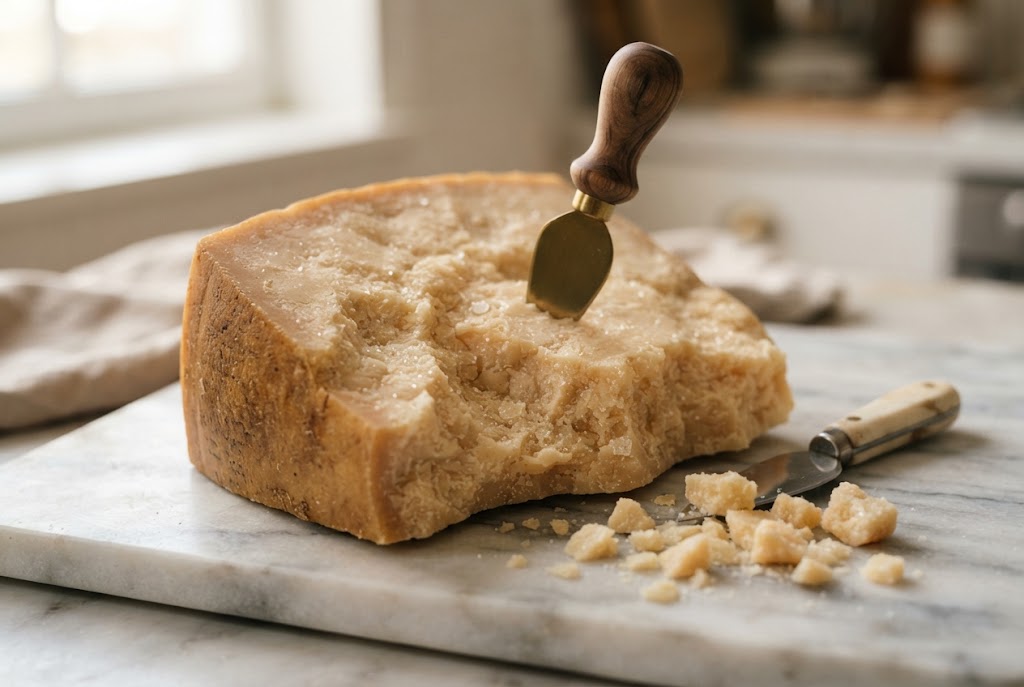
Parmigiano-Reggiano is the showpiece. Don't slice it. Break it into rough, bite-sized chunks with a short, stubby cheese knife, so the craggy surfaces show off the crystals. Take it out of the fridge 45 to 60 minutes before serving.
It pairs with:
- Sweet: honey, aged balsamic or balsamic glaze, figs and pears.
- Meat: prosciutto (they come from the same part of Italy).
- Drinks: Lambrusco, Champagne, Chianti or a nutty amber beer.
Grana Padano is the smart choice for a large board or grazing table, where you need a pound or two and a milder flavor works for more guests.
How to tell the real thing
- Parmigiano-Reggiano: dotted letters spelling Parmigiano-Reggiano pressed all over the rind, plus the DOP seal.
- Grana Padano: a diamond-pattern rind marking and the words Grana Padano.
- Pre-grated cheese: check the ingredient list. Real grated Parmigiano-Reggiano lists only milk, salt and rennet. Cellulose is added to many shaker cheeses to stop clumping.
Which should you buy?
- For a board: Parmigiano-Reggiano, 24 months, in a wedge.
- For a big crowd or a budget: Grana Padano.
- For everyday grating: Grana Padano or a good domestic Parmesan.
- If a guest needs pasteurized cheese: a domestic Parmesan made with pasteurized milk. Check the label.
Our ranking of the best Parmesan for a charcuterie board names specific brands, and the Parmigiano-Reggiano and Grana Padano guides cover pairings in detail.