The short version
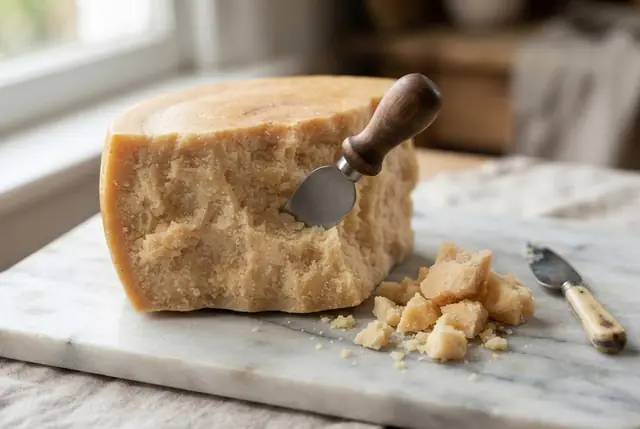
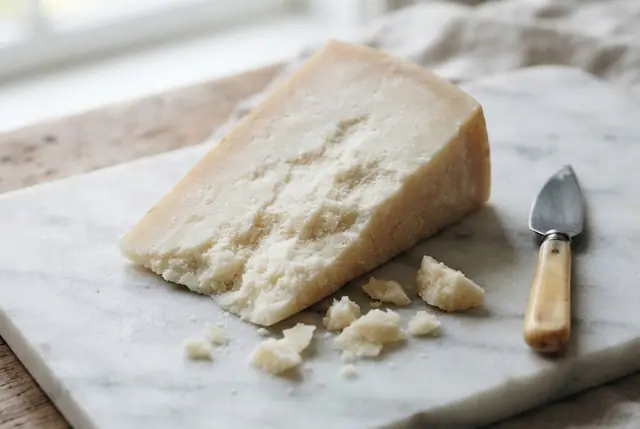
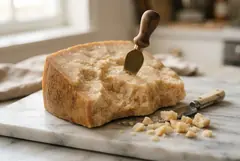
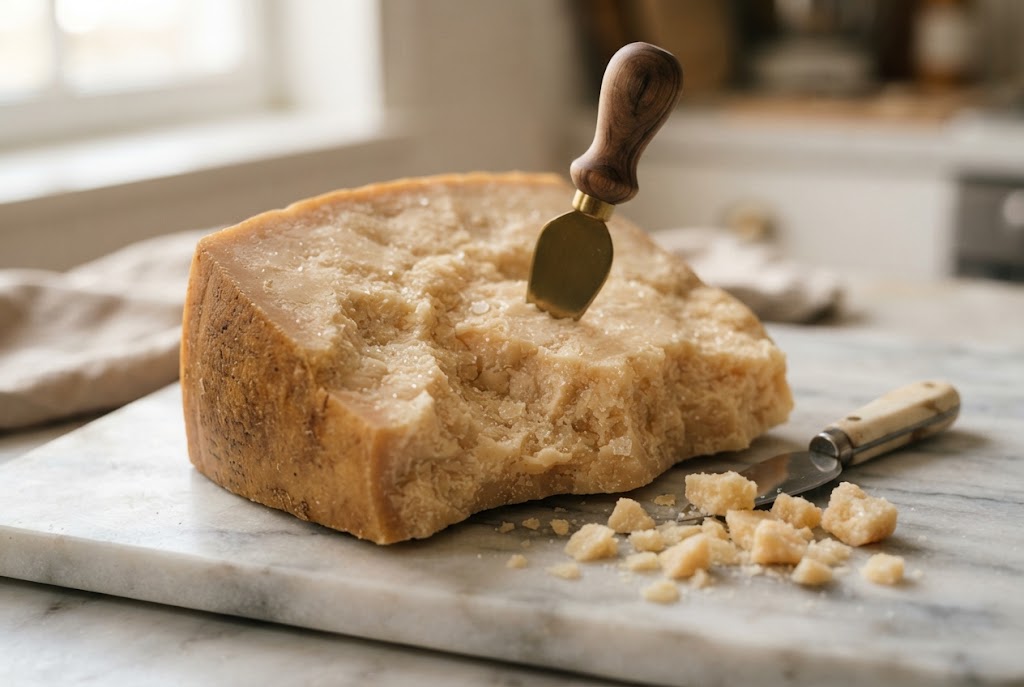
The hard, crystalline, intensely savory cheese from Emilia-Romagna. Twelve months minimum, usually twenty-four or more. Break it into rough shards with a short blade — slicing it is both difficult and wrong.
What it is
Parmigiano-Reggiano is a protected designation with rules that would exhaust most producers: raw cow's milk from a defined zone, no additives, copper vats, minimum twelve months' aging, and an inspection where each wheel is hammered and either branded or rejected. The pin-dotted rind is stamped, not printed.
- Taste
- intensely savory, nutty, salty, faintly fruity
- Texture
- hard, granular, crystalline, fractures rather than cuts
- Look
- pale straw yellow, dry, with a thick natural rind
Free glutamates are the mechanism, and they're why this cheese tastes like more than it is. Long aging breaks proteins down into free amino acids — glutamate above all — which is the compound the tongue reads as savory depth. Parmigiano is one of the most glutamate-dense foods in any cuisine, which is why a small shard registers as a big flavor.
What it pairs with — and why
| Pair it with | Why it works |
|---|---|
| Aged balsamic vinegar | The regional pairing — both come from Modena and Reggio. Sweet-sour syrup on salt crystals. |
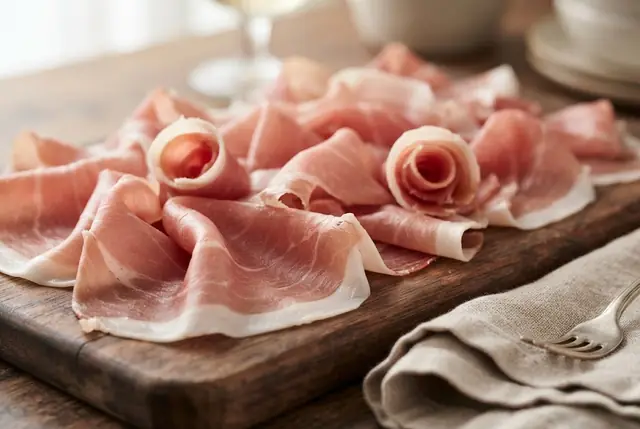
| Prosciutto di Parma | Same province, same salt-and-umami register, different textures. |
| Fresh pear | Cool, wet, sweet against dry and salty. An Italian proverb tells farmers not to reveal how good it is. |
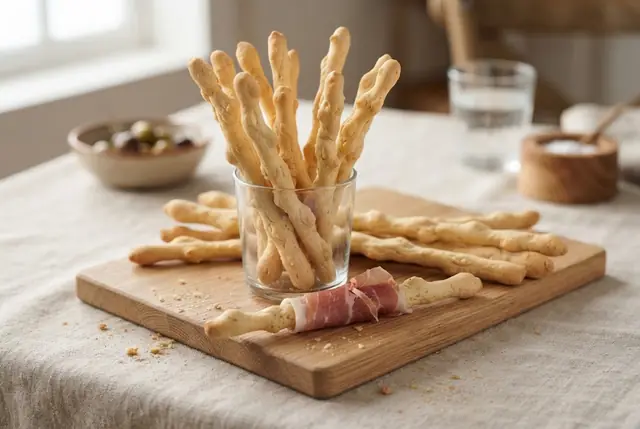
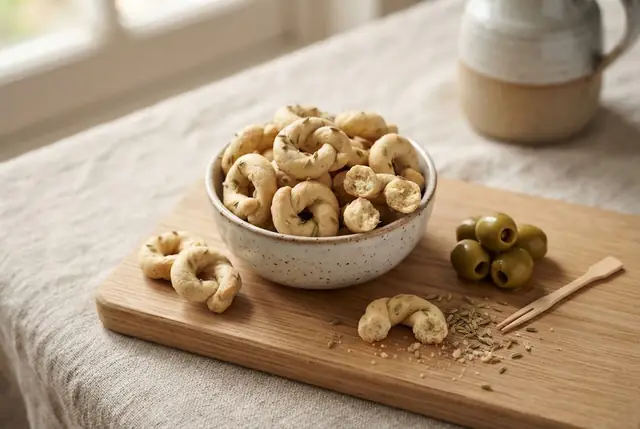
| Grissini and taralli | Plain dry bread against a very strong cheese — nothing competing. |
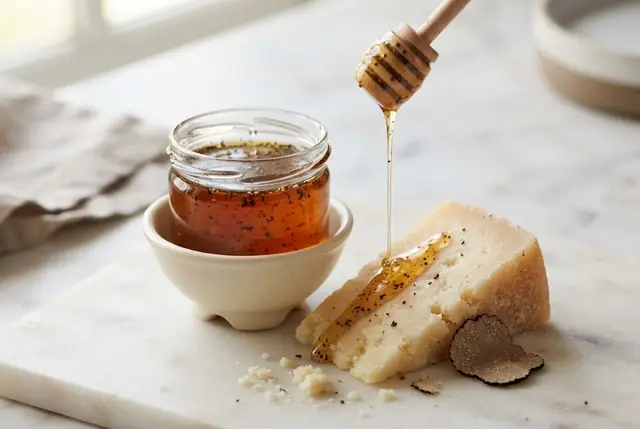
| Walnuts and honey | Bitter and sweet framing the salt. |
| Lambrusco, Prosecco, Barolo | Bubbles or tannin, both of which handle the salt. |
| Aged rum, Vin Santo | The dessert-course direction, and it works. |
Skip it with: parmesan crisps on the same board — that's the same flavor twice, one of them worse — and delicate fresh cheeses, which lose completely.
How to prep it for the board
- Break it, don't slice it. Use a short almond-shaped parmesan knife, push it into the paste, and lever off rough shards. Slicing a hard cheese fights its structure and produces dust.
- Temper 30 minutes. The fruity notes only appear at room temperature.
- Serve about 1 oz per person. It's intense and people take small pieces.
- Leave the shards irregular and pile them. Uniform cubes make an expensive cheese look cheap.
- Put balsamic beside it with a small spoon. This is the pairing that justifies the price.
- Trim the hard outer rind but keep it — it's the best thing you can drop into a soup or a pot of beans.
- Fix: dried at the cut face? Trim a thin layer and wrap the rest in parchment, not plastic. Plastic suffocates it.
What to buy
| Product | Where | Notes |
|---|---|---|
| Parmigiano-Reggiano DOP, 24 months | Cheese counters, Whole Foods, Costco | The standard and the right first purchase. Check the rind stamp. |
| Parmigiano-Reggiano, 36 months | Cheese counters, specialty | Drier, more crystalline, more expensive. Worth it once. |
| Vacche Rosse (Red Cow) | Specialty shops, online | Made from a single heritage breed. The connoisseur wheel. |
| Costco Parmigiano-Reggiano | Costco | Genuine DOP at the best price per pound anywhere. |
| Grana Padano | Grocery cheese case | The cheaper cousin. Milder, less complex, still good — see its own page. |
| Trader Joe's Parmigiano-Reggiano | Trader Joe's | Real DOP, small format, fair price. |
Label check: the pin-dot lettering on the rind reading PARMIGIANO-REGGIANO. If it isn't there, it isn't the cheese. Anything labeled "parmesan" in the US is legally something else.
Skip: pre-grated parmesan in a shaker, and anything labeled just "parmesan" for board use. Different product, different price for a reason.
Ranked picks: our top-rated Parmesan is Boar's Head Parmigiano-Reggiano (4.5 out of 5), and the best value is Kirkland Signature Parmigiano-Reggiano. See the full ranking of the best Parmesan.
Quick FAQ
Parmesan vs. Parmigiano-Reggiano — is there a difference?
Yes. Parmigiano-Reggiano is a protected Italian designation with strict rules. "Parmesan" in the US is an unregulated name that can mean almost anything.
How do I cut it?
Break it with a short parmesan knife into rough shards. Don't slice.
What are the crunchy crystals?
Tyrosine crystals from long aging — the same as in aged cheddar and gouda.
Can I eat the rind?
It's edible but unpleasantly hard. Save it for soups and stocks instead.
How much per person?
About 1 oz. It's intense, and people take small shards.