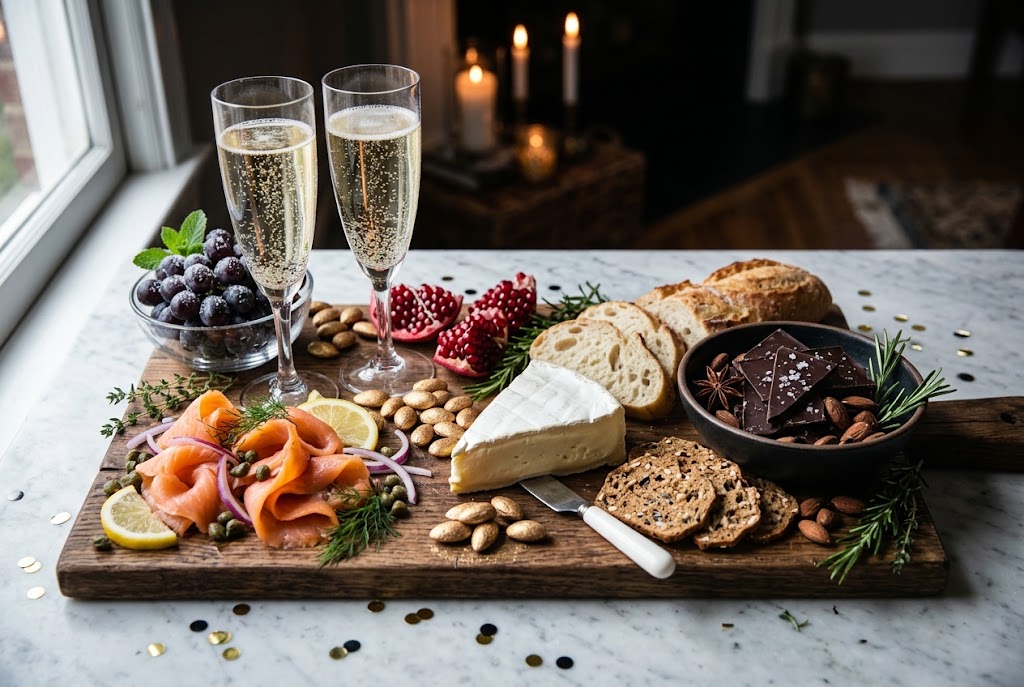
Quick Answer: A New Year's Eve charcuterie board should be built to pair with sparkling wine — lean toward salty, umami-rich, and fatty elements that make Champagne taste better. Aged Gruyère, prosciutto di Parma, smoked salmon, Parmigiano-Reggiano, marcona almonds, dark chocolate, and champagne grapes are the core. Plan 3 oz each of cheese and meat per person, since a midnight board is the party food for 2–3 hours of grazing.
Want themes instead? See our New Year's Eve charcuterie board ideas, including a midnight plan and a blini bar.
Building the Board Around Sparkling Wine
New Year's Eve boards have a specific design constraint most other boards don't: the food needs to pair with Champagne, Prosecco, Cava, or sparkling wine. That pairing constraint should drive every ingredient decision.
Sparkling wine works well with salty, fatty, umami-rich, and lightly acidic foods. The high acidity in sparkling wine cuts through fat and salt, refreshing the palate between bites — which is why fatty cured meat and aged cheese make sparkling wine taste better, and sparkling wine makes them taste more vivid. Sweet foods compete with the wine's natural fruit; bland foods make the acidity feel harsh. The board design principle: maximize the elements that make sparkling wine taste good.
Lead with Parmigiano-Reggiano. No cheese pairs better with Champagne. The crystalline, glutamate-rich texture of properly aged Parmigiano (24+ months) creates an umami synergy with the wine's yeast-derived autolytic notes — both have similar flavor compounds from protein breakdown. The salt triggers the acidity in sparkling wine to read as freshness rather than sharpness. This is the most justified pairing in the board-and-wine universe.
Aged Gruyère is the second pillar. Its nutty, caramelized quality and moderate salt complement Champagne's own toasty, brioche-like aromas from extended lees aging. If serving Prosecco or Cava rather than Champagne, Gruyère remains excellent — the fruit-forward style of those wines pairs with the cheese's sweet, nutty notes.
Brie adds softness and visual elegance. The creaminess of a properly aged brie contrasts the crystalline cheeses and gives guests a gentle, palate-coating option that moderates the wine's acidity.
Ingredient List and Quantities
For 6–8 people at a New Year's Eve gathering:
Cheese (about 1½ lb total, 3 oz per person):
- Parmigiano-Reggiano or aged Gruyère
- Aged cheddar or smoked Gouda
- Brie or Camembert: one 8 oz wheel
Meat (about 1½ lb total, 3 oz per person):
- Prosciutto di Parma (the best you can find for a celebratory occasion)
- Truffle salami or finocchiona
- Speck or bresaola for variety
Accompaniments:
- Smoked salmon with cream cheese and capers (serves as a lox-style element)
- Champagne grapes (visually distinctive, sweet-tart contrast)
- Dark chocolate bark or chocolate truffles
- Marcona almonds: 1.5 oz
- Fig jam: 2–3 tablespoons in a ramekin
- Cornichons: 6–8 pickles
- High-quality crackers and thin baguette slices
Caviar or roe (optional but impressive): A small tin of salmon roe or trout caviar on a small plate with cream cheese and blinis elevates the board to dinner-party level. The salt-and-fat of caviar is the archetypal Champagne pairing.
Elegant Styling for Midnight
New Year's Eve boards benefit from more deliberate styling than a casual weekend board. The aesthetic should feel celebratory without being gimmicky.
Color palette: Gold and dark. Aged Parmigiano and Gruyère provide warm golden tones. Dark chocolate, dark grapes, and dark rye crackers provide contrast. Deep green from fresh rosemary sprigs (used as garnish only, not for eating) adds color without introducing a competing flavor.
Board surface: Slate or marble reads more formal than wood for a celebratory occasion. If you only have a wood board, it's perfectly suitable — the food is the focus.
Gold accents: Small gold-foil-wrapped chocolate coins or golden-wrapped bonbons scattered at two or three points on the board read as festive without overwhelming the food. These are purely decorative and available at most grocery stores through the holiday season.
Champagne grapes: These small, tightly clustered grapes are visually distinctive and seasonal. If unavailable, small clusters of red or black grapes work equally well and photograph similarly.
Spacing: New Year's boards benefit from slightly more deliberate spacing than a casual board — leave small gaps between clusters rather than filling every inch. This reads as curated and intentional rather than abundant.
Midnight Timing Strategy
A New Year's Eve board has a unique timing challenge: it needs to be out for guests to graze from 10 PM onward but remain visually appealing at midnight for the countdown moment and photographs.
Assemble the board 30–60 minutes before guests arrive. For a midnight countdown, build the board at 10 PM — cheese will be properly tempered by midnight, crackers won't have gone soft, and nothing perishable (smoked salmon, cream cheese) will have been out long enough to cause concern. Refresh crackers and any wilting garnishes at 11:30 if needed.
Plan for champagne being poured between 11:50 and midnight — the board should be fully accessible and tempered for the midnight toast-and-bite moment.
The Charcuterie Lab Takeaway
A New Year's Eve board is the occasion to build a great board and let the Champagne pairing do the work. Parmigiano-Reggiano, prosciutto di Parma, smoked salmon, dark chocolate, and champagne grapes at midnight with a glass of sparkling wine is a combination that makes the occasion feel genuinely celebratory. Build it elegant, build it with good ingredients, and let the pairing science validate every choice.
Building more boards? The Charcuterie Lab ebook walks through 50 boards across every occasion — each one with exact quantities, a shopping list, and the science behind why it works.
FAQ
What do you put on a New Year's Eve charcuterie board?
A New Year's Eve board skews elegant and celebratory: aged Gruyère, aged cheddar, brie, prosciutto di Parma, truffle salami, smoked salmon, caviar or roe if budget allows, champagne grapes, marcona almonds, and dark chocolate. The flavor profile should pair with sparkling wine — lean toward umami-rich, fatty, and lightly acidic elements that make Champagne or Prosecco taste better.
What food pairs with Champagne on a New Year's Eve board?
Champagne pairs best with salty, umami-rich, and fatty foods. On a board: aged Parmigiano-Reggiano or Gruyère, prosciutto di Parma, smoked salmon with cream cheese, oyster crackers, salty roasted nuts, and aged cheddar. The high acidity in Champagne cuts through fat and salt, refreshing the palate — which is precisely what makes the pairing work. Avoid sweet elements that fight the wine's acidity.
What is a good New Year's Eve charcuterie board for two?
For two people, scale to one cheese per type (soft, semi-firm, aged), about 6 oz of meat total, and a focused selection of accompaniments — champagne grapes, marcona almonds, dark chocolate, and fig jam. Use a smaller 10–12" board. The two-person format is an opportunity to use one higher-quality ingredient (a proper Parmigiano aged 24+ months, or real prosciutto di Parma) that you might not buy in quantity for a crowd.
How do I make a New Year's Eve board look elegant?
Elegance on a board comes from restraint: fewer ingredients at higher quality, more deliberate spacing, and a monochromatic or two-color palette. Gold and dark accents (aged cheese, dark grapes, dark chocolate, gold-foil chocolates) read as celebratory. Use a slate or marble board rather than wood for a formal aesthetic. Label cheeses with small cards.
Can I make a New Year's Eve charcuterie board the night before?
Partially. Assemble hard components (nuts, chocolate, crackers) the night before. Prep cheese and meats the night before and store wrapped. Assemble the full board 1–2 hours before midnight, cover loosely, and refrigerate. Remove 30–45 minutes before serving. Add fresh grapes and any delicate garnishes at the last moment.