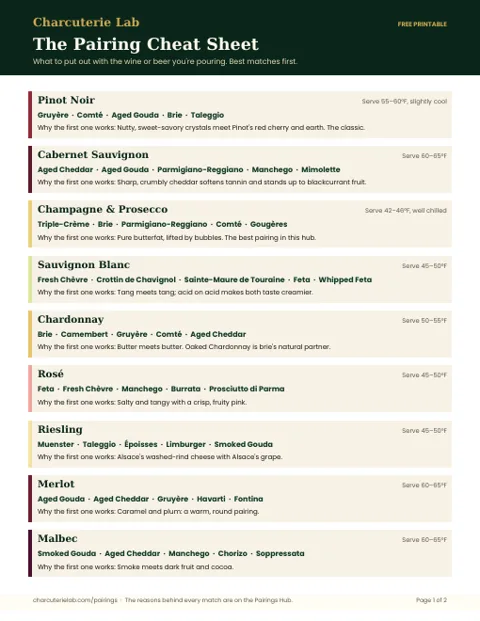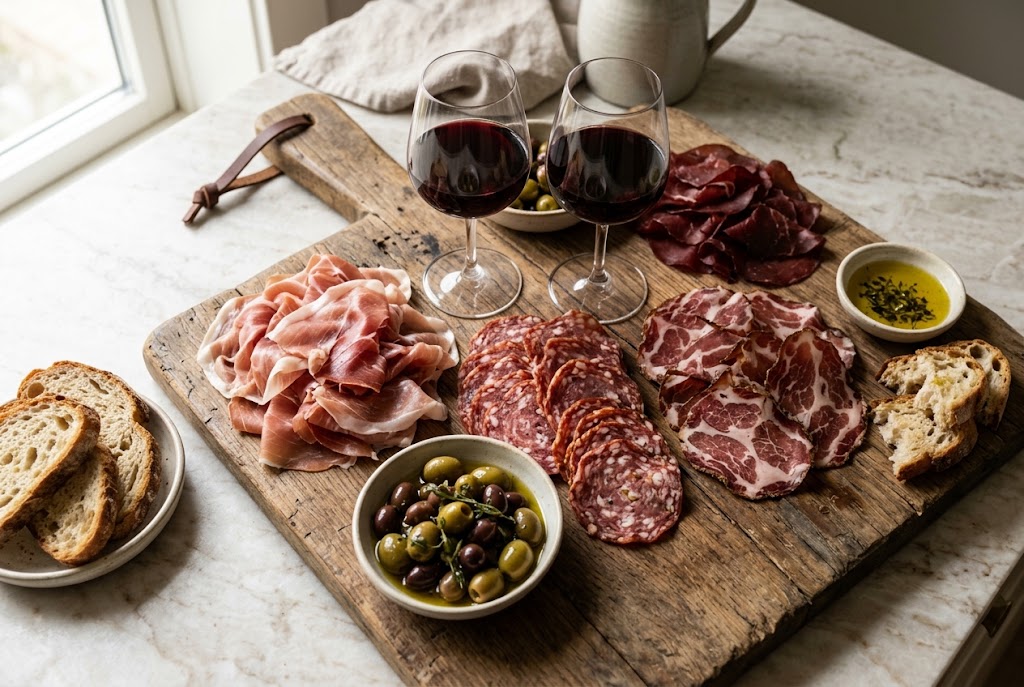
Quick Answer: Sparkling wine (Champagne, Crémant or Prosecco) or a dry rosé works with almost everything on a charcuterie board: both have the acidity to cut fat and no tannin to clash with salt. For a still red, choose a light one like Pinot Noir or Beaujolais (Gamay). Crisp whites (Albariño, dry Riesling, Sancerre) suit delicate meats and fresh cheese. Save high-tannin reds for boards built around aged hard cheese.
If you buy one bottle
Safest
Sparkling wineChampagne, Cava or Crémant. Bubbles and acid clean up fat and salt.
Red
Pinot Noir or BeaujolaisLight, low tannin, bright fruit. Works with salami and most cheese.
White
Albariño or dry RieslingHigh acid, built for salty food, great with prosciutto.
Goes with anything
Dry roséRed-grape acidity and fruit without the tannin.
Pairing by bottle: see the best cheeses, meats and snacks for each wine in our wine pairings by bottle, or print the wine and cheese pairing chart.
Why wine and charcuterie work
It comes down to fat and salt, and what four things in wine do to them.
- Acidity cuts fat. A high-acid wine cleans your palate so the next bite tastes as vivid as the first.
- Tannin grabs fat. A little softens both wine and meat. A lot, from a big Cabernet or Barolo, makes the wine taste harsh and the meat stripped.
- Bubbles scrub. Carbonation lifts fat off your palate, which is why sparkling wine suits rich boards.
- Salt boosts fruit. Cured meat makes a wine taste fruitier. Even a modest Gamay tastes richer next to salami.
Light reds: the safest red
| Wine | Why it works | Best with |
|---|---|---|
| Pinot Noir | Low tannin, high acid, red fruit. Burgundy is the classic; Oregon and New Zealand are fruitier and cheaper | Prosciutto, salami, mild coppa, soft and semi-firm cheese |
| Gamay (Beaujolais) | The most food-friendly light red. Beaujolais-Villages or a cru (Morgon, Fleurie, Moulin-à-Vent); great value | Almost anything on a standard board |
| Barbera d'Asti | More acid and less tannin than most Italian reds; cherry and plum | Salami, coppa, prosciutto, mild cheese |
Skip reds sold as "smooth" or "approachable" because they're low in acid. They go flabby next to salt and fat.
White wine: underrated with charcuterie
White wine's acidity does exactly what you want, with no tannin risk.
| Wine | Why it works | Best with |
|---|---|---|
| Albariño (Rías Baixas, Spain) | Salty-mineral, citrus, high acid. Built for salty food | Prosciutto, jamón Ibérico, Manchego; the pick for a Spanish board |
| Grüner Veltliner (Austria) | White pepper note, very high acid | Triple-crème cheese, herby dry-cured sausage |
| Dry Riesling (Alsace, Rheingau) | Handles savory, rich food better than almost any white | Pâté and rillettes; off-dry Riesling if the board has honeycomb or figs |
| Chablis (unoaked Chardonnay) | Crisp, mineral, salty | Brined, salted and cured foods |
Skip oaked Chardonnay. The oak clashes with salt-cured meat the same way red-wine tannin does.
Sparkling wine: the most versatile
| Wine | What it's like | When to pour it |
|---|---|---|
| Champagne, especially Blanc de Blancs | Highest acid, fine bubbles, toasty-bready notes that suit aged cheese and cured meat | A smaller, special board; it's pricey at scale |
| Cava (Spain) | Champagne-method at a fraction of the price; a little earthier | Spanish meats and mixed boards |
| Crémant (France) | Champagne-method from other French regions; Crémant d'Alsace is a top pick for a mixed board | Any mixed board |
| Prosecco | Lighter, lower in acid, a touch sweeter | Mild cheese, light meats; the Italian match for prosciutto |
On a rich board of triple-crème brie, prosciutto and honeycomb, bubbles do more than any still wine can.
Dry rosé: the goes-with-everything wine
- Acidity from red grapes cuts fat, like a cornichon or a grape would.
- Red-fruit flavor (strawberry, raspberry) echoes the sweetness in prosciutto and aged cheese.
- Almost no tannin, so it clashes with nothing on the board.
- Buy: Provençal rosé (Grenache, Mourvèdre, Cinsault): dry, pale and crisp. Skip off-dry or "blush" rosé.
Big reds: only with the right board
- Yes, with aged hard cheese. Parmigiano, aged Manchego, extra-sharp cheddar and aged Gruyère soften big tannins. A board built around them can take Cabernet Sauvignon, Barolo or Rioja Gran Reserva.
- Not with prosciutto or delicate meats. Tannin strips the fat and leaves harshness.
- Not with fresh or soft cheese. Brie or chèvre plus tannin tastes bitter and chalky.
- Not with lots of sweet things. A big red tastes cloying next to honey or fig jam.
Bringing a big red? Build the board toward it: heavy on aged hard cheese, light on delicate meat, no triple-crème.
The best wine for each kind of board
Easiest approach: pick the wine first, then build the board around it.
| Board | Best wine | Also good |
|---|---|---|
| Mixed (aged cheese + cured meat) | Champagne or Crémant d'Alsace | Pinot Noir: the best still red here |
| Aged cheese (cheddar, Gouda, Manchego) | Côtes du Rhône or California Zinfandel | Dry oloroso sherry, at room temperature; Cabernet with aged cheddar specifically |
| Fresh cheese (chèvre, brie, ricotta) | Sancerre or Pouilly-Fumé | Champagne or a dry Crémant for brie and triple-crème |
| Cured meat (prosciutto, salami, coppa) | Barbera d'Asti | Prosecco with prosciutto; Provençal rosé across the range |
| Blue cheese | Sauternes or late-harvest Riesling | Port |
Already chose the wine? Light red: prosciutto or salami, aged Gouda or Manchego, no triple-crème. White: coppa or bresaola, Gruyère or Comté, a fresh chèvre. Sparkling: prosciutto, triple-crème brie, aged Parmesan, honeycomb. Big red: aged cheddar, Manchego, Parmesan; skip prosciutto and soft cheese.
Classic pairings
| Pairing | Why it works |
|---|---|
| Fino sherry + jamón Ibérico | Nutty, salty match |
| Barolo or Nebbiolo + coppa | Coppa's fat softens the tannin; both are aged and complex |
| Pinot Noir + bresaola | Low tannin suits lean meat; red fruit echoes |
| White Burgundy + aged Comté | Nutty, mineral match |
| Sauvignon Blanc + finocchiona | Herbal wine meets fennel salami |
| Chablis + prosciutto | Sharp acidity cuts the fat cleanly |
| Beaujolais + salami | Low tannin, red fruit, easy |
| Dry rosé + any board | Acid and fruit, no tannin clash |
Common mistakes
- A tannic red with fresh cheese. Barolo, Cabernet or Nebbiolo with chèvre, ricotta or mild brie tastes metallic and bitter.
- A bold red with prosciutto. A 14.5% Cabernet buries it. Go lighter and higher in acid.
- Only one wine. A mixed board does better with two: a sparkling or white for the light things, a medium red for aged cheese and cured meat.
- The wrong temperature. See below.
| Wine | Serve at |
|---|---|
| Sparkling | 46°F (8°C) or colder |
| Crisp white | 50–54°F (10–12°C); straight from the fridge (about 39°F) hides the aroma |
| Light red (Pinot Noir, Gamay) | 57–61°F (14–16°C); a warm summer room (68°F+) makes it taste flabby and boozy |
Building more boards? The Charcuterie Lab ebook covers 50 boards with exact wine pairings, quantities, and the science behind every element.
FAQ
What wine goes best with a charcuterie board? Sparkling wine is the most universally reliable choice — its acidity cuts fat, its bubbles cleanse the palate, and it works with almost every cheese and cured meat combination. If you prefer still wine, a light red like Pinot Noir or Gamay is the next safest call.
Does red wine go with charcuterie? Light reds work well: Pinot Noir, Gamay (Beaujolais), and Barbera d'Asti have low-to-moderate tannins that complement rather than overwhelm cured meats and soft cheese. Avoid high-tannin reds like Cabernet Sauvignon and Barolo unless the board is built around aged hard cheeses that can stand up to them.
What white wine goes with charcuterie? Crisp whites work best: Albariño, Grüner Veltliner, dry Riesling, and Chablis all have the acidity to cut through fat without competing with delicate cured meats. Avoid heavily oaked Chardonnay — the wood tannins clash with salt-cured meat in the same way red wine tannins do.
Does Champagne go with charcuterie? Champagne and sparkling wine are the best pairing for a charcuterie board — arguably the best. Carbonation scrubs fat from the palate with each sip, the high acidity contrasts richness, and the yeasty brioche notes in Champagne complement aged cheese and cured meat simultaneously.
How do you pair wine when the board has many different items? Choose a wine that works across the widest range of ingredients, not one that pairs perfectly with a single element. Sparkling wine, Pinot Noir, and Albariño are the three most flexible choices. Avoid wines with extreme tannins, extreme oak, or extreme sweetness — they fight at least half of what's on the board.
What wine pairs with prosciutto? Prosciutto's delicate sweetness and soft fat pair best with light, crisp wines: Pinot Grigio, Prosecco, a dry Riesling, or a light Pinot Noir. The wine should be delicate enough not to overwhelm prosciutto's subtle flavor — the meat is delicate and requires a wine with similar restraint.
Can you serve both red and white wine with a charcuterie board? Yes, and it's often the best approach for a diverse board. One sparkling or white for the fish, fresh cheese, and delicate meat elements; one medium-bodied red for the aged cheeses and stronger cured meats. Keep the whites chilled and have them available as an option rather than serving only one style.