Pairings Wine & Cheese Chart
Printable chart
Wine and cheese pairing chart
You’re in. Here it is:You’re subscribed. Your free download:
Download the Pairing Cheat Sheet (PDF)Also free: the Cheat Sheet and Board 01 from the book. The weekly Lab Report starts with the next issue.
Want every board planned for you? 50 boards in the book · $14
As an Amazon Associate I earn from qualifying purchases. How that works
The safest matches: Champagne with brie, Sauvignon Blanc with goat cheese, Pinot Noir with Gruyère, Cabernet with aged cheddar, Chianti with Parmigiano and port with Stilton.
Cured meat on the board too? See the charcuterie board wine pairing guide, meat by meat.
Find a wine for your cheese
Tap a wine or a cheese to highlight its matches, and tap a dot to read why it works. Save the chart as an image for your phone or Pinterest.
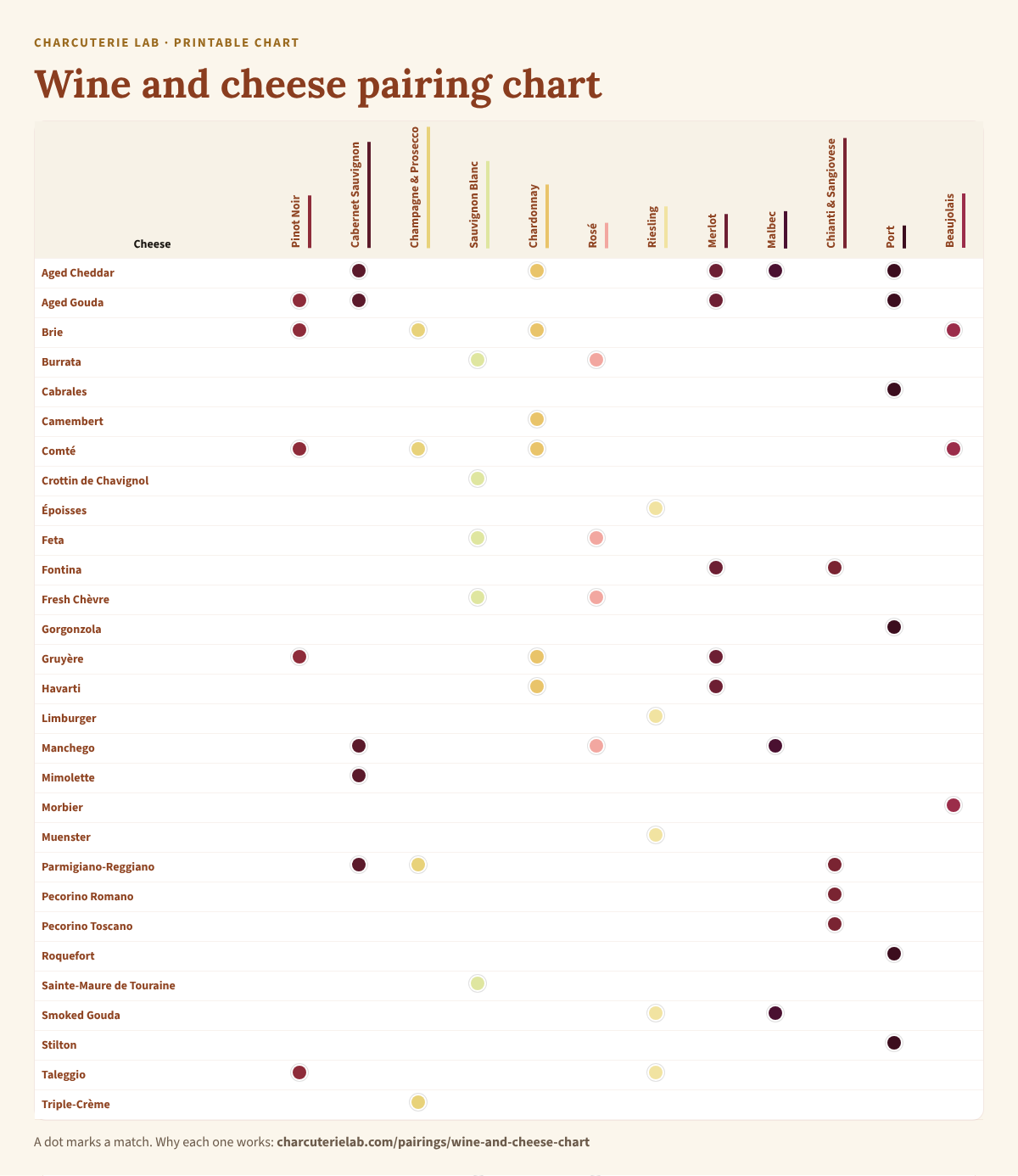
How to read it
Light, fresh cheeses sit best with crisp whites and sparkling wine; nutty, firm cheeses with light reds and Chardonnay; hard, aged cheeses with bigger reds; blue cheese with sweet port. The six pairing rules explain why.
What wine goes with fresh cheese like burrata and feta?
Milky, tangy and light. Crisp whites and dry rosé keep them fresh; tannic reds turn them bitter.
- Burrata: Sauvignon Blanc, Rosé, Pinot Grigio Best bet, Sauvignon Blanc: Fresh cream and a squeeze-of-lemon wine.
- Feta: Sauvignon Blanc, Rosé, Pinot Grigio Best bet, Sauvignon Blanc: Salty brine and bright citrus.
- Fresh Mozzarella: Pinot Grigio Best bet, Pinot Grigio: Light, milky Italian cheese and a light Italian white.
- Ricotta: Pinot Grigio Best bet, Pinot Grigio: Soft, sweet-milky cheese for a soft wine.
Skip: Malbec with Fresh Mozzarella (milky and fresh; the tannin turns bitter); Port with Fresh Mozzarella (delicate cheese vanishes).
What wine goes with goat cheese?
Tangy and chalky. Sauvignon Blanc is the classic match, because both are bright and grassy.
- Crottin de Chavignol: Sauvignon Blanc Best bet, Sauvignon Blanc: From Sancerre's own village. The textbook regional match.
- Fresh Chèvre: Sauvignon Blanc, Rosé, Pinot Grigio, Moscato Best bet, Sauvignon Blanc: Tang meets tang; acid on acid makes both taste creamier.
- Sainte-Maure de Touraine: Sauvignon Blanc Best bet, Sauvignon Blanc: Loire goat cheese with a Loire wine.
Skip: Cabernet Sauvignon with Fresh Chèvre (tangy, fresh goat cheese makes the tannin taste metallic); Merlot with Fresh Chèvre (tangy goat cheese makes it taste bitter); Zinfandel with Fresh Chèvre (tangy fresh goat cheese makes a 15% red taste hot and bitter).
What wine goes with brie and camembert?
Buttery and mushroomy. Bubbles and Chardonnay cut the richness; light reds work at room temperature. Big tannic reds erase them.
- Brie: Pinot Noir, Champagne & Prosecco, Chardonnay, Beaujolais, Moscato Best bet, Pinot Noir: Mushroomy rind meets an earthy red. Serve the brie at room temperature.
- Camembert: Chardonnay Best bet, Chardonnay: Mushroomy rind and toasty oak.
- Triple-Crème: Champagne & Prosecco Best bet, Champagne & Prosecco: Pure butterfat, lifted by bubbles. The best pairing in this hub.
Skip: Cabernet Sauvignon with Brie (too mild; the wine erases it); Malbec with Brie (delicate cheese disappears); Chianti & Sangiovese with Brie (too mild for the acid and tannin); Zinfandel with Brie (big fruit and alcohol swamp a mild, creamy cheese).
What wine goes with mild cheese like havarti and fontina?
Gentle and creamy. Soft reds and round whites suit them; anything too big takes over.
- Fontina: Merlot, Chianti & Sangiovese Best bet, Merlot: Earthy, melting Italian cheese and a round red.
- Havarti: Chardonnay, Merlot, Pinot Grigio Best bet, Chardonnay: Buttery and mild, so it won't fight the oak.
- Pepper Jack: Moscato Best bet, Moscato: Sugar and low alcohol tame the jalapeño heat.
- Smoked Gouda: Riesling, Malbec, Zinfandel Best bet, Riesling: Smoke softens next to off-dry fruit.
Skip: Pinot Noir with Pepper Jack (chili heat makes the alcohol burn and strips the fruit); Sauvignon Blanc with Smoked Gouda (heavy smoke buries the wine's freshness); Rosé with Smoked Gouda (heavy smoke flattens the fruit); Beaujolais with Smoked Gouda (heavy smoke flattens the fruit).
What wine goes with Gruyère and Comté?
Nutty, sweet and savory. The most wine-friendly cheeses there are: Pinot Noir, Chardonnay and bubbles all shine.
- Comté: Pinot Noir, Champagne & Prosecco, Chardonnay, Beaujolais Best bet, Pinot Noir: Brown-butter and hazelnut notes echo the wine's forest-floor side.
- Gruyère: Pinot Noir, Chardonnay, Merlot Best bet, Pinot Noir: Nutty, sweet-savory crystals meet Pinot's red cherry and earth. The classic.
What wine goes with aged cheddar, manchego and Parmigiano?
Salty, firm and full of flavor crystals. They can stand up to big reds like Cabernet and Malbec, and to Chianti for the Italian ones.
- Aged Cheddar: Cabernet Sauvignon, Chardonnay, Merlot, Malbec, Port, Zinfandel Best bet, Cabernet Sauvignon: Sharp, crumbly cheddar softens tannin and stands up to blackcurrant fruit.
- Aged Gouda: Pinot Noir, Cabernet Sauvignon, Merlot, Port, Zinfandel Best bet, Pinot Noir: Caramel and crunch against red fruit; the wine keeps the richness in check.
- Manchego: Cabernet Sauvignon, Rosé, Malbec, Zinfandel Best bet, Cabernet Sauvignon: Aged sheep's milk has the fat and firmness Cabernet wants.
- Mimolette: Cabernet Sauvignon Best bet, Cabernet Sauvignon: Nutty, hard and dense enough for a heavy red.
- Parmigiano-Reggiano: Cabernet Sauvignon, Champagne & Prosecco, Chianti & Sangiovese Best bet, Cabernet Sauvignon: Salty, savory crystals make the fruit taste riper.
- Pecorino Romano: Chianti & Sangiovese, Moscato Best bet, Chianti & Sangiovese: Salty and sharp; Sangiovese's acid keeps up.
- Pecorino Toscano: Chianti & Sangiovese Best bet, Chianti & Sangiovese: Tuscan sheep's cheese with a Tuscan red.
Skip: Pinot Grigio with Aged Cheddar (sharp, aged cheese buries the delicate fruit).
What wine goes with stinky washed-rind cheese?
Pungent rind, sweet and meaty inside. Off-dry Riesling is the most reliable match; a light red like Pinot Noir or Beaujolais suits the milder ones.
- Époisses: Riesling Best bet, Riesling: One of the few wines Époisses can't overpower.
- Limburger: Riesling Best bet, Riesling: Pungent rind, tamed by acid and sweetness.
- Morbier: Beaujolais Best bet, Beaujolais: Mild, earthy French cheese.
- Muenster: Riesling Best bet, Riesling: Alsace's washed-rind cheese with Alsace's grape.
- Taleggio: Pinot Noir, Riesling Best bet, Pinot Noir: Washed-rind funk is tamed by bright acid instead of fought by tannin.
What wine goes with blue cheese?
Salty and sharp. Sweet wine is the answer: port with Stilton and gorgonzola. Most dry wines taste thin or bitter next to a strong blue.
- Cabrales: Port Best bet, Port: Spain's fierce blue needs a sweet, strong wine.
- Gorgonzola: Port, Moscato Best bet, Port: Creamy blue softened by sweetness.
- Roquefort: Port Best bet, Port: Salty sheep's-milk blue with sweet, rich wine.
- Stilton: Port Best bet, Port: The most famous cheese-and-wine pairing in Britain.
Skip: Riesling with Gorgonzola (only with sweet dessert riesling; a dry one tastes thin next to it); Pinot Noir with Roquefort (pungent blue overwhelms a light red; the wine tastes thin and sour); Champagne & Prosecco with Roquefort (strong blue makes dry sparkling wine taste bitter); Chardonnay with Roquefort (salty blue plus oak tastes bitter).
Serving temperatures and best cheeses for each wine
| Wine | Serve at | Best cheeses |
|---|---|---|
| Pinot Noir | 55–60°F, slightly cool | Gruyère, Comté, Aged Gouda |
| Cabernet Sauvignon | 60–65°F | Aged Cheddar, Aged Gouda, Parmigiano-Reggiano |
| Champagne & Prosecco | 42–46°F, well chilled | Triple-Crème, Brie, Parmigiano-Reggiano |
| Sauvignon Blanc | 45–50°F | Fresh Chèvre, Crottin de Chavignol, Sainte-Maure de Touraine |
| Chardonnay | 50–55°F | Brie, Camembert, Gruyère |
| Rosé | 45–50°F | Feta, Fresh Chèvre, Manchego |
| Riesling | 45–50°F | Muenster, Taleggio, Époisses |
| Merlot | 60–65°F | Aged Gouda, Aged Cheddar, Gruyère |
| Malbec | 60–65°F | Smoked Gouda, Aged Cheddar, Manchego |
| Chianti & Sangiovese | 60–65°F | Pecorino Toscano, Parmigiano-Reggiano, Pecorino Romano |
| Port | 60–65°F (tawny slightly cooler) | Stilton, Roquefort, Gorgonzola |
| Beaujolais | 55°F, lightly chilled | Comté, Brie, Morbier |
| Zinfandel | 60–65°F, slightly cool | Aged Cheddar, Smoked Gouda, Aged Gouda |
| Pinot Grigio | 45–50°F, chilled | Fresh Mozzarella, Burrata, Feta |
| Moscato | 40–45°F, well chilled | Gorgonzola, Brie, Fresh Chèvre |
Take the cheese out of the fridge ahead of time; our temperature guide has the timings. For meats, see the meat and cheese pairing chart. Need a bottle? Our tested picks: Champagne under $30 and the best Prosecco.
Questions
What wine goes best with cheese?
For one bottle on a mixed board, pour Pinot Noir or a dry sparkling wine. Both have bright acid and gentle tannin, so they suit brie, Comté, Gruyère and Parmigiano without flattening any of them.
Is red or white wine better with cheese?
White works more often than people expect. Crisp whites and bubbles suit fresh, goat and soft cheeses; light reds suit nutty, firm cheeses; big tannic reds only suit hard, aged cheeses. Tannin clashes with soft and fresh cheese, which is why Cabernet with brie or goat cheese tastes bitter.
What wine goes with brie?
Champagne or Prosecco, Chardonnay, Pinot Noir or Beaujolais. Skip big reds like Cabernet, Malbec and Chianti: their tannin erases a mild, buttery cheese.
What wine goes with goat cheese?
Sauvignon Blanc first, then a dry rosé. Both are bright enough for the tang. Avoid Cabernet and Merlot, whose tannin turns metallic and bitter next to fresh goat cheese.
What wine goes with blue cheese?
Port, or another sweet dessert wine. The sweetness balances the salt. Dry sparkling wine, Chardonnay, rosé and light reds tend to taste thin or bitter next to a strong blue like Roquefort or Stilton.
What wine goes with aged cheddar?
Cabernet Sauvignon, Merlot or Malbec for a red, oaked Chardonnay for a white, and port for dessert. Aged cheddar is salty and firm enough to stand up to tannin.
How should I serve wine and cheese?
Take the cheese out of the fridge ahead of time so it reaches room temperature. Chill whites and rosé to about 45–50°F and sparkling wine a little colder, and serve most reds slightly cool, around 60–65°F. Go from mild to strong, and from light wine to heavy.