Quick Answer: Pick 2–4 wines first, then choose a cheese for each: rich aged cheeses (aged cheddar, Parmigiano, aged Manchego) with tannic reds, fresher and softer cheeses with crisp whites. Group each cheese with the foods that suit its wine, add acidic resets like grapes and cornichons, and tell guests one pairing to try.
The method in four steps
1
Choose the wines firstTwo (one white, one red) cover most boards. Four only for a real tasting.
2
Match a cheese to each wineAged and rich with big reds; fresh and soft with crisp whites.
3
Build in zones, not pilesWhite-wine end, red-wine end, crossover in the middle.
4
Tell guests one pairingTwo sentences as you set it down. That's all it takes.
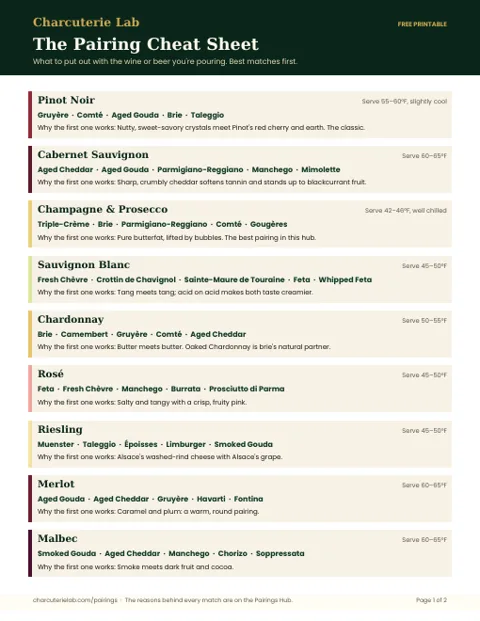
More on wine: for every bottle and what to serve with it, see our wine and charcuterie pairing guide, the wine pairings by bottle and the printable wine and cheese pairing chart.
Step 1: choose the wines first
Most people build a board they like and hope the wine works. Flip it: pick the bottles, note how tannic and acidic each one is, then buy cheese and meat to suit them.
| Wine style | Examples | Cheese to match |
|---|---|---|
| Light white | Sauvignon Blanc, Pinot Grigio | Fresh cheese: chèvre, ricotta |
| Rich white | Chardonnay, Viognier | Semi-firm and creamy: Gruyère, Fontina |
| Light to medium red | Pinot Noir, Barbera | Semi-firm to firm: Gruyère, young Manchego |
| Full red | Cabernet Sauvignon, Barolo, Syrah | Aged hard cheese: aged cheddar, aged Manchego, Parmigiano |
How many: two wines (one white, one red) cover most boards. Three widen the cheese range. Four is for a dedicated tasting where the cheese is there to show off the wine.
Step 2: match a cheese to each wine (the fat-tannin rule)
Fat and protein soften tannin. The more tannic the wine, the richer and older the cheese it needs.
- Aged hard cheese (aged cheddar, Parmigiano, aged Manchego): stands up to tannic reds. Place it next to the red wine.
- Semi-firm cheese (Gruyère, Gouda, Fontina): Pinot Noir or Chardonnay. Put it in the middle, within reach from both ends.
- Soft bloomy rind (brie, Camembert): Pinot Noir or Champagne. Its fat handles a light red's tannin.
- Fresh cheese (chèvre, ricotta, burrata): whites and sparkling only. Keep it away from the red wine end.
Add palate resets
Something acidic or fresh between pairings keeps each sip and bite tasting like the first.
- Fresh grapes: the most reliable reset on any board.
- Green apple slices: a bit tarter; great between white wine pairings.
- Cornichons: a sharp, instant reset from the brine.
- Dried apricots: tart, and they won't make anything soggy.
Spread them out: a cluster of grapes at each end of a long board means nobody has to reach.
Step 3: build in zones
Group food by the wine it goes with, not by type. Don't put all the cheese together.
| Board | White-wine end | Middle | Red-wine end |
|---|---|---|---|
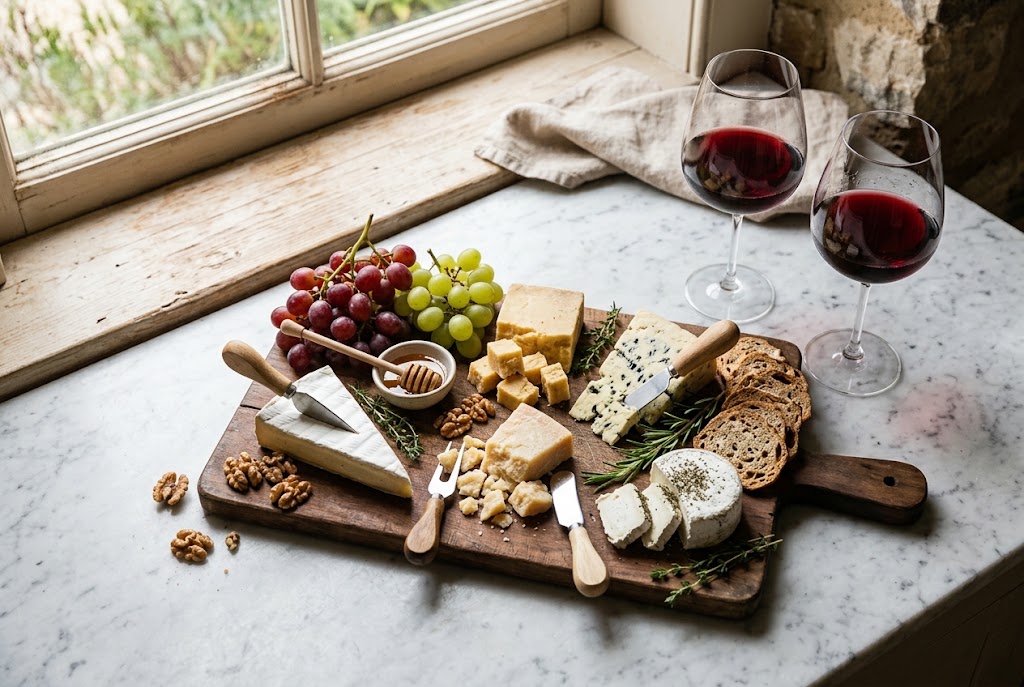
| 2 wines | Fresh chèvre, Gruyère, grapes, apple slices, light honey, plain crackers | Mild salami, plain crackers, dried apricots | Aged cheddar or Parmigiano, brie, prosciutto, walnuts, dried figs, dark rye |
| 3 wines | Fresh chèvre, goat milk butter, light crackers, apple slices | Gruyère, Fontina, grapes, prosciutto, plain crackers | Aged Manchego, Parmigiano, salami, walnuts, dried figs, dark rye |
Cured meat goes in the middle or at the red end: its savory flavor builds on aged cheese, and it suits red wine better than white.
Step-by-step assembly
- Glasses first. Set the glasses (or wine markers) down so you know which end of the board goes with which wine.
- Bowls next. Honey, cornichons and olives go in their spots; everything else builds around them.
- Cheese. Each one in its zone. Break aged hard cheese into rough chunks or slice it; set soft cheese out whole with a spreader.
- Meat. Fold prosciutto near the aged cheese, salami in the middle, bresaola toward the white end if you have it.
- Fruit. Grapes at both ends, plus one fruit per zone (apple on the white side, dried figs on the red).
- Fill gaps with nuts and fresh herbs.
- Crackers last, within 30 minutes of serving, so they stay crisp.
Setting up a wine and cheese tasting
- Label each zone: a small card or chalk label, "Pairs with [wine]".
- Go light to full: sparkling or white at one end, light red in the middle, full red at the other. Guests move along the board in order.
- One glass per wine per guest, so pairings stay separate.
- Water between tastings. It clears the palate without getting in the way like bread does.
- Start neutral: a water cracker and a mild cheese before the first pairing.
Building more boards? The Charcuterie Lab ebook covers 50 boards with wine pairing guides, exact quantities, and shopping lists for every occasion.
Step 4: tell guests one pairing
Guests don't want a lecture, but one suggested pairing makes them far more likely to try it instead of grazing at random. Try:
"The aged cheddar is over here for the Cabernet — the fat in the cheese takes the edge off the tannin. And the chèvre is at this end for the Sauvignon Blanc — they're from the same part of France and they're made to go together."
That's enough. The board does the rest.
Quick wine-to-cheese reference
| Wine | Tannin and acid | Cheese match | Why |
|---|---|---|---|
| Sauvignon Blanc | High acid, no tannin | Fresh chèvre | Bright with bright; both a little herbal |
| Chardonnay (oaked) | Medium acid, no tannin | Gruyère, Fontina | Nutty, toasty notes match; acid cuts the richness |
| Pinot Noir | Low to medium tannin | Brie, Gruyère, young Manchego | Fat handles a light tannin easily |
| Cabernet / Barolo / Syrah | High tannin | Aged cheddar, Parmigiano, aged Manchego | Lots of fat and protein to soften big tannin |
| Champagne / Prosecco | High acid, no tannin | Triple-crème, brie, aged Gouda | Acid and bubbles cut through the fat |
| Tawny Port | Sweet, low tannin | Stilton, aged Gouda | Sweet against salty; caramel notes in both |
Get weekly pairing science in the Charcuterie Lab Report newsletter.
FAQ
What is the first rule of wine and cheese pairing? What grows together, goes together. Wines and cheeses from the same region are almost always natural partners — they evolved side by side over centuries. Burgundy wines with Époisses, Spanish Rioja with Manchego, Sancerre with chèvre, Port with Stilton. When in doubt, match the geographic origin before worrying about flavor profiles.
Does red wine always pair with cheese? No — this is one of the most common charcuterie myths. White wine and sparkling wine are often better cheese companions. Tannins in red wine can clash with the fat in cheese, creating a metallic or bitter sensation. High-acid whites (Sauvignon Blanc, Riesling, Chablis) cut through fat and complement salt in a way that red wine often can't.
What wine pairs with blue cheese? Sweet wines are the classic blue cheese partner: Sauternes with Roquefort, Port with Stilton, Banyuls with Gorgonzola. The sweetness of the wine balances the sharp saltiness and pungency of blue cheese. Among reds, bold, fruity options like Zinfandel or Amarone work. Avoid dry, tannic reds — they amplify the bitterness in blue cheese.
How many wines should you serve with a wine and cheese board? One well-chosen wine is enough for an intimate board. For a formal tasting: two wines (one white, one red or sweet) cover the full spectrum of cheeses. For a large party, three options (crisp white, light red, and a sparkling) let guests self-select. More than three wines creates confusion and detracts from the cheese focus.
What is the proper order to taste wine and cheese? Taste wine first to calibrate your palate, then eat cheese, then return to wine. This sequence shows how the cheese changes your wine perception. Move through pairings from lightest to most intense — fresh chèvre before aged Manchego, light Sauvignon Blanc before bold Cabernet. End with the most powerful pairing (blue cheese + sweet wine) as the finale.
What is the best wine and cheese combination for a charcuterie board? Sparkling wine with triple-crème brie and prosciutto is the most reliable high-impact combination: carbonation cuts fat, high acidity contrasts richness, and brioche notes resonate with aged cheese. For red wine: Pinot Noir with aged gouda, manchego, and mild salami. For white: Chardonnay or Grüner Veltliner with Gruyère and coppa.
How do you set up a wine and cheese tasting with a charcuterie board? Label each cheese-meat cluster with its intended wine pairing. Serve wines in separate glasses (one per wine per guest). Build the board so the lightest-wine cluster (sparkling or crisp white) is at one end and the fullest-bodied-wine cluster (aged hard cheese + full red) is at the other. Guests progress through the board as they progress through the wines.