Quick Answer: Yes, olives belong on almost every board. Buy Castelvetrano: mild, buttery and bright green. Serve 6–8 per person in a small bowl, never loose, with a second bowl for pits, and put them next to the aged cheese and cured meat.
The short version
Best olive
CastelvetranoMild and buttery, so even olive skeptics eat them.
How many
6–8 per personAbout 1–1½ oz each. A side, not a star.
Where
Next to aged cheese and salamiAway from crackers and soft cheese, in case the brine spills.
Why olives work on a board
- They echo the meat. The salty, slightly sour brine matches cured meat, so the board tastes connected.
- They suit aged cheese. Olives are rich in the same kind of fat as Marcona almonds (oleic acid), which is why both taste right next to Manchego and Parmigiano.
- They reset your palate. A gentle bitterness cuts through creamy cheese, the same way dark chocolate works with blue cheese.
Which olives to buy
| Olive | What it's like | Best on |
|---|---|---|
| Castelvetrano (Sicilian green) | Large, mild, buttery, barely bitter; bright green | Almost any board. The default |
| Kalamata (Greek) | Dark, firm, strongly briny | Boards with bold aged cheese and cured meat |
| Castelvetrano, marinated | In oil with rosemary, thyme, garlic and lemon peel | A step up from plain, without Kalamata's punch |
| Mixed marinated | Manzanilla, Picholine and Kalamata in herbed oil | Boards with strong, confident flavors |
- Skip: canned pimento-stuffed olives, very bitter raw olives and olives in artificially colored brine.
How to serve them
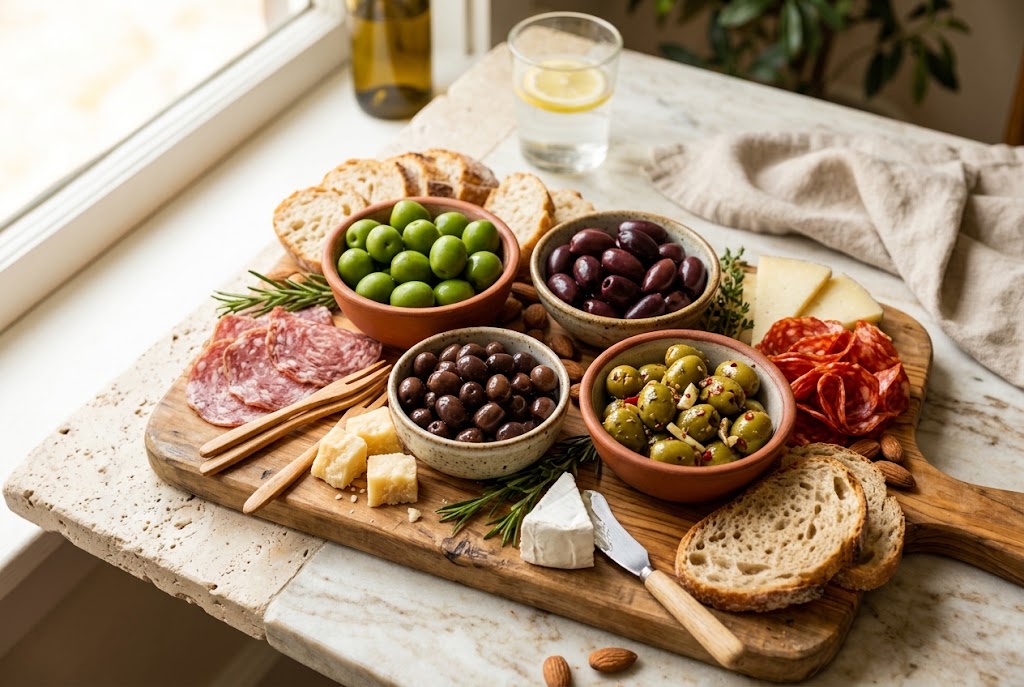
- Always in a small bowl. Loose olives leak brine into the crackers and soft cheese.
- Add a pit bowl. Without one, guests struggle or make a mess.
- 6–8 per person, about 1–1½ oz.
- Next to the aged cheese and cured meat, away from crackers and fresh cheese in case the bowl tips. A few loose olives beside the bowl add color.
Best pairings
| Olives with | Why it works |
|---|---|
| Manchego | Shared richness, and both are Spanish |
| Parmigiano-Reggiano | The olive's slight bitterness makes the cheese taste even more savory |
| Prosciutto | The brine boosts the ham's saltiness without fighting it |
| Chèvre | Marinated olives' herbs match the fresh goat cheese |
Ranking the jars? See the best olives for charcuterie.
Building more boards? The Charcuterie Lab ebook covers 50 boards with exact quantities and element-by-element pairing logic.
FAQ
Do olives go on a charcuterie board? Yes — olives are one of the best elements on a charcuterie board because they perform multiple flavor functions simultaneously: they provide brininess that echoes cured meat salt, oleic acid fat that resonates with cheese fat, and mild phenolic bitterness that contrasts soft and creamy cheeses. They also act as natural palate cleansers between bites.
What type of olives are best for a charcuterie board? Castelvetrano olives are the most board-friendly option: mild, buttery, and bright green — they pair with nearly everything and are approachable for guests who don't love traditional olive brininess. Kalamata olives work for a more assertive, briny presence. Mixed marinated olives add herbal complexity. Avoid canned, pimento-stuffed olives — they read as low-quality on a curated board.
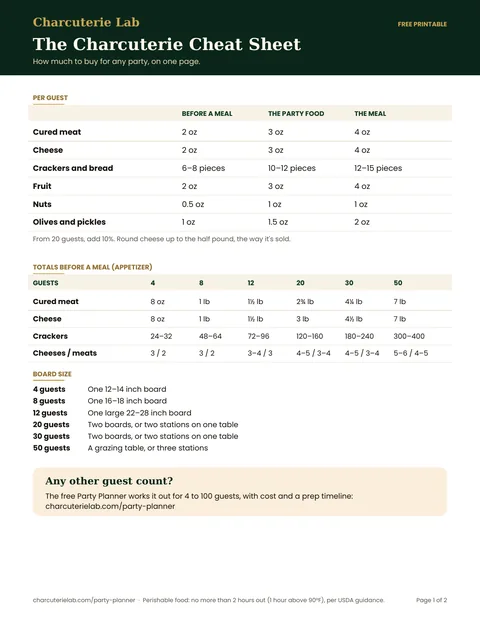
How many olives should I put on a charcuterie board? 6–8 olives per person (about 1–1.5oz), served in a small bowl or ramekin rather than scattered directly on the board. The brine from loose olives bleeds onto crackers and other board elements. A small bowl keeps them contained and positions them as a deliberate element rather than a scattered garnish.
Should olives be marinated on a charcuterie board? Marinated olives add herbal and aromatic complexity (rosemary, thyme, citrus peel, garlic) that increases pairing versatility. Plain olives are simpler and less likely to introduce a competing flavor. For most boards, a quality plain Castelvetrano or marinated mixed olive works. The key is avoiding low-quality canned olives regardless of marinade.
What cheese pairs best with olives on a charcuterie board? Aged feta in brine, aged hard cheeses like Manchego and Parmigiano, and soft chèvre all pair well with olives. The oleic acid in olives resonates with aged cheese fat (the same reason Marcona almonds pair well with these cheeses). Avoid pairing olives directly with very mild fresh cheeses, where the brine can overwhelm the delicate flavor.