Quick Answer: The three essential dips for a charcuterie board are honey, fig jam, and grain mustard. Honey bridges almost every cheese pairing; fig jam targets aged and blue cheese; grain mustard cuts fatty meats. Use small bowls, 1–2 tablespoons per condiment per person, and limit yourself to two or three condiment elements so the board doesn't become a condiment display.
Why Dips Matter on a Charcuterie Board
Dips and condiments on a charcuterie board aren't decoration — they're flavor modifiers. A well-chosen condiment can suppress bitterness in an aged cheese, amplify umami in a cured meat, or provide the acid contrast that makes a fat-rich bite land cleanly. A poorly chosen condiment competes with the cheese, overwhelms the meat, or contributes nothing but clutter.
The rule: every condiment on your board should have a specific job. If you can't identify what it's pairing with and why, it doesn't belong.
The Three Essential Dips
Honey Honey is the most versatile condiment on a charcuterie board. Its fructose and glucose provide sweetness that suppresses bitterness in aged rinds; its aromatic esters add complexity without competing; and it has almost no acidity to interfere with cheese flavor. It works with mild brie, sharp cheddar, salty blue cheese, and creamy triple-crème. If you're only putting one condiment on your board, make it honey. Drizzle a small amount over brie or place in a small bowl with a honey dipper.
Fig jam Fig jam is the pairing-specific condiment. Its tannins (from the skin and seeds) bind directly to casein proteins in aged and blue cheeses, suppressing bitterness and amplifying the underlying sweetness of the milk. It also contributes fructose that creates cross-modal flavor synergy with glutamates in aged hard cheeses. Fig jam is not a universal condiment — it's best with aged cheddar, aged gouda, Manchego, Parmigiano, and blue cheeses. It competes with mild fresh cheeses and overwhelms delicate whites.
Grain mustard Grain mustard is the meat-side condiment. Its acidity and sharp aromatic compounds cut through the fat in prosciutto, salami, and coppa, resetting the palate between bites. It works poorly with most cheeses but is essential for guests who want something to dip their meat into. Use whole-grain Dijon or a coarse French-style mustard — smooth yellow mustard reads as a hot dog condiment.
Optional Dips That Work
Quince paste (membrillo) The classic Spanish pairing for Manchego, but equally useful with other hard aged cheeses. Its high pectin content and concentrated fruit sweetness provide the same tannin-binding function as fig jam but with a drier, denser texture. Serve as a small block alongside the cheese, not spooned into a bowl.
Hot pepper jelly Works specifically with sharp aged cheddar and on boards that lean toward a Southern or American theme. The capsaicin-fat interaction adds interest and the sweetness bridges the sharp cheese without suppressing its character. Use sparingly — too much and it overwhelms.
Pesto (for lighter boards) On boards oriented around fresh cheeses, crudités, and lighter fare, a good basil or sun-dried tomato pesto gives guests a herb-forward dip option. Skip it on boards heavy with aged or funky cheeses — the strong green herb flavor competes.
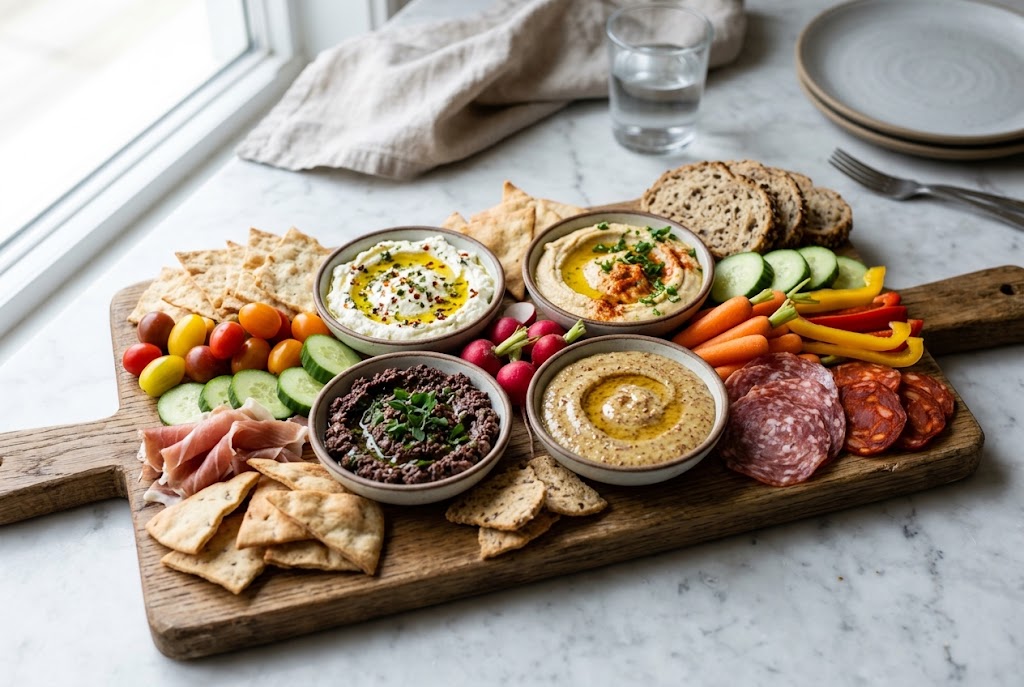
Hummus Works on vegetable-forward and lighter boards. Paired with crudités, pita chips, and mild cheese, it pulls its weight. On a traditional cured-meat board, it's incongruous.
What to Skip
Ranch dressing: Too rich and herb-heavy for most cheese pairings. Fine on a casual board, wrong on a curated one.
Balsamic glaze: Visually popular on boards; functionally inconsistent. Works with strawberries and mild cheese but competes with most cured meats and kills aged cheese complexity. Use sparingly or skip.
Salsa: Too wet, too acidic, too much going on. Makes crackers soggy. Not a charcuterie condiment.
Sweet chili sauce: Overwhelms subtle cheeses and has no logical pairing partner on a traditional board.
How Many Dips, and How Much
Two to three condiment elements per board is the right number. More than three and the board becomes a condiment display rather than a cheese-and-meat board.
Quantity per condiment: 1–2 tablespoons per person. For a board serving 6, that's about 6–12 tablespoons per condiment — roughly half a small jar of jam and a 2oz honey portion.
Always serve condiments in small bowls or ramekins, not spread directly on the board. Direct application looks messy after the first few guests and prevents guests from controlling their own ratios.
Building more boards? The Charcuterie Lab ebook walks through 50 boards — each with exact condiment lists, quantities, and the pairing science behind every element.
The Charcuterie Lab Takeaway
Every dip on your board should earn its place by serving a specific pairing function. Honey is the universal bridge; fig jam targets aged and blue cheese; grain mustard handles the meat side. Add one optional condiment that matches your board's profile, keep it to two or three total, use small bowls, and leave the ranch for something else.
FAQ
What dips go on a charcuterie board?
Honey, fig jam, and grain mustard are the three essentials. Honey works with almost every cheese and acts as a sweet bridge between salty and rich elements. Fig jam pairs with aged and blue cheese. Grain mustard cuts through fatty meats. Beyond these three, add one optional dip that matches your board's theme.
How much dip do I put on a charcuterie board?
1–2 tablespoons per condiment per person is the standard. Use small bowls or ramekins rather than spreading condiments directly on the board — it keeps the board cleaner and lets guests control their own ratios. Two to three condiment bowls is the right number for most boards.
Is hummus good on a charcuterie board?
Hummus works well on boards oriented toward vegetables and lighter fare. It pairs with crudités, pita, and mild cheeses. On a traditional charcuterie board heavy with cured meats and aged cheese, hummus can feel incongruous — the chickpea flavor competes rather than complements. Use it when your board skews lighter or vegetarian.
Can I put ranch dressing on a charcuterie board?
Ranch works on boards that are casual and vegetable-forward — crudités, pepperoni, mild cheddar. It doesn't pair well with aged or funky cheeses, and the herb-dairy flavor competes with most cured meats. If you're serving a family or kids-friendly board, ranch is a practical choice. For a traditional charcuterie board, skip it.
What is the difference between using jam vs honey on a charcuterie board?
Honey is aromatic and sweet with no astringency — it works with nearly every cheese and acts as a soft bridge between flavors. Jam contains fruit tannins and pectin that specifically bind to cheese proteins, making it most effective with aged and blue cheeses where tannin-casein binding suppresses bitterness. Use both when possible.