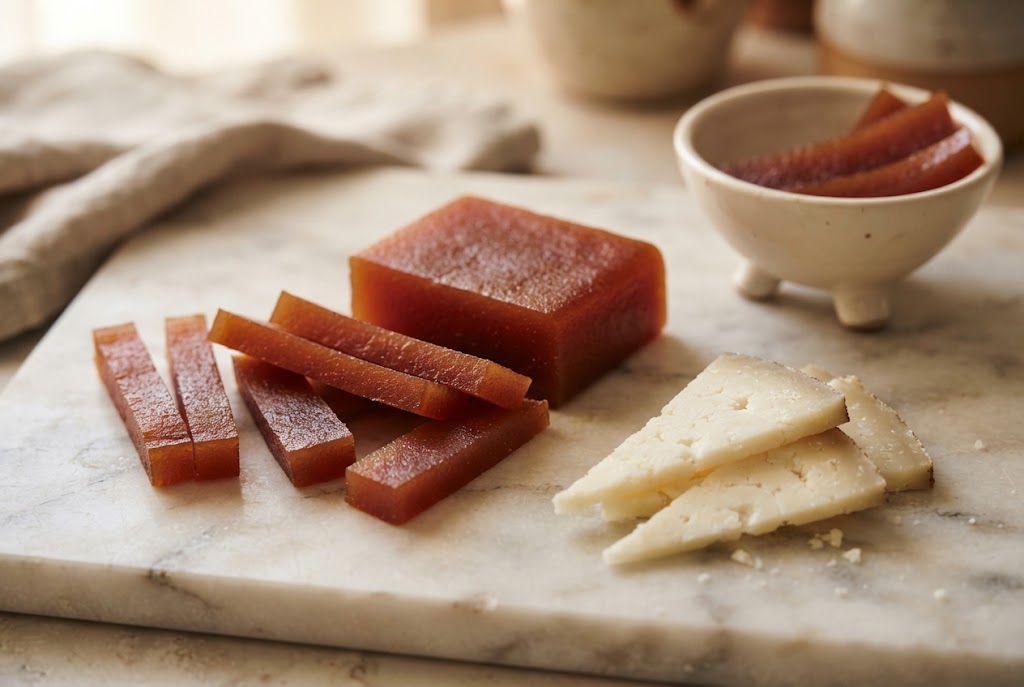
The short version
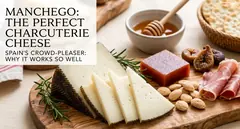
Quince cooked with sugar until it sets into a firm, sliceable block — a jam you cut with a knife rather than spread. Membrillo y manchego is the Spanish pairing, and it's on this list because it's a jam that needs no bowl, no spreader, and no explanation.
What it is
Quince paste, sold as a rectangular block or a small round. Spanish membrillo and Portuguese marmelada are the same thing; Latin American ate de membrillo is close. The fruit is inedible raw — hard, astringent, sour — and only becomes this after hours of cooking, which turns it deep amber.
- Taste
- sweet, floral, faintly of apple and rose, mildly tannic
- Texture
- firm and dense, like a very stiff jelly; slices cleanly
- Look
- translucent amber-red batons or slices
The mechanism is jam in solid form. Every other sweet element on a board needs a vessel and a utensil, and guests have to assemble the bite themselves. Membrillo is pre-portioned — a slice sits on a slice of cheese with no equipment — which is why it appears on almost every Spanish cheese plate.
What it pairs with — and why
| Pair it with | Why it works |
|---|---|
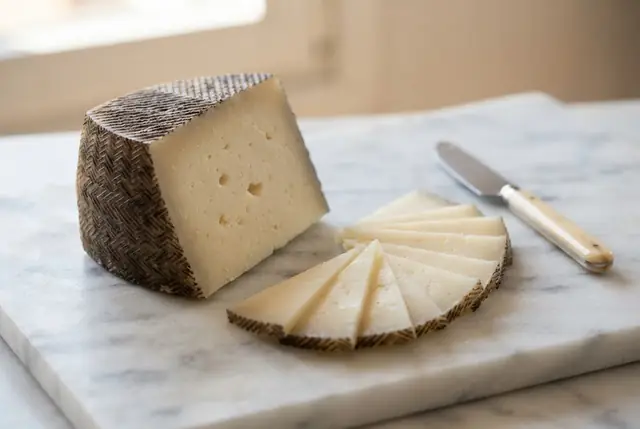
| Manchego | The pairing. Salt and sheep-milk fat against floral sugar, with both firm enough to eat stacked in the hand. |
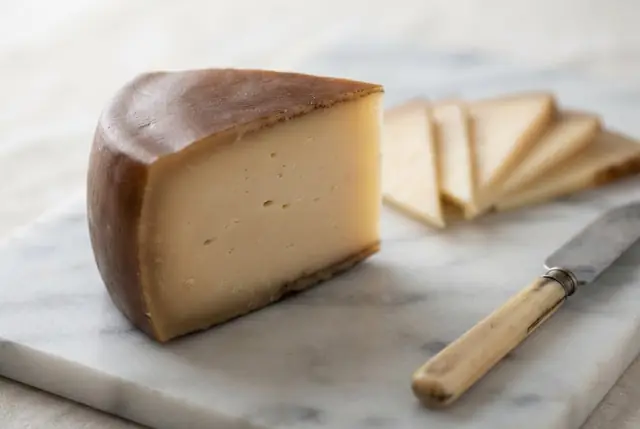
| Idiazábal and aged sheep cheeses | Same logic with smoke added; the quince's floral edge cuts through it. |
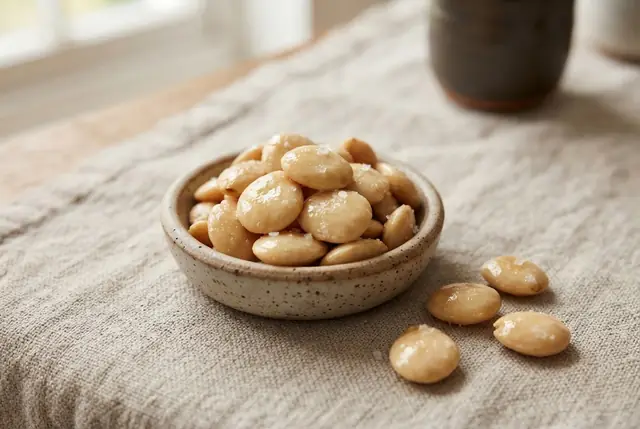
| Marcona almonds | The full Spanish plate: cheese, quince, almond. Three textures, one region. |
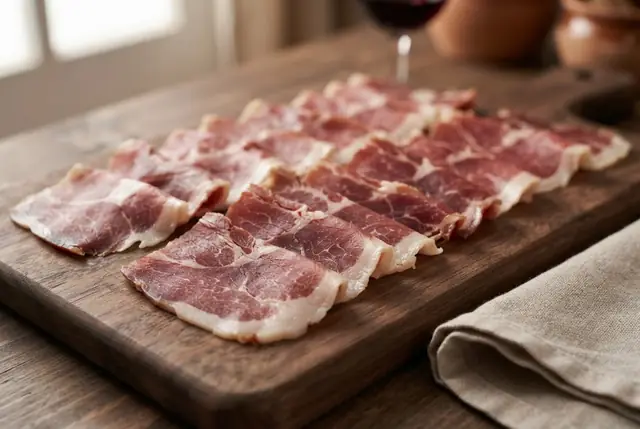
| Jamón serrano | Salt and fat against dense sugar, with the meat's chew matched by the paste's. |
| Aged gouda and hard cheeses | Anything crystalline and salty pairs the same way manchego does. |
| Blue cheese | Firm sweetness handling salt, without the mess of a spoonable jam. |
Skip it with: soft fresh cheeses. Membrillo is too dense to eat with something that has no structure.
How to prep it for the board
- Cut it into batons or thin slices, about the size of the cheese slices they'll sit on.
- Use a hot dry knife if it sticks — wipe between cuts.
- Lay the slices directly against the manchego. Stacking them shows people what to do.
- Or cut small cubes and skewer them with cheese on picks.
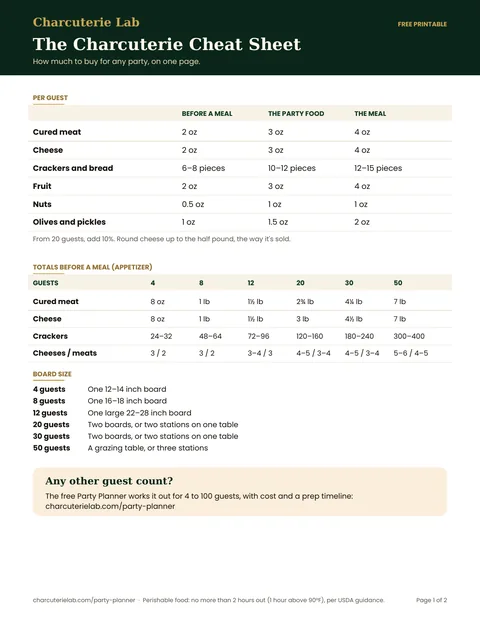
- Serve 0.5 oz per person.
- Keep the block wrapped in the fridge; it lasts months.
- Fix: sweating or sticky? Blot with paper towel and let it come to room temperature before slicing.
What to buy
| Product | Where | Notes |
|---|---|---|
| Spanish membrillo | Whole Foods, cheese shops, Spanish delis | The standard. Sold in a small block or round. |
| Mitica or Fermin membrillo | Cheese shops, online | Better quality, deeper flavour. Worth it. |
| Portuguese marmelada | Portuguese and Brazilian markets | Same product, often cheaper. |
| Ate de membrillo | Latin markets | Latin American version. Sometimes sweeter. |
| Guava paste (ate de guayaba) | Latin markets | Not quince, but the same idea and excellent with salty cheese. |
Label check: quince and sugar should be the only real ingredients. Some cheaper versions bulk it out with apple.
Skip: anything with added pectin listed high — it sets rubbery rather than dense.
Our buyer's guide: Mitica Membrillo is the easiest good one to find, and Murray's Membrillo is the cheese-shop pick. See our quince paste buyer's guide.
Quick FAQ
What is membrillo?
Quince paste — quince cooked with sugar until it sets firm enough to slice. A Spanish cheese-board staple.
What cheese goes with membrillo?
Manchego above all, plus other aged sheep cheeses, aged gouda, and blue cheese.
How do I cut membrillo?
Into thin slices or batons with a hot dry knife, wiped between cuts.
Is membrillo the same as quince jelly?
No — jelly is spoonable, membrillo is firm enough to slice and eat by hand.
How long does it keep?
Months in the fridge, wrapped. It's a preserve, and a very stable one.