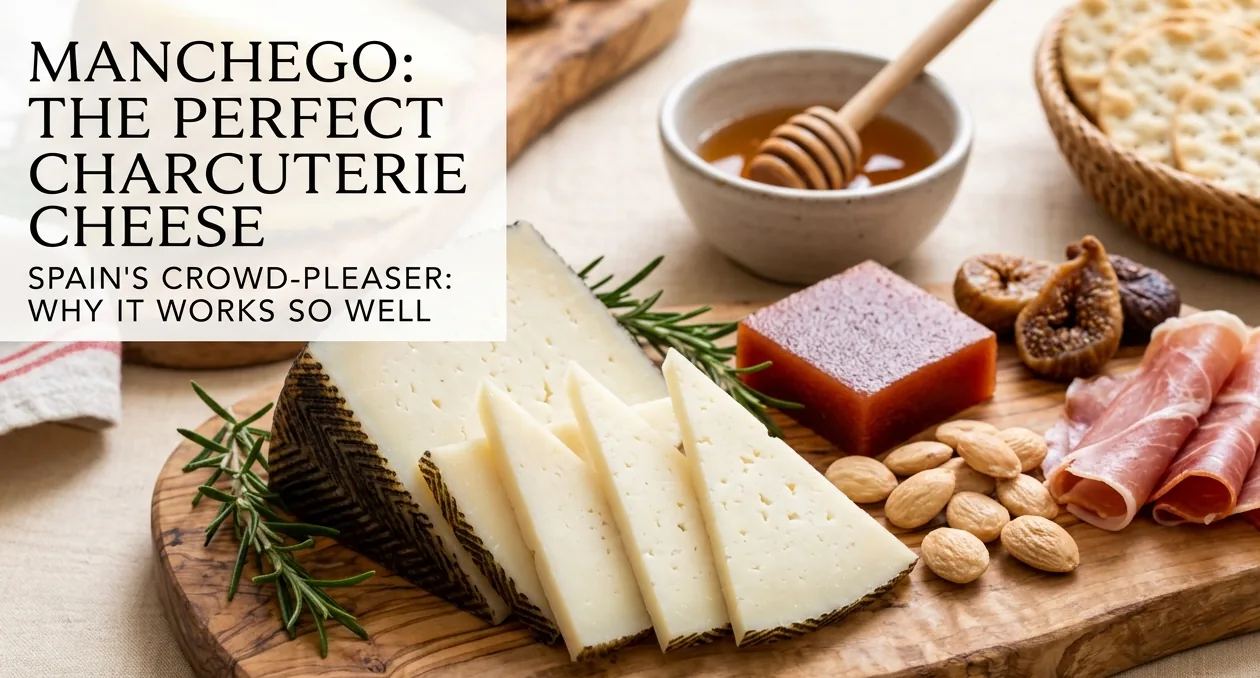
Quick Answer: Manchego is a PDO sheep's milk cheese from La Mancha in central Spain. For a board, choose semicurado or curado for a firm, nutty, slightly tangy cheese. Cut it into thin triangles and serve it with quince paste (membrillo), the classic Spanish pairing, or with honey and Marcona almonds.
Walk through the cheese section of any well-stocked grocery store and you'll find Manchego. It's one of the few cheeses from outside France that has achieved genuine mainstream recognition in the United States — and for good reason. Manchego is firm, flavorful, visually distinctive with its characteristic zigzag rind pattern, and cooperative on a board in a way that some more assertive cheeses aren't.
But most people using it don't know why it tastes the way it does, which age to choose, or what it actually pairs with best. The answers to those questions turn a good cheese into a great board element.
What Is Manchego?
Manchego is a protected designation of origin (PDO) cheese produced exclusively in the La Mancha region of central Spain, from the milk of Manchega sheep. The PDO designation means that true Manchego — the real thing — cannot be produced anywhere else in the world with that name, regardless of how the production method is replicated.
Manchega sheep graze the high, dry plateau of La Mancha, a landscape defined by sparse vegetation, harsh temperature swings, and low humidity. This environment produces a milk that is richer in fat and protein than typical cow's milk, and the flavors of the pasture — dried grass, herbs, mineral elements — influence the flavor of the cheese in ways that commodity versions made from other milk sources simply cannot reproduce.
The cheese is pressed and aged in molds that give it its characteristic cylindrical shape and the distinctive zigzag pattern on the rind — originally the impression of esparto grass molds used in traditional production, now typically pressed into the plastic molds used at scale.
The Science of Manchego's Flavor
Sheep's milk is the foundation of Manchego's distinctive flavor, and it behaves differently from cow's milk in ways that matter.
Fat content: Manchega sheep's milk contains roughly twice the fat content of standard cow's milk. Higher fat means more substrate for lipolysis — the breakdown of fats into flavor-active free fatty acids. This is why Manchego has a richness and "lanolin" quality at its best expressions that cow's milk cheeses don't — the fatty acid profile of sheep milk fat is distinctive, producing slightly buttery, slightly waxy, savory notes not found in most cow's milk cheeses.
Protein: Sheep's milk also has higher protein content than cow's milk, which means the cheese is denser and the proteolysis during aging (breakdown of casein protein chains into flavor-active amino acids) produces more intense savory compounds per unit of cheese. The result is a cheese that is noticeably "meaty" or savory in character for a semi-firm cheese that isn't aged to extreme sharpness.
Natural rind vs. wax rind: Authentic Manchego develops a natural rind during aging, which allows some interaction with the environment and produces the characteristic earthy, herbal notes in the outer layer. Many commercial versions sold in the United States are coated in a dark wax or a pressed plastic rind for shelf life — functionally the same cheese mechanically, but without the surface complexity.
Choosing Manchego by Age
Manchego comes in three primary aging categories, each with meaningfully different character:
Fresco (Fresh, under 60 days): Soft, white, mild, and slightly tangy. Not typically available in most U.S. markets. Not the best board choice — minimal complexity.
Semicurado (Semi-cured, 60 days–6 months): Pale ivory interior, smooth and slightly springy texture. Mild to moderate flavor — buttery, grassy, lightly tangy. The most approachable Manchego and the best choice when you need a mild/medium hard cheese for a crowd-pleasing board.
Curado (Cured, 3–6 months): This is the most common grocery store Manchego. Firmer, slightly more crumbly, with more developed savory, nutty flavor. The herbal and grassy notes from the sheep's milk start to come forward. This is the board workhorse — complex enough to be interesting, accessible enough for most guests.
Viejo (Aged, 1–2 years): The most intensely flavored Manchego. Quite firm, sometimes faintly granular, with a deep golden-ivory color and pronounced savory, nutty, slightly spicy character. Best used as a feature cheese. The flavor intensity calls for a stronger sweet pairing — quince paste or dark honey rather than delicate fruit.
How to Present Manchego on a Board
Cutting: Manchego's firm, dense texture slices cleanly. The classic presentation is thin triangular wedges cut from a larger piece — slice across the cylinder to get rounds, then cut into triangles from there. Alternatively, cut into matchstick-style rectangular batons, which stack neatly and allow guests to take a piece without awkwardly cutting from a wedge.
Remove the rind before serving unless you're using a natural rind version where guests may want to taste the edge. The plastic or wax rinds common on commercial Manchego are not food-grade pleasant eating. Natural rinds are edible but have a strong earthy flavor not everyone enjoys — mark them clearly if you leave them on.
Temperature: Like all hard cheeses, Manchego expresses its full flavor at room temperature. Remove from refrigeration 30–45 minutes before serving.
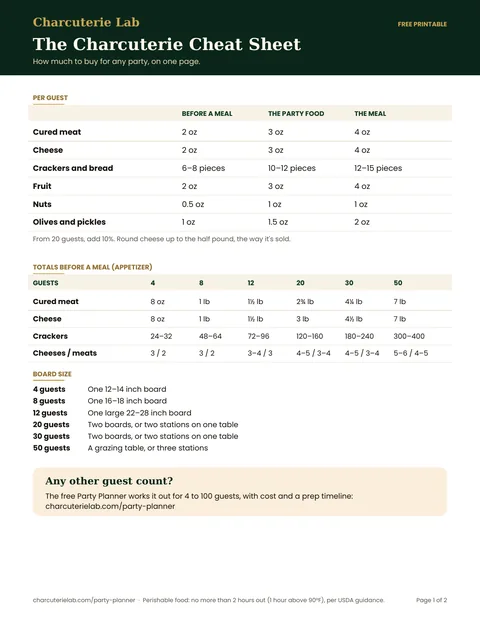
Quantity: About 1 oz per person when Manchego is one of two or three cheeses, within the usual 2 oz of cheese per person before a meal (3 oz as the party food).
Pairing Manchego
The traditional pairing — Manchego and quince paste (membrillo): This is one of the most celebrated cheese pairings in Spanish cuisine, and its longevity is evidence of how well the salt-sweet principle operates here. Quince paste is intensely sweet and slightly astringent, with a dense, almost jelly-like texture. Placed against Manchego's savory, grassy saltiness, the quince's sweetness amplifies the cheese's complexity while the cheese's salt makes the quince taste brighter and more aromatic. A small smear of membrillo on a slice of Manchego is the most authentic expression of this pairing.
Sweet condiment pairings beyond membrillo:
- Honey — particularly a floral or amber honey. Raw wildflower honey works; Manchego's herbal notes pair especially well with Spanish wildflower or thyme honey.
- Dried figs — concentrated sweetness with a mild tannin note. Excellent alongside Manchego viejo.
- Marcona almonds — technically not a sweet, but the buttery, slightly sweet, mildly salted flavor of Marcona almonds is Spain's natural companion to Manchego. The fat-on-fat combination of almond oil and sheep fat is extraordinarily satisfying.
- Pear slices — the mild sweetness and high water content of pear provides relief from the cheese's density; it resets the palate cleanly.
Bread and cracker pairings:
- Plain water crackers — allow Manchego's flavor to lead without competition.
- Spanish bread (pan de cristal or baguette-style) — a thin-crumbed, crispy bread.
- Rosemary crackers — the herbal note in rosemary mirrors the herbal quality in Manchego's sheep's milk flavor.
- Breadsticks (grissini) — the neutral, crunchy texture provides a satisfying contrast.
Meat pairings:
- Serrano ham — the classic Spanish board combination. Two Spanish cured products share flavor compounds from similar traditions, and the interplay of Serrano's slightly sweet, nutty fat against Manchego's savory density is one of the most balanced pairings in charcuterie.
- Chorizo — the paprika-spiced, slightly smoky character of Spanish chorizo pairs with Manchego's earthiness. Use a mild or semi-cured chorizo rather than a very spicy one for the best balance.
- Coppa — the sweet, slightly spiced Italian cured shoulder is an excellent cross-cultural pairing with Manchego.
- Bresaola — lean, slightly sweet beef complements without dominating.
Drink pairings:
- Rioja or Tempranillo — the national pairing. Spanish red wines made from Tempranillo have a savory, earthy, leather-and-cherry profile that mirrors Manchego's character.
- Fino or Manzanilla Sherry — the nutty, slightly salty, bone-dry character of fino sherry is one of the most natural wine pairings for sheep's milk cheese. Underused in the U.S. but extraordinary.
- Spanish cava — sparkling wine cuts through Manchego's fat and refreshes the palate; the light autolytic notes in cava complement the cheese's nutty aging.
- Craft amber ale — the malty, slightly caramel notes of amber ale work with Manchego's savory-sweet character.
Manchego at a Glance
| Property | Description |
|---|---|
| Milk | Manchega sheep's milk (PDO) |
| Origin | La Mancha, Spain |
| Texture | Firm, dense; slightly crumbly with age |
| Flavor | Buttery, savory, grassy, nutty; lanolin character from sheep fat |
| Rind | Natural (earthy, herbal) or pressed wax/plastic (commercial) |
| Best board role | Featured semi-hard cheese; works at any position |
| Optimal age for boards | Curado (3–6 months) for crowd appeal; Viejo (1–2 yr) for feature use |
| Sweet pairing | Quince paste (membrillo), raw honey, dried figs |
| Cracker pairing | Plain water crackers, rosemary crackers |
| Meat pairing | Serrano ham, mild Spanish chorizo, coppa |
Quick Pairing Reference
| Board Type | Manchego Pairing |
|---|---|
| Spanish/Mediterranean board | Serrano ham + quince paste + Marcona almonds |
| Red wine board | Coppa + dried figs + rosemary crackers + Rioja |
| Crowd-pleasing board | Curado + raw honey + plain crackers + pear slices |
| Feature cheese board | Viejo + dark honey + breadsticks + Serrano ham |
| Beer board | Curado + mild chorizo + Marcona almonds + amber ale |
Putting It on the Board
Manchego belongs in the middle of the hard cheese spectrum on a board — more complex and distinctive than a mild cheddar, more approachable than an aged Parmigiano. It earns a featured position, not a background one. Place quince paste or honey directly adjacent to it, and lay a few Marcona almonds nearby if you have them.
The zigzag rind pattern is visually recognizable to most guests — lean into it by keeping some of the rind visible in your presentation even if you're trimming it from what guests will eat.
Weekly pairing science in the Charcuterie Lab Report newsletter.