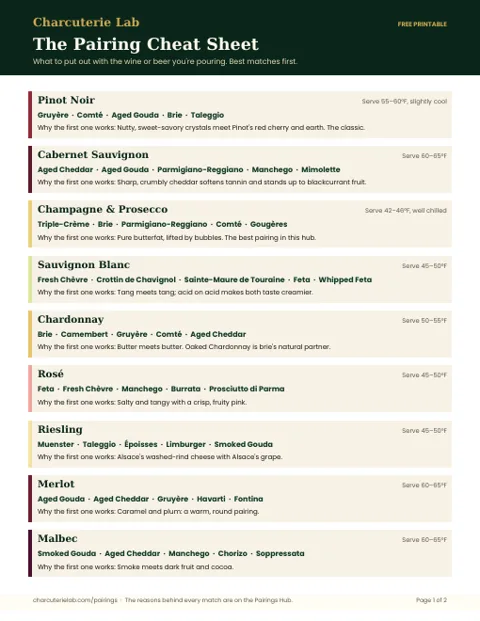
Quick Answer: Chorizo and Manchego pair because pimentón's aromatic compounds are lipophilic — they dissolve directly into Manchego's sheep's milk fat and amplify through retronasal perception. Sheep's milk's higher medium-chain fatty acid content makes it a more efficient carrier for pimentón lipophiles than most cow's milk cheeses. Both ingredients amplify each other at the biochemical level.
The Direct Answer
The chorizo and Manchego pairing works through a lipophilic aromatic transfer mechanism that is specific to the chemistry of Spanish smoked paprika (pimentón) and sheep's milk fat.
Pimentón's flavor is produced by a complex mixture of volatile compounds formed during the drying and smoking of capsicum peppers: carotenoid pigments (capsanthin and capsorubin, responsible for the deep red color), pyrazines (earthy, roasted notes from the Maillard reactions during drying), and lactones (sweet, fruity notes from the smoking process). These compounds are all highly lipophilic — they have low water solubility and high affinity for fat molecules.
During the curing of Spanish chorizo, these pimentón compounds are absorbed into the ground pork fat, which acts as their primary carrier. When chorizo is eaten, the fat melts at body temperature and the pimentón lipophiles volatilize into the retronasal passage, producing the characteristic paprika aroma.
When Manchego is present simultaneously, a second fat carrier becomes available. Sheep's milk fat — the defining medium for Manchego — has an unusually high proportion of medium-chain fatty acids compared to cow's milk: specifically caprylic acid (C8), capric acid (C10), and caproic acid (C6). These shorter-chain fats have lower melting points than the longer-chain fats dominant in cow's milk, meaning they melt more readily at body temperature and release their dissolved aromatic compounds more efficiently into the vapor phase.
When pimentón lipophiles from the chorizo transfer into Manchego's sheep's milk fat during chewing, the higher-volatility fat matrix releases them into the retronasal passage more efficiently than the chorizo's own pork fat alone. The pimentón aroma perception intensifies. At the same time, Manchego's own aromatic compounds — the grassy, nutty notes from the sheep's milk and the aging pyrazines — are now present in a fat matrix that also contains pimentón aromatics. The combined retronasal signal is an integrated aroma rather than two separate ones.
The Capsaicin Component
For picante chorizo specifically, capsaicin adds a second pairing mechanism. Capsaicin is highly lipophilic — it is responsible for the burning sensation associated with chili heat by binding to TRPV1 heat receptor sites on pain-sensing nerve endings. When Manchego's fat is present in the mouth simultaneously with capsaicin from the picante chorizo, the fat molecules compete with capsaicin for the lipid-rich environment near the receptor sites. Fat molecules physically dilute the capsaicin concentration available to bind TRPV1 receptors, reducing the effective heat level.
This is the biochemical reason that dairy fat is the most effective capsaicin antidote — fat competes with capsaicin for both the receptor environment and the lipophilic binding spaces in the oral mucosa. With Manchego, this mechanism is slightly more efficient due to the medium-chain fat advantage: the shorter-chain fats melt faster and coat the oral mucosa more completely.
The practical outcome: picante chorizo paired with Manchego tastes spicier than the cheese alone (the pimentón amplification effect) but with more controlled heat (the fat-capsaicin competition effect). The spice becomes more present without becoming uncomfortable.
Why Spain Gets It Right
The pairing predates modern food science. In La Mancha — the central Spanish plateau where Manchego is produced — and in Extremadura and Andalusia, where much of Spain's pimentón comes from, both ingredients developed within the same agricultural and culinary tradition. Sheep-grazing and pig-curing coexisted in the same landscapes for centuries.
The biochemical compatibility is not coincidental. Regional food pairings that survive across centuries and generations do so because they are reproducible and reliable — guests respond positively to them across cultures, generations, and individual taste preferences. The chorizo-Manchego combination falls into this category. Understanding the mechanism confirms what tradition already established: this pairing works, every time, because the chemistry makes it work.
Building the Spanish Board Cluster
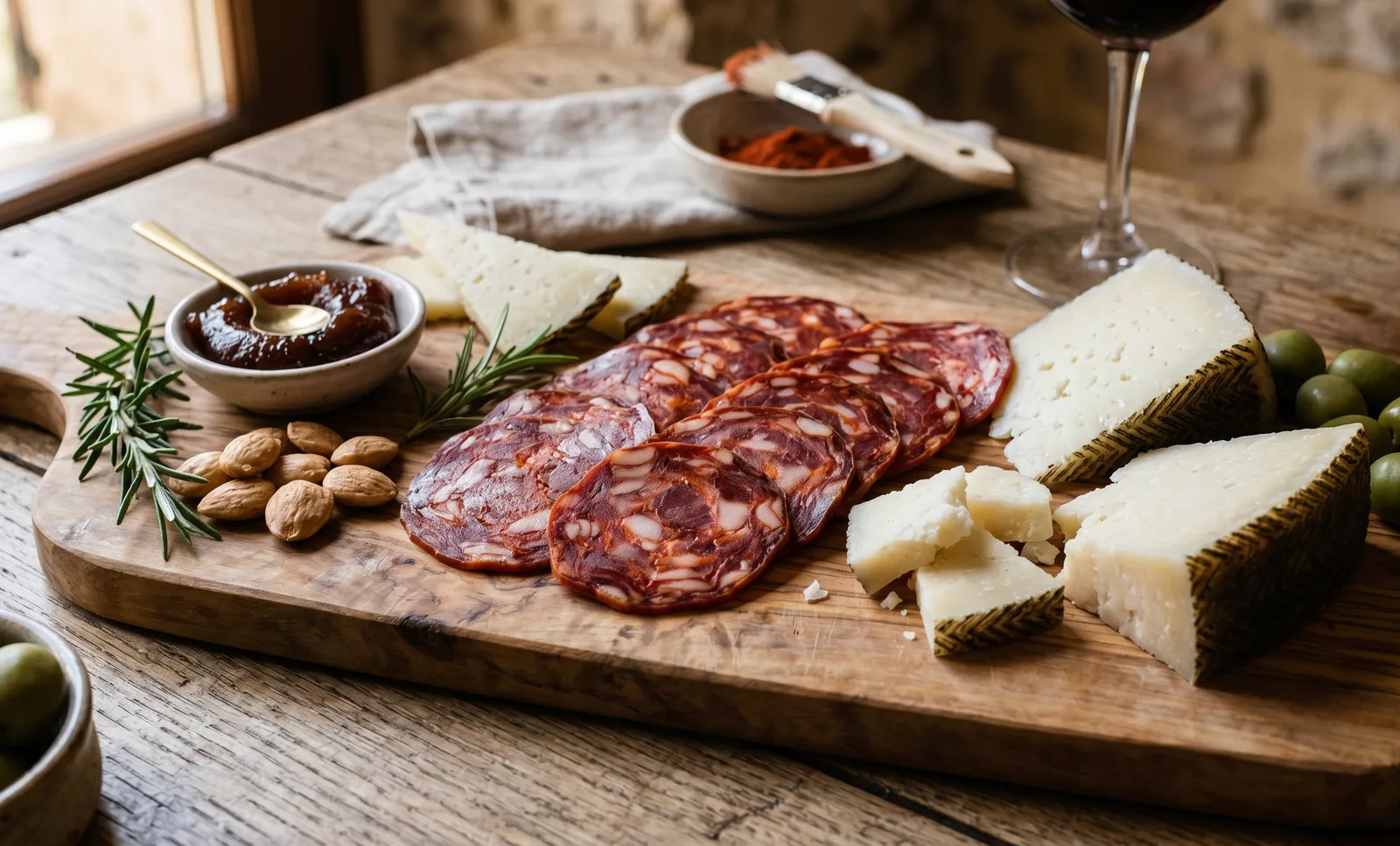
Core two: chorizo + Manchego. Slice chorizo on a 3–4mm bias; position adjacent to Manchego wedges or broken chunks. Both at room temperature.
Add membrillo. Quince paste alongside provides the tannin-casein binding and fructose suppression that manages Manchego's aging bitterness — the missing third element that completes the biochemical picture for the cheese side of the pairing.
Add Marcona almonds. Oleic acid in the almonds resonates with both fats through lipophilic affinity. The mild roasted almond note also echoes Manchego's aging pyrazines and the paprika's roasted character.
Add Castelvetrano olives. Olive oleic acid and phenolics bridge the meat and cheese zones, providing a neutral-fat and phenolic-bitterness palate reset between bites.
This four-element Spanish cluster — chorizo, Manchego, membrillo, Marcona — is the most biochemically complete regional board configuration available.
Building more boards? The Charcuterie Lab ebook covers 50 boards — each with exact quantities, shopping lists, and the science behind every pairing.
The Charcuterie Lab Takeaway
Chorizo and Manchego pairs because pimentón lipophiles transfer from cured pork fat into sheep's milk fat and amplify — sheep's milk's medium-chain fatty acids release the aromatic compounds more efficiently than most cow's milk cheeses. For picante chorizo, Manchego's fat simultaneously dilutes capsaicin concentration near TRPV1 receptors, softening the heat while preserving the spice character. Add membrillo and Marcona almonds to build the complete Spanish cluster.
FAQ
Why do chorizo and Manchego go together?
Chorizo and Manchego pair because pimentón's aromatic compounds (carotenoids, pyrazines, and lactones from Spanish smoked paprika) are highly lipophilic — they dissolve into Manchego's sheep's milk fat at body temperature and amplify through retronasal perception. Sheep's milk fat has a higher proportion of medium-chain fatty acids than cow's milk, making it a more efficient carrier for the pimentón lipophiles than most other board cheeses.
What type of chorizo pairs best with Manchego?
Spanish cured chorizo — either picante (spicy, with hot pimentón) or dulce (sweet, with mild pimentón) — is the correct pairing. Picante chorizo creates a spice-fat interaction where capsaicin binds to Manchego's medium-chain fatty acids, softening the heat perception while amplifying the paprika aromatics. Dulce chorizo is milder and suits mixed crowds while using the same fat-resonance mechanism. Fresh cooking chorizo cannot be used on a board uncooked.
Is this a traditional Spanish pairing?
Yes — chorizo and Manchego appears across Spanish cuisine as a tapa, sandwich filling, and board staple. The pairing predates modern food science by centuries, having emerged from the same regional agricultural tradition that produced both ingredients in La Mancha and Extremadura. The biochemical mechanism explains why the pairing persisted: it is reliable and reproducible across every quality production of both products.
What else goes with chorizo and Manchego on a board?
Quince paste (membrillo) completes the classic Spanish trio — its tannins bind Manchego casein and its fructose suppresses aging bitterness, while its slight tartness provides the acid contrast that resets the fat-rich chorizo-cheese bite. Marcona almonds add oleic acid that resonates with both fats. Castelvetrano olives provide phenolic bitterness and oleic fat that bridges the cheese and meat zones.
How do you serve chorizo and Manchego on a charcuterie board?
Slice chorizo on a bias at 3–4mm to expose the fat marbling and cured paste. Serve at room temperature — cold chorizo fat is waxy and the pimentón aromatics are suppressed. Manchego in wedges or broken chunks at room temperature (30–45 minutes out). Position them adjacent or overlapping on the board so guests can combine each bite easily. The visual contrast of the deep red chorizo against pale Manchego is one of the strongest color pairings on a Spanish-style board.