Quick Answer: Cream cheese does not mute smoked salmon's smoke flavor — it amplifies it. The phenolic compounds responsible for smoke aroma (guaiacol and syringol) are lipophilic: they dissolve into cream cheese fat and release more intensely into the retronasal passage during chewing than they would from the fish alone. Fat is a smoke carrier, not a smoke suppressor.
The Direct Answer
The most common misconception about this pairing is that cream cheese "balances" or "softens" the smoke. That is not what happens. The actual mechanism is the opposite: fat amplification.
Wood smoke flavor is produced by the pyrolysis of lignin in the smoking wood, which releases a family of phenolic compounds — primarily guaiacol (2-methoxyphenol) and syringol (2,6-dimethoxyphenol). These compounds are highly lipophilic: they have very low water solubility and very high fat solubility.
When smoked salmon is eaten alone, the smoke phenolics release from the fish's omega-3 fat matrix as it warms in the mouth, traveling through the retronasal passage to the olfactory receptors. The signal is clear but finite — limited by the amount of fat in the fish itself.
When cream cheese is present simultaneously, the smoke phenolics transfer from the fish fat into the cream cheese fat phase — a much larger lipid reservoir. As this larger fat mass warms and melts at body temperature, it releases a proportionally larger smoke phenolic signal into the retronasal passage. The smoke aroma perception intensifies rather than diminishes.
Cream cheese's lactic acid (from its bacterial fermentation) provides a secondary function: mild acid contrast to the salt in the salmon's cure. This contrast prevents the combined bite from reading as salty-only, keeping the palate receptive to the smoke signal.
Cold-Smoked vs Hot-Smoked
The distinction matters for a board.
Cold-smoked salmon (Nova, lox): Cured in salt and cold-smoked at temperatures below 80°F (27°C). The flesh retains its raw texture — silky, translucent, sliceable at paper-thin portions. The smoke character is pronounced but integrated into the cure. This is the board standard.
Hot-smoked salmon: Smoked at temperatures between 120–180°F (49–82°C). The flesh is fully cooked, flaky, and has a different textural presentation. The smoke character is heavier and more pronounced than cold-smoked. Works on boards in small flaked clusters rather than draped slices; pairs with the same elements but reads differently.
For a styled charcuterie board, cold-smoked is the right choice. For a casual board or bagel-spread format, hot-smoked works well.
Building the Full Pairing on a Board
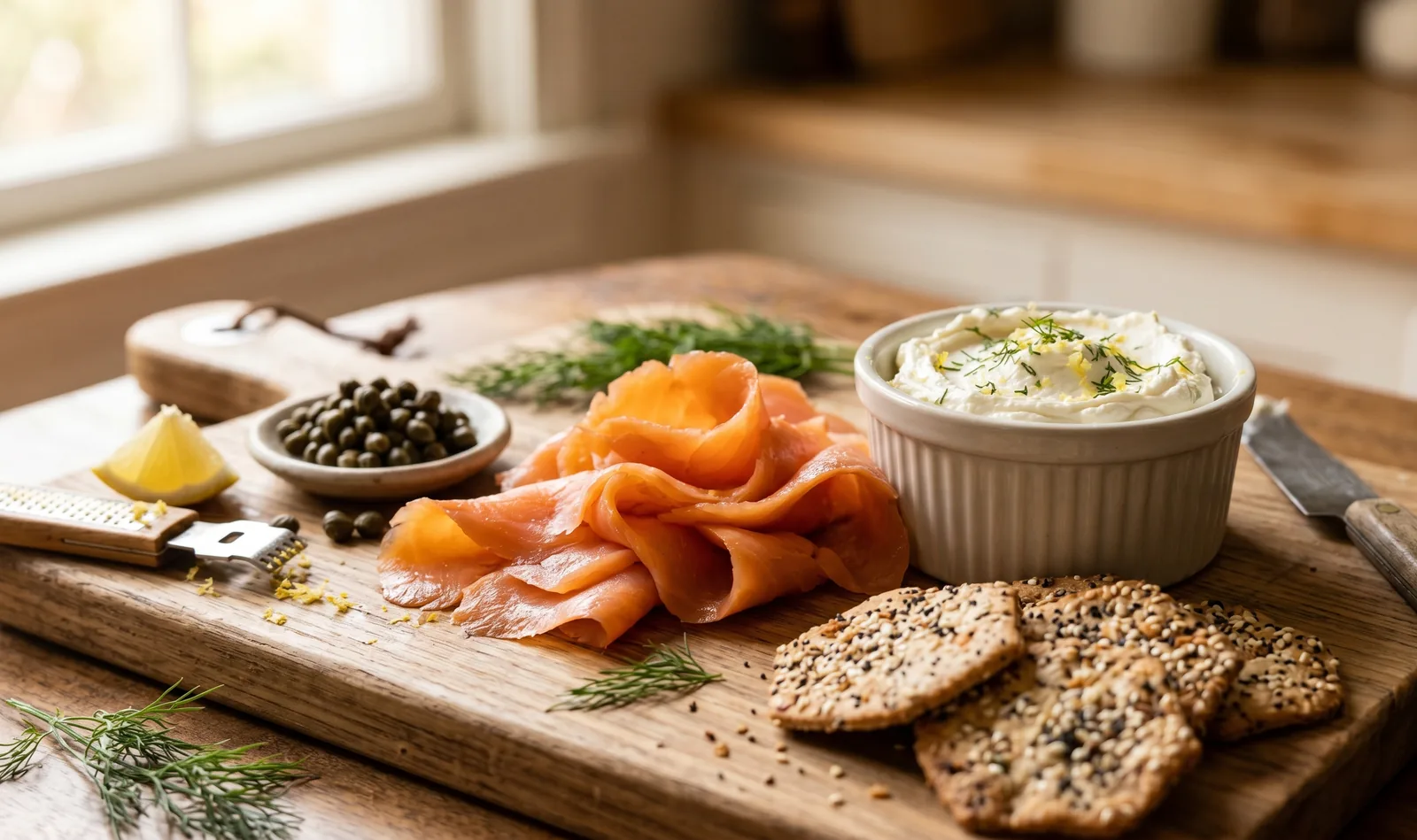
The core two: smoked salmon + cream cheese. Arrange cold-smoked salmon in loose ribbons or folds exposing the individual slices. Place cream cheese in a small mound or use a pastry bag to pipe a neat portion beside the salmon. Provide a spreader dedicated to the cream cheese.
Add capers. This is not optional for the complete version of this pairing. Capers contain citric and tartaric acid in their brine — this acid resets the palate between the fat-heavy bites and the brine echoes the salmon's salt register without duplicating it. Place capers in a small ramekin beside the salmon zone.
Add lemon. Fresh lemon zest or a small wedge for squeezing. Citric acid volatilizes the smoke phenolics in the retronasal passage — it brightens rather than diminishes the smoke perception. Squeeze over the salmon immediately before eating, not during board assembly.
Add sliced red onion (optional). Red onion's organosulfur compounds (primarily allicin) are also lipophilic, and they resonate with the smoke phenolics on the sulfur-aromatic axis. The sharpness contrast with the cream cheese also cleans the palate. Slice very thin (1mm); thick onion slices overwhelm everything.
Vehicle: Everything crackers are the most complete vehicle — the sesame and onion seed compounds in the everything seasoning are lipophilic and extend the smoke amplification mechanism. Plain bagel chips work as a more neutral alternative.
Variations Worth Trying
+ Dill: Dill's primary aromatic compound (limonene) is a terpene — fat-miscible, distributes through the cream cheese fat, and creates aromatic coherence between the herbal and smoke registers. Fresh dill placed directly over the cream cheese zone is the most effective application.
+ Everything cracker: The allicin and sesame aromatic compounds in everything seasoning are both lipophilic and extend the smoke-fat amplification beyond the cream cheese alone.
+ Cucumber: Cucumber provides water-based palate refresh alongside the acid reset of capers — a neutral structural element that lengthens the board's eating window.
Elevated version — smoked salmon + crème fraîche + caviar: Crème fraîche is looser and tangier than cream cheese, and that lactic tang creates a more complex base. Caviar's briny, mineral notes extend the salt register into a third dimension.
Building more boards? The Charcuterie Lab ebook covers 50 boards — each with exact quantities, shopping lists, and the science behind every pairing.
The Charcuterie Lab Takeaway
Cream cheese amplifies smoked salmon's smoke flavor — it does not soften it. The smoke phenolics dissolve into the fat and release more intensely through retronasal perception. Use cold-smoked salmon, good cream cheese or crème fraîche, capers (non-negotiable), lemon, and everything crackers. Keep the salmon cold until just before service and follow the 2-hour room temperature rule strictly.
FAQ
Why does cream cheese go with smoked salmon?
Cream cheese pairs with smoked salmon because the smoke phenolic compounds (primarily guaiacol and syringol) are lipophilic — they dissolve into cream cheese fat and amplify through retronasal perception. The fat does not muffle the smoke; it carries it. Cream cheese also provides a lactic acid base that contrasts the salt in the cure and the smoke without competing.
What type of smoked salmon is best for a charcuterie board?
Cold-smoked salmon (Nova or lox style) is the board standard — it has a silky, raw-textured flesh with a pronounced smoke character and is sliced paper-thin. Hot-smoked salmon is flakier and has a cooked texture; it works on boards but in a different role, placed in small clusters rather than draped in thin slices. Both are valid; cold-smoked is more elegant for a styled board.
What else goes with smoked salmon and cream cheese on a board?
Capers are essential — their citric and tartaric acid provide a palate reset between the fat-heavy bites, and the caper brine echoes the salmon's salt. Thinly sliced red onion adds sulfur compounds that resonate with the smoke phenolics. Lemon zest or a squeeze of lemon citric acid brightens the smoke aroma through volatilization. Everything crackers or plain bagel chips complete the New York deli format.
How do you serve smoked salmon on a charcuterie board?
Drape cold-smoked salmon in loose folds or ribbons so the individual slices are visible and accessible. Arrange cream cheese in a small mound or dollop beside the salmon, not spread on the board surface. Keep everything on a cold surface or near a cold pack — smoked salmon is perishable and should not sit at room temperature for more than 2 hours.
Is smoked salmon on a charcuterie board safe to eat?
Cold-smoked salmon is safe to eat on a board served within 2 hours at room temperature, or within 1 hour in warm ambient conditions. It is not raw — it is cured and cold-smoked. However, it is more perishable than dry-cured meats and should be the last protein added to the board before service and the first removed if replenishing.