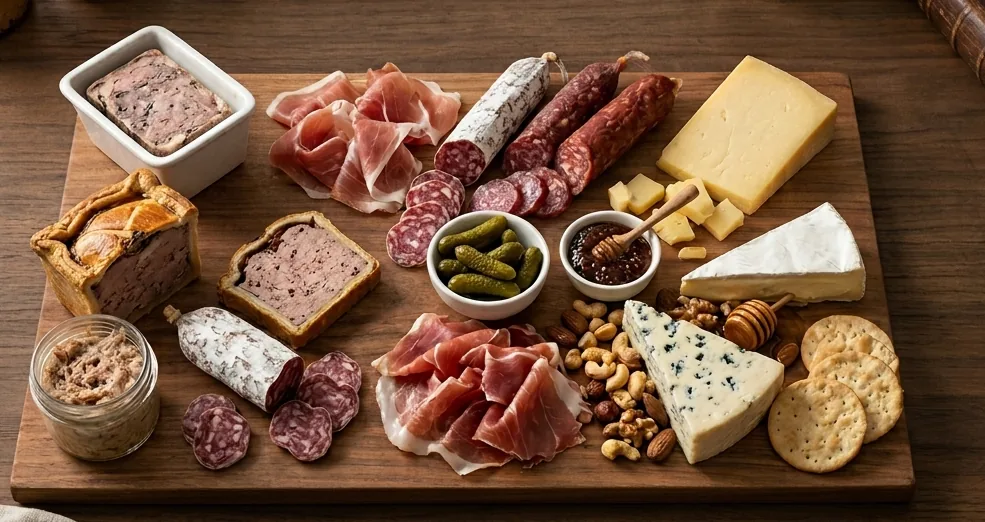
Charcuterie (pronounced shar-KOO-tuh-ree) is the French culinary art of preparing and preserving meat products — specifically pork — through curing, smoking, salting, and cooking. The word derives from the French chair (flesh) and cuit (cooked), literally meaning "cooked flesh." In its original definition, charcuterie referred both to the products themselves (cured meats, pâtés, terrines, sausages) and to the specialized shops that produced and sold them.
Today, the word has expanded — particularly in the United States — to describe the assembled boards of cured meats, cheeses, condiments, and accompaniments that have become one of the most popular forms of casual entertaining. This article covers both: what charcuterie originally meant, what it means now, and why both definitions matter.
Quick Answer: Charcuterie (shar-KOO-tuh-ree) is the French culinary tradition of preparing and preserving meat products — including cured whole-muscle meats, fermented sausages, pâtés, and terrines — using salt, smoke, and fermentation. In contemporary usage, "charcuterie" refers to an assembled board of cured meats and cheeses served with accompaniments. The word derives from the French chair cuit ("cooked flesh").
The Historical Definition
In classical French culinary tradition, charcuterie is a specific craft with centuries of history. The charcutier — the craftsperson who produced charcuterie — was a specialized butcher and artisan, distinct from a regular butcher (boucher) who sold fresh meat. Charcutiers were licensed by guild in medieval France to work with cooked pork products, including:
- Rillettes — slow-cooked, shredded pork fat
- Pâté — finely ground meat, often pork liver, cooked and set in a mold
- Terrine — coarsely textured version of pâté, often layered
- Saucisson sec — dry-cured sausage (France's answer to Italian salami)
- Jambon — cured ham, including the great regional hams of France
- Andouille and andouillette — cooked sausages made from intestine
- Boudin — blood sausage (boudin noir) or white sausage (boudin blanc)
This tradition was rooted in necessity: before refrigeration, salt, smoke, fermentation, and fat were the technologies used to preserve meat through winter and transport it without spoilage. The science underlying these techniques — the reduction of water activity through salt, the creation of antimicrobial lactic acid through fermentation, the use of smoke compounds as preservatives — was understood empirically long before it was understood biochemically.
The Modern Definition
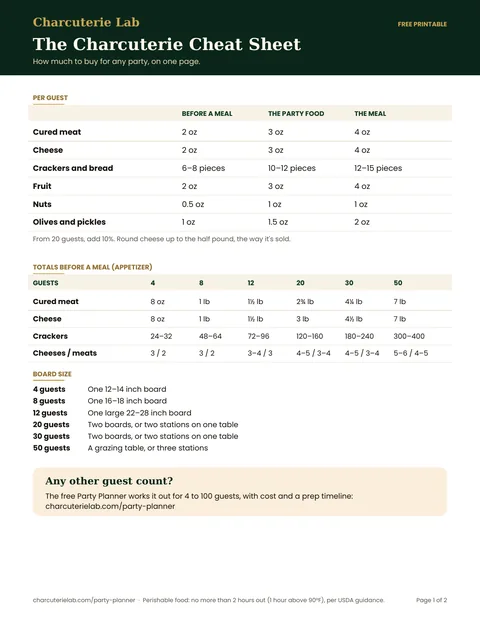
The word "charcuterie" in contemporary American usage — and increasingly in global usage — refers to an assembled board of cured meats, cheeses, condiments, fruits, nuts, and crackers served for sharing. This expanded definition is what most people mean when they say "let's do a charcuterie board."
This usage is technically imprecise but culturally well-established. The "board" tradition blends several European traditions: French charcuterie (cured meats), French and Italian cheese culture, the Spanish tabla de embutidos (cured meat board), and the Mediterranean mezze table. The result is a distinctly modern, multicultural interpretation that has taken on its own identity.
What belongs on a modern charcuterie board:
- Cured meats — prosciutto, salami, soppressata, coppa, bresaola, Serrano ham, and others
- Cheeses — typically 2–4 varieties spanning hard, semi-soft, and soft/creamy
- Condiments — honey, fig jam, whole grain mustard, quince paste
- Fresh and dried fruit — grapes, sliced apples, pears, dried apricots, figs, Medjool dates
- Nuts — Marcona almonds, walnuts, candied pecans
- Crackers and bread — water crackers, crostini, seeded crackers, baguette
- Extras — olives, cornichons, pickled vegetables, dark chocolate
Charcuterie vs. a Cheese Board: What's the Difference?
A cheese board is focused primarily on cheese — typically 3–5 cheeses with minimal accompaniments. The cheese is the subject; everything else exists to complement it.
A charcuterie board gives equal or primary emphasis to cured meats alongside cheese. The pairing of salty, savory cured meat with cheese and sweet condiments is the defining characteristic.
In practice, the terms are used interchangeably by most people. The distinction matters most when you're intentionally designing a board: if you want the cheese to be the feature, it's a cheese board. If you want the interplay of meat, cheese, and condiments, it's charcuterie.
The Science Behind Why Charcuterie Works
Charcuterie's appeal as a format for eating isn't arbitrary — it's grounded in how human taste perception works.
Salt and sweet interaction: The salt in cured meats and aged cheeses suppresses bitter taste receptors while amplifying the perception of sweetness. This is why honey next to aged cheddar, or melon next to prosciutto, tastes better than either alone. The salt-sweet pairing principle is the engine that drives almost every great combination on a well-built board.
Texture contrast: A board that offers creamy soft cheese, firm aged cheese, crunchy crackers, chewy dried fruit, and tender cured meat provides variety across multiple sensory dimensions simultaneously. Texture contrast prevents palate fatigue — the reason a board is more satisfying to graze on over two hours than a single dish of equal caloric value.
Acid as a palate reset: Pickled elements (cornichons, pickled grapes), acidic fruits (apples, grapes), and mustard serve as palate cleansers between rich, fatty, and salty bites. The acid stimulates salivary flow and reduces the lingering fat coat from cheese or cured meat, making the next bite taste as fresh as the first.
Portioning and autonomy: Grazing foods — where each person assembles their own combinations — are more satisfying than pre-portioned food because the act of building your own combination creates engagement and mild anticipation. The flavor payoff of a self-assembled bite consistently exceeds that of a pre-made one, because the assembly itself is part of the sensory experience.
What Makes a Great Charcuterie Board
A great charcuterie board isn't only a collection of good ingredients. It's a designed flavor system:
- Variety across flavor intensity — include mild, medium, and assertive elements
- At least one sweet anchor — honey, jam, or fruit to activate the salt-sweet principle
- Texture range — something crunchy, something creamy, something chewy
- An acid element — cornichons, pickles, or fresh fruit to reset the palate
- Visual composition — color, shape, and density variation that invites exploration
When these elements are present and positioned thoughtfully, the board becomes greater than the sum of its parts. Every bite combination a guest discovers on their own is a small moment of delight that they'll associate with the host who built it.
Charcuterie Lab is built around the science of why these combinations work. If you want more practical examples, the Charcuterie Lab Report newsletter sends pairing science and board-building ideas you can use on your next spread.
FAQ
What does charcuterie mean?
Charcuterie (pronounced "shar-KOO-tuh-ree") is the French culinary art of preparing and preserving meat products through curing, smoking, salting, and fermentation. The word comes from the Old French "chair cuite" meaning "cooked flesh." Traditionally, it encompassed pâtés, terrines, rillettes, sausages, and cured whole-muscle meats. In contemporary usage, it typically refers to any board or spread featuring these preserved meat products alongside cheeses and accompaniments.
Is charcuterie a French word?
Yes. Charcuterie is French in origin and refers both to the craft of meat preservation and to the shop where these products are sold. In France, a charcutier (charcuterie artisan) specializes in pork products — sausages, pâtés, rillettes, boudin, and air-dried meats. The tradition has Italian and Spanish equivalents (salumeria, charcutería) with their own distinct products and methods.
What is the difference between charcuterie and deli meat?
Charcuterie involves traditional preservation techniques — specific curing salts, controlled fermentation, extended aging, and artisanal production methods that developed flavor complexity over time. Deli meat is typically processed more quickly using industrial methods, often with more additives and fillers, producing a blander, more uniform product. True charcuterie has distinct terroir and craft character; deli meat is primarily functional.
Is charcuterie always pork?
Traditionally, yes — the craft originated with pork preservation. Today, charcuterie includes cured beef (bresaola), duck (duck prosciutto, duck confit), game meats, and even fish preparations (though fish curing is typically categorized separately). The modern "charcuterie board" as a food trend includes all these variations plus cheese and other accompaniments, well beyond the original pork-focused definition.
What is an American charcuterie board?
An American charcuterie board combines European cured meat traditions with American accessibility: grocery store cheddar alongside imported prosciutto, American artisan salamis next to French cornichons, local honey alongside imported fig jam. The American board tends toward abundance and accessibility rather than strict regional authenticity, drawing freely from Italian, French, and Spanish traditions while making it approachable for a broad audience.