Quick Answer: Five categories: cheese (2–4 kinds), cured meats (2–3), crackers or bread, fresh and dried fruit, and condiments like honey and jam. Then add nuts, olives or pickles for crunch and contrast. For 4–6 people that's 3 cheeses, 2–3 meats, 2 kinds of crackers, grapes plus one other fruit, and a honey or jam.
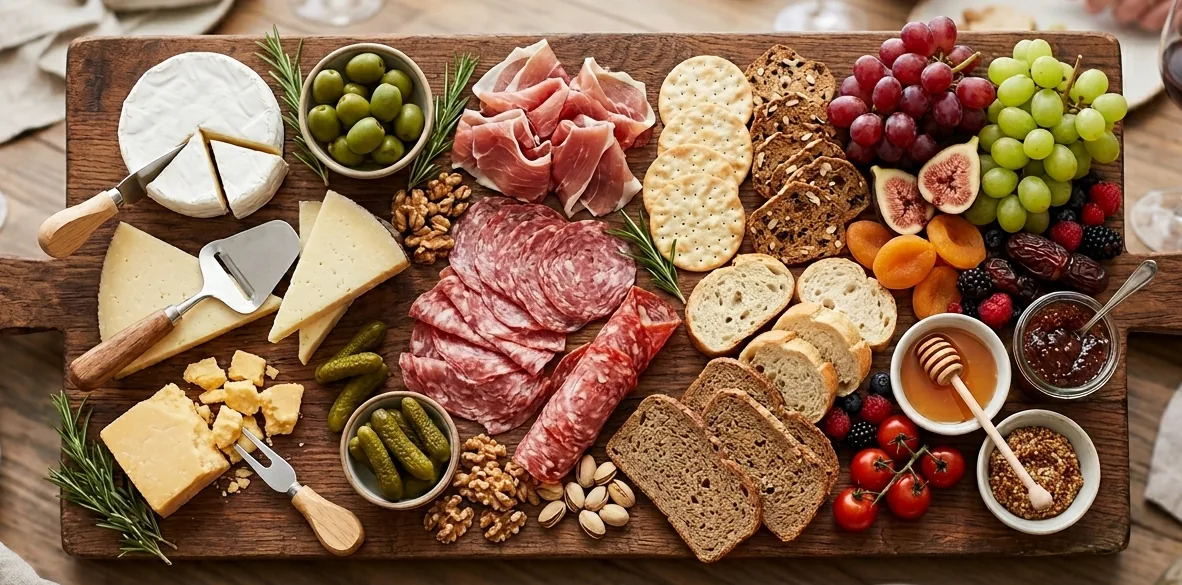
A charcuterie board typically includes five categories of elements: cheese, cured meats, crackers or bread, fresh and dried fruit, and condiments. Beyond those five, there's a supporting cast of optional elements — nuts, olives, pickles, fresh vegetables — that add variety, flavor contrast, and visual interest. Everything on a well-built board is there for a reason.
Here's the complete breakdown.
1. Cheese (2–4 varieties)
Cheese is the anchor of a charcuterie board. Most boards include 2–4 varieties selected to cover different textures and flavor intensities:
Soft cheese: Brie, Camembert, fresh goat cheese (chèvre), burrata. These are the creamy, approachable cheeses that most guests gravitate toward first. They pair best with light, plain crackers or baguette and with fresh fruit.
Semi-firm cheese: Gruyère, young Manchego, Fontina, Havarti. These slice or fan cleanly and work in the middle of a board as a reliable, crowd-pleasing option.
Hard cheese: Aged cheddar, aged Manchego, aged Gouda, Parmigiano-Reggiano. These are broken or sliced into smaller pieces and provide the most complex, intensely flavored cheese experience on the board.
Blue or funky (optional): Gorgonzola, Stilton, Roquefort. These are strong and polarizing — not essential, but valuable for adventurous guests and for boards with bold flavors.
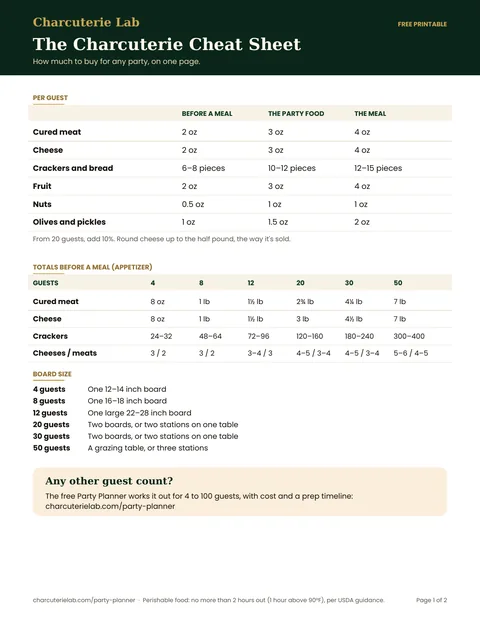
The standard quantity: 2 oz of cheese per person when a meal follows, 3 oz when the board is the party food, 4 oz when it's dinner.
2. Cured Meats (2–3 varieties)
Cured meats are the charcuterie in charcuterie boards. Two to three varieties provides enough range without overwhelming the board:
Sliced salami or soppressata: The most versatile and universal choice. Genoa salami is mild and fatty; soppressata offers more complexity; spicy calabrese or finocchiona add different flavor registers.
Prosciutto or other whole-muscle cured meats: Thin, delicate, and visually elegant. Prosciutto, coppa, and bresaola all fold, drape, and rose differently and occupy a different flavor register than ground salami.
A third option: Spreadable (nduja), smoked (smoked salmon on lighter boards), or something regional and unexpected (mortadella, lardo, 'nduja).
The standard quantity: the same as the cheese, 2 oz of cured meat per person before a meal, 3 oz as the party food, 4 oz as dinner.
3. Crackers and Bread
Crackers and bread are the vehicle — they carry cheese and meat to the mouth and provide textural contrast to soft elements.
Plain water crackers: The most versatile option. Neutral flavor, sturdy enough for spreading soft cheese, clean enough to not compete with any topping.
Artisan crackers with seeds, herbs, or grains: Add visual interest and slight flavor variation. Good next to complex aged cheeses.
Sliced baguette: Provides chew and slight Maillard flavor. Pairs particularly well with prosciutto, bresaola, and soft cheeses.
Dark rye or pumpernickel: The slight bitterness and earthiness provides excellent contrast to sweet or caramel-forward cheeses like aged Gouda or aged cheddar.
Crackers and bread should always be added to the board as close to serving time as possible — they absorb moisture and soften quickly. Never add them more than an hour before guests arrive.
4. Fresh and Dried Fruit
Fruit provides the sweet and acid contrast that prevents a charcuterie board from being monotonous. The mechanism: fresh fruit acid resets the palate; dried fruit sweetness creates salt-sweet contrast with salty cheese and meat.
Fresh fruit options: Grapes (the most classic), apple slices, pear slices, figs, berries. Grapes are unbeatable because they require no prep, look good at any size, and their fresh acid and sweetness pair with almost every cheese.
Dried fruit options: Dried apricots, Medjool dates, dried figs, dried cranberries. Dried fruit is more intensely sweet than fresh and pairs especially well with aged hard cheeses.
The visual contribution of fresh fruit — clusters of red or green grapes, bright berries, sliced figs with their interior visible — is as important as the flavor.
5. Condiments and Spreads
Condiments are served in small bowls and provide concentrated flavor accents for pairing or spreading.
Honey: The most essential condiment. Dark honey (buckwheat, chestnut) with aged hard cheeses; light floral honey (acacia) with fresh chèvre.
Jam or fruit spread: Fig jam, apricot jam, cherry jam. These work as cheese accompaniments and add deep sweetness and complexity.
Mustard: Whole grain or Dijon. Provides bright acidity and pairs particularly well with hard cheeses and cured pork.
Olive oil or tapenade: For boards with a Mediterranean or Italian focus.
Supporting Elements
Nuts: Almonds, walnuts, pecans, pistachios. They add crunch, fat, and visual texture. Walnuts pair well with blue and aged cheeses; almonds with lighter boards; pistachios add color.
Olives: Castelvetrano olives (mild, buttery, green) are the most board-friendly. Kalamata for more intense, salty flavor. Always in a small bowl.
Pickles and brined items: Cornichons, caperberries, pickled grapes. The acid from brine provides a palate reset similar to fresh fruit acid.
Fresh herbs: Rosemary sprigs, thyme, fresh basil — used as garnish and to fill gaps. They signal freshness and add aroma.
Vegetables: Cherry tomatoes, cucumber slices, roasted peppers. Optional; add lightness and color on summer boards.
Quick Board Formula
For a standard 4–6 person board:
- Cheese: 3 varieties (1 soft, 1 semi-firm, 1 hard), 3–4 oz each
- Meat: 2–3 varieties, 3–4 oz each
- Crackers/bread: 2 types, total ~15–20 pieces
- Fresh fruit: 1 cluster grapes + 1 other fruit
- Dried fruit: 1 type in a small bowl
- Condiments: Honey + 1 jam or mustard, in pinch bowls
- Nuts: 1 handful (1–2 oz) scattered or in a small bowl
- Olives: 2–3 oz in a small ramekin
See the full quantity guide for groups of 4 to 30+ at How Much Charcuterie Per Person.
Need a theme? Pick one from 50 charcuterie board ideas, then get exact amounts for your guest count from the Party Planner.
What You Don't Need
No rule requires any specific ingredient. Boards work without meat (for vegetarian guests), without crackers (for gluten-free), and with any combination of the above categories that suits your guests and budget. The framework is a guide, not a law.
Get weekly board-building science in the Charcuterie Lab Report newsletter.