Quick Answer: Bresaola is air-cured lean beef, usually top round, from Italy's Valtellina valley. With almost no fat it tastes clean and mildly savory. Serve it sliced 1–2 mm thin, draped loosely, next to rich hard cheeses like aged Gouda, Gruyère or Parmigiano, where it resets the palate instead of adding more richness.
Most charcuterie is pork-based, and most pork-based charcuterie is characterized by fat — the fat marbling in coppa, the white ribbons in salami, the translucent fat border on prosciutto. Bresaola is different. It's made from lean beef — typically the top round — with almost no visible fat, cured in salt and spices and air-dried until it achieves a deep burgundy color and a clean, mildly savory flavor that is unlike anything else in the charcuterie category.
Bresaola brings a different textural and flavor register to a board. It's the element that provides contrast to the richness of hard cheese and fatty cured pork, and it's consistently one of the more elegant things you can offer.
What Is Bresaola?
Bresaola della Valtellina is an IGP (Indicazione Geografica Protetta) product from the Valtellina valley in Lombardy, northern Italy. The IGP designation specifies that it must be made from beef (top round, eye of round, or similar lean cuts), produced in the Valtellina province, and dried in mountain air according to traditional methods.
Outside the IGP designation, bresaola-style products are produced in other regions and countries — these are generally acceptable for charcuterie board purposes, though the depth and balance of flavor in authentic Valtellina production is difficult to replicate.
Production: Top round beef is trimmed of any remaining fat, rubbed or immersed in a curing mixture of salt, sugar, and spices (traditionally including juniper berries, bay leaf, black pepper, cinnamon, and nutmeg), and cured for 10–15 days. After curing, the meat is dried and air-aged for 4–8 weeks. The total process is considerably shorter than pork-based products like prosciutto or coppa, which reflects the lean nature of the base protein — without fat to protect the meat during extended aging, it would dry to an inedible hardness.
The result is a deep burgundy to purple-red color (from myoglobin in the lean beef — the same protein responsible for red meat color), a firm but yielding texture, and a clean, mildly savory flavor with subtle spice notes.
The Science: Why Lean Beef Ages Differently
The fundamental difference between bresaola and pork-based charcuterie is the near-absence of fat — and fat plays multiple roles in traditional curing beyond flavor.
Fat as water activity regulator: In pork products like prosciutto, the fat layer slows moisture loss and distributes it evenly across the product. Without this fat layer, lean beef loses moisture more rapidly and uniformly — which is why bresaola cures in weeks rather than months.
Fat as flavor development medium: Most of the complex flavor compounds in long-aged pork products come from lipolysis — enzymatic breakdown of fat into free fatty acids and their derivatives. Bresaola has minimal fat to undergo lipolysis, so its flavor is cleaner and less complex than aged prosciutto or coppa. The flavor profile is dominated by:
- Proteolysis products — amino acids released from beef protein breakdown, including glutamate (mild umami), which gives bresaola its savory depth
- Spice compounds — juniper, black pepper, and nutmeg notes that penetrate the meat during curing
- Myoglobin oxidation products — the chemical changes in the beef's iron-containing protein during aging that contribute to the characteristic slightly mineral, clean iron note
The color: Bresaola's deep burgundy-purple color comes from metmyoglobin — myoglobin that has lost its iron electron to oxidation during the drying process. Fresh beef is bright red (oxymyoglobin). As water activity drops and oxygen exposure continues during air-drying, the myoglobin converts to its oxidized form, producing the characteristic dark color. This is the same chemistry that makes aged beef darker at the surface.
How to Present Bresaola on a Board
Slicing: Bresaola is always served in thin slices — ideally 1–2mm, translucent at the edges. It is almost always pre-sliced by the producer or by the deli counter. If slicing yourself, use a very sharp blade and a light hand.
Arrangement options:
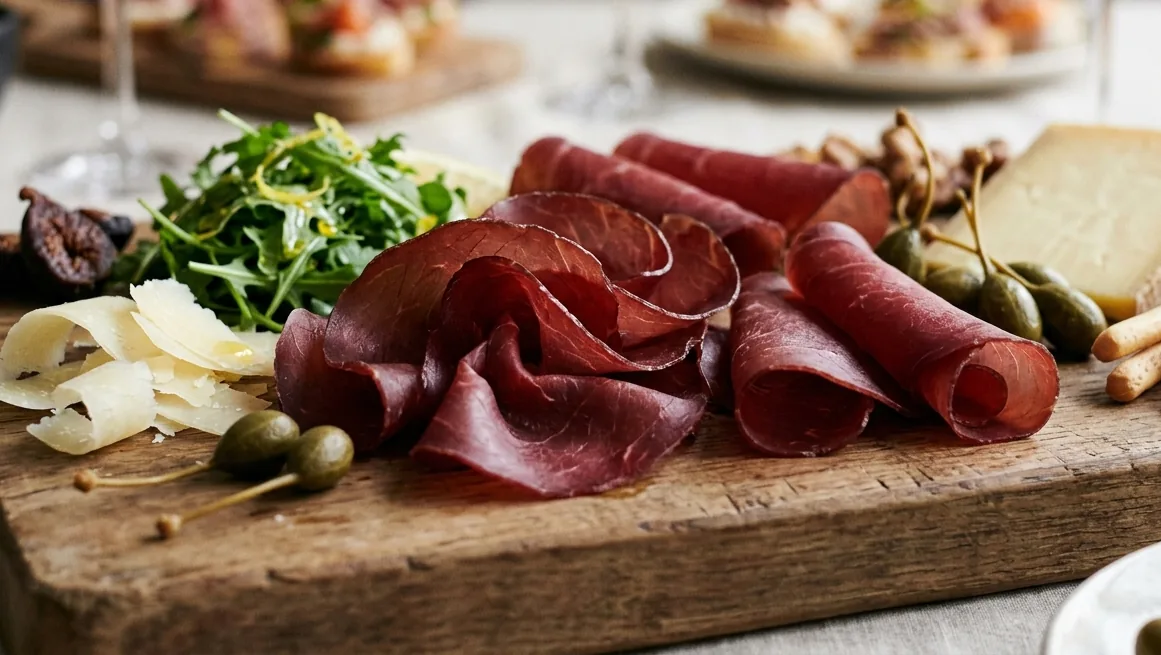
- Draped and folded — thin slices draped loosely over the board surface, folded in the middle for volume. The softest presentation.
- Rolled into loose cylinders — slices rolled loosely and stood upright in small groups. Elegant, height-adding.
- Layered flat — slices slightly overlapped in a fan. Simple and clean.
Bresaola's deep burgundy color is one of the most visually striking elements on a board. Position it where the color is visible — adjacent to pale cheeses or cream-colored crackers for maximum contrast.
Temperature: Pull from refrigeration 15–20 minutes before serving. Unlike fat-rich meats, bresaola doesn't require as long a rest to develop flavor at room temperature — the lean protein's flavor is less temperature-sensitive than fat-derived aromatics.
Pairing Bresaola
Bresaola's near-absence of fat changes the pairing logic significantly compared to pork charcuterie. Without fat to buffer tannin, it doesn't buffer tannic red wines the way prosciutto or coppa does. And without fat's richness, it pairs best with elements that provide acid contrast or complementary lean flavors rather than rich, creamy counterpoints.
The classic Italian preparation: Bresaola served with arugula, shaved Parmigiano-Reggiano, lemon juice, and olive oil is the traditional Northern Italian starter that represents the definitive bresaola flavor combination. Arugula's peppery bitterness, Parmigiano's umami salt, lemon's acid brightness, and olive oil's richness all work against bresaola's clean lean protein in precisely calibrated ways. Recreating this combination on a board — with a small dressed arugula salad alongside bresaola — is worth doing.
Cheese pairings:
- Aged Gouda or Gruyère — the caramel-nutty character of these cheeses provides richness and contrast to bresaola's lean savory profile without competing
- Parmigiano-Reggiano — echoes the traditional preparation; the umami synergy between beef and aged Parmigiano is powerful
- Fresh chèvre — the tangy, bright lactic acid profile in fresh goat cheese provides acid contrast to the mild mineral notes in bresaola
Fresh element pairings:
- Lemon or lemon zest — acid brightens the iron mineral notes in bresaola; a few drops change the flavor dramatically
- Arugula — the peppery bitterness provides contrast
- Caperberries — the vinegary brine provides acid contrast while the texture echoes the meat's firmness
- Fig or dried fig — the sweetness provides contrast; matches well with the spice notes in the curing blend
Bread and cracker pairings:
- Plain water crackers — the clean neutral vehicle lets bresaola's flavor show
- Thin breadsticks (grissini) — the traditional Northern Italian accompaniment
- Lightly toasted baguette — adds slight Maillard toastiness that complements the beef's clean savoriness
Drink pairings:
- Barbera d'Asti — the medium-bodied, high-acid, low-tannin red from Piedmont is the traditional regional pairing; acidity complements beef's mineral notes, low tannin doesn't fight the lean protein
- Valtellina Superiore (Nebbiolo-based) — the wine from the same valley as bresaola; mineral and lean with fresh acidity
- Pinot Grigio — a crisp white alternative; the clean acidity works against bresaola's lean, clean flavor
- Prosecco — the acid sparkle and slight fruitiness is a lighter, fresher option
Bresaola at a Glance
| Property | Description |
|---|---|
| Meat | Lean beef (top round, eye of round) |
| Origin | Valtellina, Lombardy, Italy (IGP protected) |
| Texture | Firm, yielding; nearly fat-free |
| Flavor | Clean, mildly savory; subtle spice (juniper, pepper); slight mineral note |
| Color | Deep burgundy-purple (metmyoglobin) |
| Board role | Lean contrast to rich cheeses and fatty pork; elegant visual element |
| Classic pairing | Arugula + Parmigiano + lemon + olive oil |
| Drink pairing | Barbera d'Asti, Valtellina Superiore, Pinot Grigio |
Putting It on the Board
Bresaola is the most elegant thing you can put next to a rich hard cheese. Its clean, lean profile provides contrast to the fat and complexity of aged Gouda, Gruyère, or Parmigiano in a way that another pork product doesn't — it resets the palate rather than adding more richness.
If you have space for a small dressed element (arugula with lemon and olive oil), placing it adjacent to bresaola on the board recreates the Northern Italian antipasto tradition and elevates the entire board.
Get weekly ingredient science in the Charcuterie Lab Report newsletter.