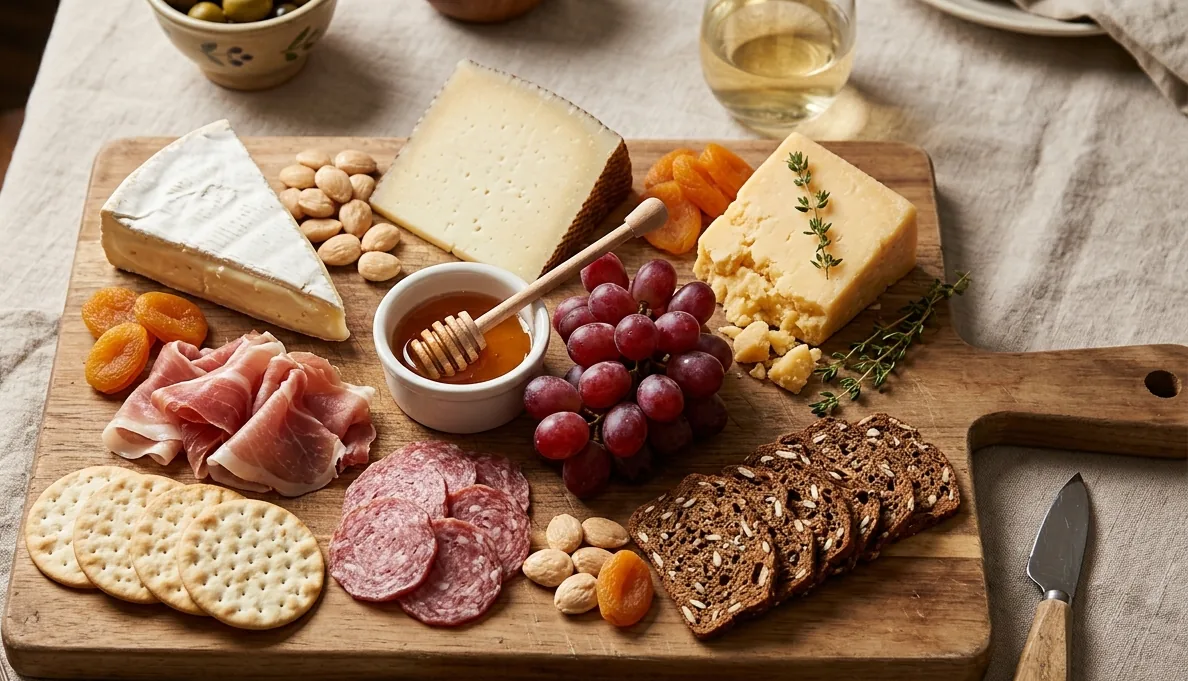
Quick Answer: Start with 3 cheeses (one soft, one semi-firm, one aged) and 2 meats (one whole-muscle like prosciutto, one salami), plus two kinds of crackers, a fruit and a sweet condiment like honey or fig jam. Take the cheese out of the fridge before serving and keep it simple: five well-chosen things beat fifteen.
The most common thing first-time charcuterie board builders get wrong is trying to do too much. A well-built board with five elements is better than a crowded board with fifteen. The goal isn't volume — it's contrast, balance, and intentional pairing.
This guide covers the minimum viable charcuterie board, the most common beginner mistakes, and a shopping list that works reliably.
The Beginner Minimum: 3 Cheeses + 2 Meats
Every successful charcuterie board rests on the same structural foundation: a spread of cheeses that cover different textures, and a spread of meats that cover different preparation styles. Everything else — fruit, crackers, condiments, garnishes — is supporting.
The 3-cheese minimum:
The goal is texture variety, not just flavor variety. Three cheeses that cover different textures produce a more interesting board than three cheeses that are all firm or all soft.
- One soft or creamy (Brie, Camembert, chèvre, fresh ricotta, burrata) — the spreader; approachable for everyone; provides visual contrast
- One semi-firm (Gruyère, Manchego, Fontina, Gouda, Havarti) — the workhorse; pairs with everything; slices cleanly
- One aged or bold (aged cheddar, Parmigiano-Reggiano, aged Manchego, Stilton or Gorgonzola if desired) — the flavor anchor; provides complexity
This three-tier structure — soft / semi-firm / aged — is what professional board builders use as the starting framework, whether the board has 3 cheeses or 8. Start here and expand later.
The 2-meat minimum:
Two meats that cover different preparation styles produce more variety than two meats from the same category.
- One whole-muscle (prosciutto, bresaola, coppa) — delicate, thin-sliced, mild-to-savory
- One ground-and-cured (salami, soppressata, pepperoni, nduja) — sliced rounds, bolder flavor, holds its shape on the board
This two-type split provides texture contrast (silky vs. chewy), visual variety (draped folds vs. rounds), and flavor range (mild vs. spiced) with just two products.
The Supporting Elements: What You Actually Need
Beyond the 3 cheeses and 2 meats, a functional beginner board needs:
Crackers (2 types):
- Plain water crackers — the universal neutral vehicle for everything on the board
- One flavor-compatible cracker (dark rye for aged cheeses, honey oat for fresh cheeses) — optional but adds interest
One fresh fruit:
- Grapes are the most reliable choice — they provide acid, sweetness, and visual fill without any prep
- Alternatives: apple slices, strawberries, fig halves, melon
One condiment:
- A small bowl of honey (acacia or wildflower) covers the most pairings and is always appropriate
- Alternatives: fig jam, whole grain mustard (pairs with charcuterie meats)
That's it. A board built from these seven elements — 3 cheeses, 2 meats, 2 cracker types, 1 fruit, 1 condiment — is a complete, functional charcuterie board. Everything beyond this is decoration and enhancement, not requirement.
Quantities for Beginners
One of the most common beginner mistakes is buying too little of everything, resulting in a board that looks sparse, or too much, resulting in significant waste.
As a starter vs. light meal:
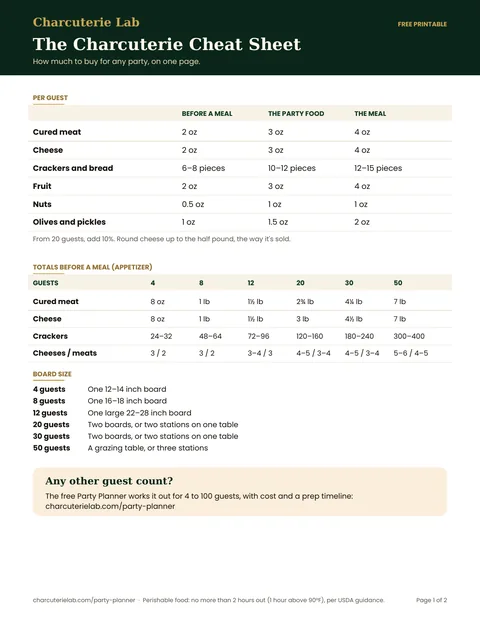
- Cheese: 2 oz per person in total, split across your cheeses (3 oz if the board is the party food)
- Meat: 2 oz per person in total, split across your meats (3 oz as the party food)
- Crackers: 6–8 crackers per person
- Fruit: 3–4 grapes or 2 apple slices per person
Example for 6 people:
- 3 cheeses × 4–5 oz each = about 1 lb total cheese
- 2 meats × 6 oz each = 12 oz total meat
- 1 bunch of grapes
- 1 sleeve plain crackers + 1 sleeve specialty crackers
- 1 small jar of honey
This is more manageable than the quantities that seem overwhelming in a full ingredient list.
Common Beginner Mistakes (And What to Do Instead)
Mistake 1: Serving cheese straight from the refrigerator
Cold cheese is a different product than room-temperature cheese. Brie from the refrigerator is chalky, firm, and flavorless. Room-temperature Brie is soft, runny at the center, and aromatic. Aged cheddar at refrigerator temperature has muted flavor and a waxy texture; at room temperature, the fat softens and the sharpness emerges fully.
Fix: Pull all cheese from refrigeration 30–45 minutes before serving. This is the single highest-impact change a beginner can make.
Mistake 2: Putting everything in clusters by type
"All the cheese together, all the meat together, all the fruit together" is how a beginner boards looks. A professional board distributes elements so that a pairing partner is always accessible without reaching.
Fix: Place cheeses at different positions on the board (not clustered). Put fruit and condiments adjacent to the cheeses they pair with. Scatter crackers throughout or in multiple piles.
Mistake 3: Adding crackers too early
Crackers absorb moisture from other board elements and from refrigerator humidity. Crackers added hours before serving are soft by the time guests arrive.
Fix: Add crackers within 30–60 minutes of serving, always last.
Mistake 4: Buying a board that's too small
The most common equipment mistake. A board that's too small forces elements to stack or crowd, makes assembly frustrating, and prevents the visual breathing room that makes a board look intentional.
Fix: For 4–6 people, use a board that's at minimum 12" × 16". A large cutting board, serving tray, or wooden slab all work. The board surface doesn't need to be specialty — it needs to be large enough.
Mistake 5: Over-garnishing with inedible herbs
Fresh rosemary, lavender, and decorative herbs placed throughout a board look nice in photos but confuse guests about what's edible and can transfer strong flavors to adjacent cheese.
Fix: Keep garnishes edible or skip them. Fresh thyme sprigs near aged cheese are functional (edible, mild flavor complement). Whole rosemary branches used as dividers are decorative but fine. Large lavender sprigs are photogenic but don't improve the eating experience.
Mistake 6: Choosing all mild cheeses to "play it safe"
A board where every cheese is mild — mild white cheddar, mild Gouda, mild Havarti — has no contrast. There's nothing for the soft element to contrast against, and nothing bold enough to be interesting.
Fix: Include at least one cheese with character. This doesn't mean extremely strong — Manchego is firm, slightly tangy, and approachable. Aged cheddar is familiar and bold. Brie is polarizing for beginners but beloved by experienced guests. One cheese with personality elevates the whole board.
The Beginner Shopping List
For a board serving 6 as an appetizer:
Cheeses:
- 4–5 oz Brie or Camembert (soft)
- 4–5 oz Manchego or Gruyère (semi-firm)
- 4–5 oz aged cheddar or Parmigiano-Reggiano (aged/bold)
Meats:
- 6 oz prosciutto (whole-muscle)
- 6 oz salami (sliced rounds)
Crackers:
- 1 sleeve Carr's Table Water Crackers
- 1 sleeve dark rye crispbread or specialty cracker
Fruit & Condiments:
- 1 bunch red or green grapes
- 1 small jar acacia or wildflower honey
Optional additions once you have the basics:
- Cornichons (brine acid for palate reset)
- Walnuts or marcona almonds
- Dried apricots or fig jam
- Fresh herbs (thyme)
Total cost for 6 people: roughly $40–60 at a standard grocery store, depending on cheese selection. Higher-end or specialty cheeses increase this; quality domestic alternatives keep it accessible.
Building the Board: The Beginner Assembly Order
- Place small bowls first — honey, condiments, any dips. These are the anchors everything else organizes around.
- Add cheeses — one at each end, one in the middle, or distributed at different positions. Don't cluster.
- Add meats — fold prosciutto loosely near one of the cheeses; arrange salami rounds near another.
- Add fruit — clusters of grapes fill visual gaps and are accessible from anywhere.
- Fill gaps with nuts and dried fruit — these fill the remaining spaces and add texture variety.
- Add crackers last — within 30–60 minutes of serving.
This order ensures the anchor elements are placed first and the fill elements support them. It produces a finished board without the stressful mid-assembly rearrangement that happens when everything goes on simultaneously.
Quick Reference: Beginner Board Summary
| Element | What to Buy | Quantity (6 people) |
|---|---|---|
| Soft cheese | Brie, Camembert, or chèvre | 6–8 oz |
| Semi-firm cheese | Manchego, Gruyère, or Gouda | 6–8 oz |
| Aged/bold cheese | Aged cheddar or Parmigiano | 6–8 oz |
| Whole-muscle meat | Prosciutto or bresaola | 3–4 oz |
| Sliced cured meat | Salami or soppressata | 3–4 oz |
| Crackers | Water crackers + one specialty | 1 sleeve each |
| Fruit | Grapes | 1 bunch |
| Condiment | Honey | 1 small jar |
Get weekly board-building tips in the Charcuterie Lab Report newsletter.