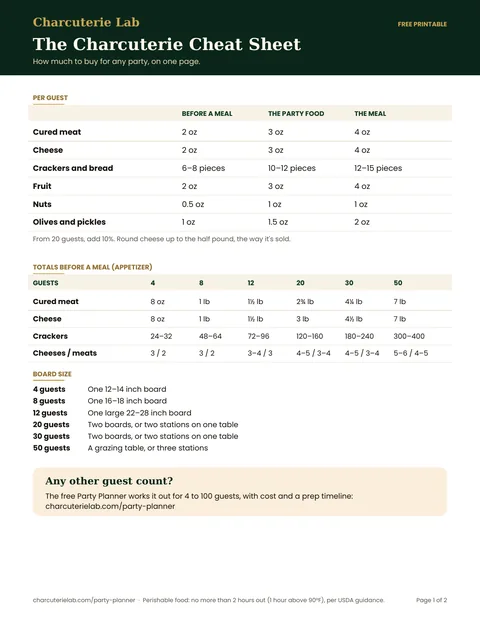
Quick Answer: A great board for 4–6 people costs about $35–50 when you spend strategically. Buy one excellent anchor (real Parmigiano-Reggiano, aged Comté or DOP prosciutto) and make everything else good but ordinary. Remember that deli prices are per pound, and a small board needs ounces, not pounds.
The myth: A great charcuterie board requires spending $80–100+ on ingredients.
The reality: A board that looks and tastes excellent for 4–6 people costs $35–50 when you spend strategically — and the strategic choices are learnable.
The expensive-board belief persists because most people price boards incorrectly. They calculate by scanning every element (specialty cheese at $15/lb, prosciutto at $22/lb, plus jam, crackers, fruit, olives...) and arrive at a number that feels prohibitive. What they miss is that those prices are per pound — and a board for 4–6 people before a meal needs 8–12 oz each of cheese and charcuterie, not a pound of each.
The other thing they miss: visual impact and flavor impact are not the same as ingredient cost, and the techniques that produce the most visual impact are free.
Where the Cost Actually Goes
On a well-built $45 board for 4–6 people, the budget breaks down roughly:
- 1 premium anchor cheese (Brie, aged Comté, or a quality blue): $6–10 for the amount needed
- 1 secondary cheese (a firm Cheddar or Manchego from a quality but not specialty source): $3–5
- 2 meats (1/4 lb prosciutto + 1/4 lb salami): $8–12 total
- Crackers (two types): $5–7
- Condiments (honey, fig jam, whole-grain mustard): $4–6 combined, and these are pantry items you'll use repeatedly
- Fruit (grapes, apple, pear): $3–5
- Garnish: $0–2 (rosemary from a garden or grocery herb bunch, lemon wheel)
The board costs $35–45. It looks and tastes like more because the visual assembly — not the ingredient cost — is doing most of the work.
The Four High-ROI Moves
1. One excellent anchor, everything else good-not-premium. Buy one thing that's genuinely excellent — a small wedge of real Parmigiano-Reggiano or 18-month Comté, or actual DOP prosciutto — and let that be the standout. The excellence of one element elevates the perceived quality of the whole board. This is the contrast principle applied to quality rather than flavor.
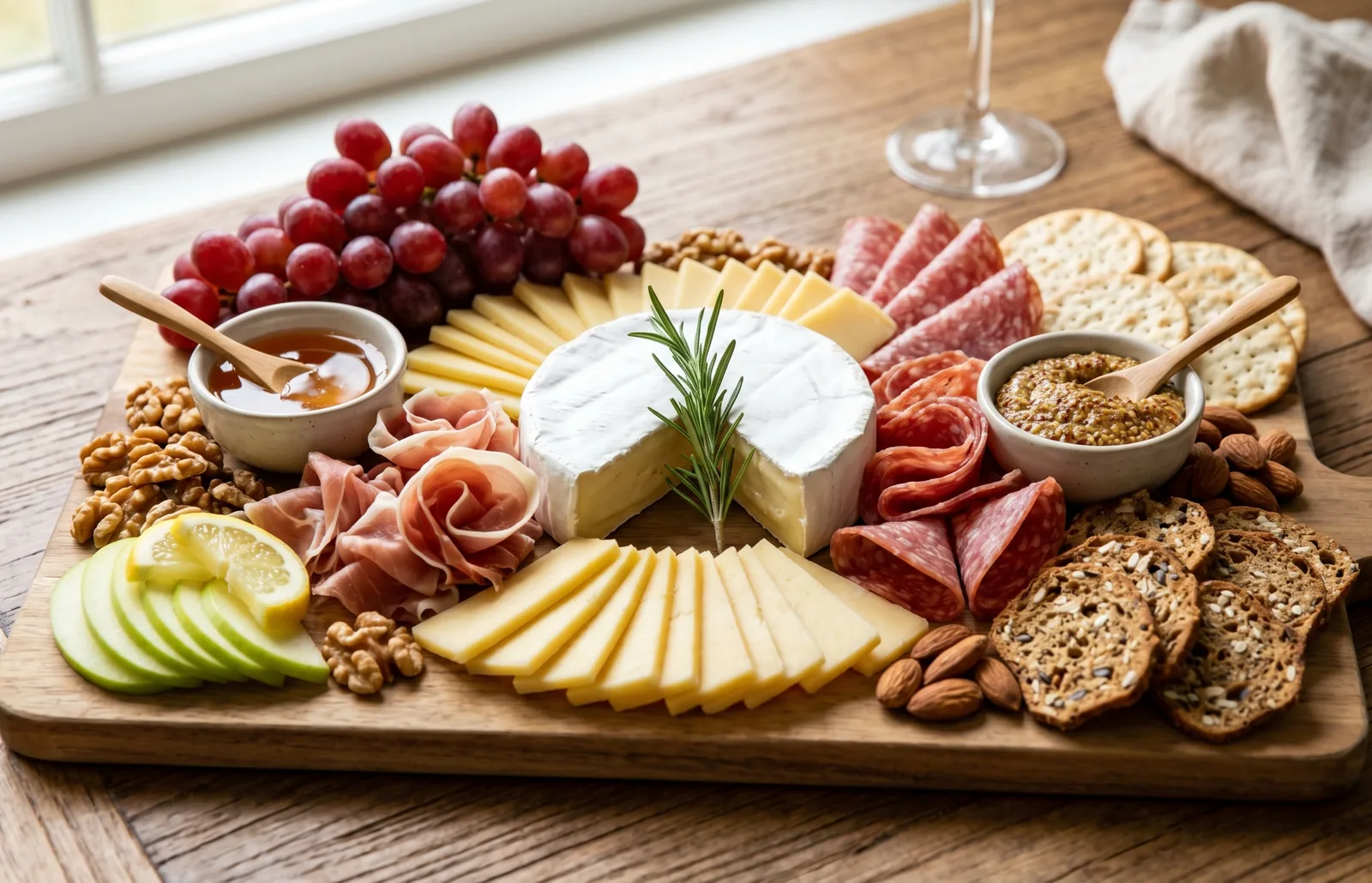
2. Use technique to create visual impact. Prosciutto rosettes look expensive. They're the same prosciutto. The fold takes 60 seconds. Fan-sliced cheese arranged in overlapping arcs looks like a professional setup. A Brie wheel with two sprigs of rosemary standing upright looks like you knew what you were doing. None of these cost anything beyond the basic ingredient.
3. Use free garnishes. Fresh rosemary (from a grocery herb bunch, $1.50) provides the most visual impact per dollar of any board element. Lemon slices or wheels, green herb sprigs, edible flowers if in season — all cost almost nothing. A board with rosemary standing upright in a cheese wheel and a scatter of pomegranate arils looks dramatically more intentional than the same board without them.
4. Make condiments do double work. A jar of good fig jam ($6–8) serves multiple boards. So does a jar of whole-grain mustard. Condiments are not single-use board expenses — they're pantry items that appear on four or five boards before they need replacing. Amortized per board, the cost is low.
Where Not to Save
DOP whole-muscle meats. The quality differential between actual prosciutto di Parma and generic pre-sliced "prosciutto" is the most noticeable quality gap on a board. The per-serving price difference is $1–2 for a group of 6. This is the wrong place to economize.
The centerpiece cheese. A wedge of something genuinely excellent — even a small amount — makes the board taste better and gives guests something to talk about. A wedge of good Comté costs $3–4 for the quantity a board needs.
Crackers. Not for quality reasons — cheap crackers are fine — but for variety. Two types of crackers (a neutral water cracker and a seeded crispbread, or a water cracker and a rye) add visual and textural variety for $5–7. One type of cracker makes the board look flat.
The $35 Board That Looks Like $80
The board: a small wedge of aged Comté (or a half-round of Brie), a block of good Cheddar cut into fans, 1/4 lb DOP prosciutto folded into rosettes, 1/4 lb Genoa salami in quarter-moon folds, a small bowl of honey, a small bowl of whole-grain mustard, a cluster of red grapes, sliced green apple with lemon juice, water crackers, a sprig of rosemary standing upright in the Comté.
Total cost for 4–6 people: $35–42. Total build time: 20 minutes. Visual result: looks assembled by someone who knows what they're doing.
The myth is that the ingredients are the investment. The real investment is five minutes learning the techniques.
More board-building guides: charcuterielab.com Subscribe to the Charcuterie Lab Report: charcuterie-lab-report.beehiiv.com
FAQ
Do you need to spend a lot of money to make a great charcuterie board?
No. A $30–40 board for 4–6 people using grocery store ingredients can be genuinely excellent. The key is spending intentionally: invest in 2–3 high-quality cheeses and 1 premium meat, then fill the rest of the board with budget accompaniments (seasonal fruit, nuts, store-brand crackers). Quality in the anchor elements matters far more than total spend.
What is the most important thing to spend money on for a charcuterie board?
Cheese quality has the highest impact-to-dollar ratio on a board. The difference between a $4 supermarket cheddar and a $10 aged farmhouse cheddar is dramatic and immediately noticeable. Prioritize spending on cheese, then choose one premium cured meat (prosciutto or a good dry salami), and keep accompaniments modest.
What are the best budget-friendly charcuterie ingredients?
Fruit (grapes, apple slices, seasonal stone fruit) adds color and freshness at low cost. Olives, pickles, and mustard are inexpensive but high-impact. Nuts (walnuts, almonds, pistachios) add texture and fill space affordably. Store-brand crackers are functionally equivalent to premium crackers. Honey, even a quality local honey, is a small-volume purchase that elevates the entire board.
Can you build a charcuterie board for $20?
For 2–3 people, yes. A $6–8 wedge of aged cheddar, a $4 package of salami, a sleeve of crackers, a cluster of grapes, and a handful of nuts from the pantry gets you to a complete board for around $20. Scale is the main constraint — the board will be small, but quality within that constraint is entirely achievable.
Is a more expensive charcuterie board always better?
No. More expensive boards can be worse if the money is spent on visual novelty rather than ingredient quality. Exotic cheeses that no one will eat because they're too pungent, expensive imports placed next to $1 grocery store crackers, or oversized boards that look sparse — these are spending patterns that don't improve the eating experience. Intention matters more than budget.