Quick Answer: The French deli cluster is four mechanisms in one composed bite. Gruyère's Alpine fat and propionic nuttiness anchors the flavor profile. Ham's cured salt pre-wets the palate and contributes glutamate umami that resonates with the cheese. Cornichon acetic acid resets the fat between bites. Dijon's allyl isothiocyanate bridges the clearing acid and the cheese's warm nuttiness with volatile pungency. Nothing is decoration.
The Direct Answer
The croque monsieur combination — Gruyère and ham — is the French board's foundation, and cornichon and Dijon are its functional partners rather than optional additions. Each of the four performs a specific chemical job that the other three cannot replicate.
Gruyère's Alpine fat and aromatic complexity (propionic, pyrazine, diacetyl from cooked-curd production) is the pairing's primary target. Ham's salt pre-wets the palate and contributes umami that resonates with Gruyère's glutamate from proteolysis. Cornichon acetic acid clears the fat that builds from Gruyère and ham's combined richness. Dijon's allyl isothiocyanate provides the volatile pungent note that bridges cornichon's acidity and Gruyère's warm, nutty warmth — a sensory connector between the acid and the fat.
The quartet is the French deli board made mechanistically explicit.
Why Gruyère
Gruyère's flavor complexity comes from two distinct production processes: the Maillard pyrazines generated when the curd is heated to 57°C during production, and the propionate from Propionibacterium freudenreichii fermentation during maturation. These two processes produce nutty, hazelnut, and slightly sweet aromatic compounds that stack with the natural butter and cream notes from Alpine pasture milk fat.
The result is a cheese that's rich, complex, and warm in its aromatic register — an ideal anchor for a composed four-ingredient cluster. The four ingredients in this pairing all serve Gruyère's character rather than competing with it: ham echoes its savory-umami dimension, cornichon clears the fat to keep each bite fresh, and Dijon bridges the two with pungent aromatic complexity.
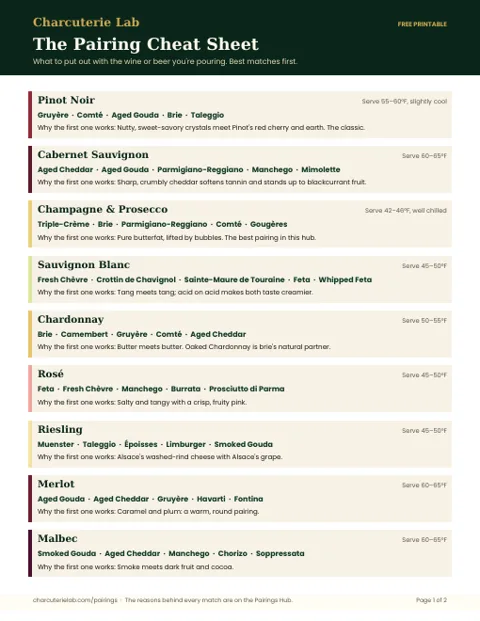
Aged Gruyère (10–12 months) over standard Gruyère (5–7 months) for this pairing. The older version has more developed pyrazines and propionate character, more of the Alpine depth that makes the cluster cohesive.
Why Ham
Ham performs two functions in this cluster: salivary pre-wet and umami resonance.
Salt in ham's cure triggers salivary gland response — the palate is pre-wetted with saliva before the Gruyère fat arrives, optimizing the mucosal surface for fat contact. This is the same salivary mechanism as in prosciutto-burrata pairing, but less dramatic against a cured cooked ham than against prosciutto's more intensely cured salt.
More distinctively, ham contributes glutamate — the free amino acid responsible for umami — produced during the curing and cooking process. Gruyère's extended aging also produces free glutamate through proteolysis. When ham's glutamate and Gruyère's glutamate arrive at the palate together, they activate the same umami receptors simultaneously. Umami compounds are additive at the receptor level — two sources of glutamate produce a combined umami perception greater than either source alone.
This is the same glutamate-additive mechanism that makes Parmesan and prosciutto such a potent umami cluster. Gruyère produces less free glutamate than Parmesan, but the principle holds at a more subtle level.
Jambon de Paris (cooked French ham) is the precise pairing — its mild flavor, slight sweetness, and low smoke let Gruyère's aromatic complexity dominate without competition. Smoked or heavily spiced hams add competing phenolics or spice notes that fight Gruyère's delicate character.
Why Cornichon
Cornichon provides acetic acid palate reset through the same mechanism as the salami-cornichon pairing: direct chemical fat clearing and triggered salivation through sour taste response. Against the combined fat from Gruyère's Alpine paste and ham's cured fat, the reset function is more consequential than in a single-fat-source pairing.
The combined Gruyère-ham fat load is significant enough that without a reset mechanism, bites three and four taste noticeably less distinct than bites one and two. Cornichon prevents this accumulation, keeping each bite of the quartet fresh.
French cornichons (white wine vinegar brine, Maille standard brand). The white wine vinegar brine provides a cleaner, more refined acid note than the sweeter gherkin brine — in a pairing with four distinct aromatic contributors, the cornichon's acid character matters. A sweeter pickle muddies the acid clarity.
Why Dijon
Dijon mustard's active compound is allyl isothiocyanate — produced when sinigrin (a glucosinolate in mustard seeds) is broken down by myrosinase enzymes when the mustard is chewed or diluted. Allyl isothiocyanate is volatile, pungent, and slightly warming — the "heat" of mustard is a mix of allyl isothiocyanate's enzyme-linked chemical activity and the olfactory response to its volatility.
In this quartet, Dijon performs a bridging function. After cornichon's acetic acid has cleared the fat layer, the palate is clean and cool. Gruyère's warm, nutty character arrives into that clean state. Dijon's volatile pungency bridges the transition — providing an aromatic note that links the acid sharpness of cornichon and the warm nuttiness of Gruyère. It's the connector between the cold acid moment and the warm fat moment.
Allyl isothiocyanate is also a fat-phase compound at sufficient concentration — it can dissolve into Gruyère's fat during a composed bite, integrating the pungency into the cheese's aromatic expression rather than sitting as a separate layer.
Whole-grain mustard adds textural interest (seed crunch registers as a distinct sensory event) and releases isothiocyanates more slowly for a milder, more sustained pungency. Dijon is sharper and more precise. Both work; the choice depends on the intensity level desired for the board.
How to Serve
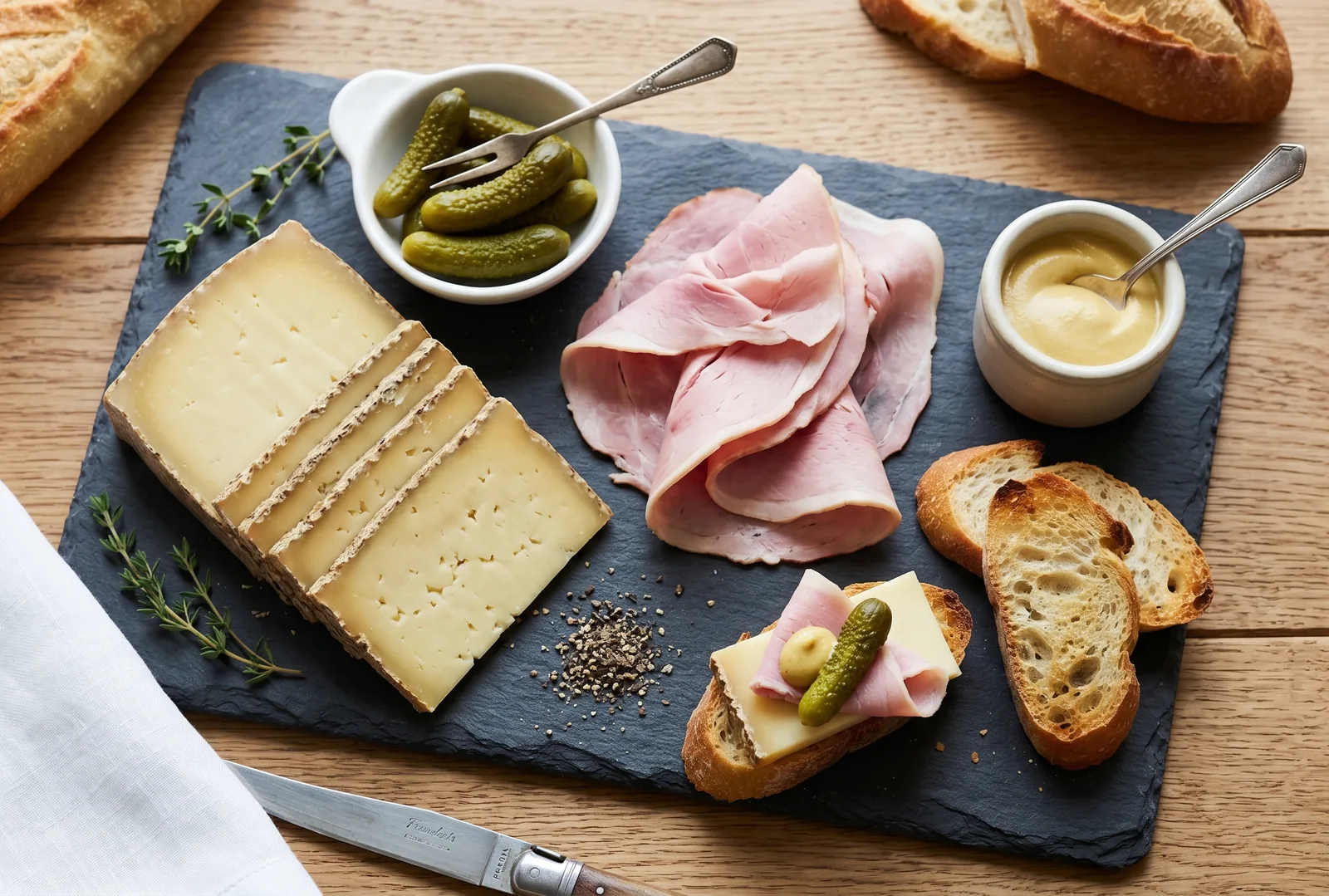
Gruyère: Sliced 3–4mm. Room temperature 30–45 minutes. 1–1.5oz per person.
Ham: Thin slices of jambon de Paris, folded or draped near the Gruyère. 1 slice per person.
Cornichons: Small bowl, French cornichons, brine drained. 4–5 per person.
Dijon: Small condiment bowl with a small spoon or spreader. Guests apply to crackers or bread and assemble the bite themselves.
Baguette or pain de campagne: This cluster is designed for bread, not thin crackers — the composed bite is thicker and more substantial than crackers support well.
Assembly intent: The pairing works best as a composed bite — Gruyère on baguette, ham alongside, Dijon applied, cornichon eaten with the bite. Communicate this by arranging the four elements as a cluster rather than scattering them.
Extending the Pairing
Aged Comté as a Gruyère alternative: Same Alpine cooked-curd family, slightly more floral and complex aromatic profile. The pairing logic is identical.
Radishes: The glucosinolate pungency from fresh radish is milder than Dijon's isothiocyanate but provides a fresh, crunchy contrast that extends the bitter-pungent dimension of the cluster.
Wine: Dry white Burgundy (Chardonnay) or Alsatian Pinot Gris — both have fat-compatible aromatic profiles that resonate with Gruyère's propionic and pyrazine compounds without fighting the cornichon's acidity. The pairing extends naturally into French wine accompaniment.
The Charcuterie Lab Takeaway
Gruyère, ham, cornichon, and Dijon is the French board's mechanistic anchor: Alpine fat and nutty complexity (Gruyère), umami resonance and salivary pre-wet (ham), acetic acid palate reset (cornichon), and volatile isothiocyanate bridging (Dijon). Four mechanisms, four ingredients, nothing interchangeable.
Jambon de Paris for the ham. French cornichons (Maille). Dijon or whole-grain mustard. Aged Gruyère (10–12 months). Room temperature cheese.
Building more boards? The Charcuterie Lab ebook walks through 50 boards across every occasion — each one with exact quantities, a shopping list, and the science behind why it works.
FAQ
Why do Gruyère, ham, cornichon, and Dijon work together?
Each covers a distinct function. Gruyère provides the Alpine fat and nutty aromatic complexity that anchors the cluster. Ham's cured salt triggers salivary pre-wet for fat contact and contributes umami that resonates with Gruyère's glutamate from proteolysis. Cornichon acetic acid resets fat accumulation between bites. Dijon's allyl isothiocyanate provides volatile pungency that bridges the acid reset and the cheese's nuttiness.
What does Dijon mustard do in this pairing?
Dijon mustard's allyl isothiocyanate is produced when sinigrin (a glucosinolate) is broken down by myrosinase enzymes when the mustard is chewed or mixed with liquid. The resulting compound is volatile and pungent — similar in class to arugula's isothiocyanates but more concentrated. This volatile note bridges the acid reset from cornichon and Gruyère's warm nuttiness, acting as a sensory connector between the two.
What kind of ham is best for this pairing?
Jambon de Paris (cooked French ham) is the traditional pairing — mild, slightly sweet, low-smoke, with enough fat and salt for the salivary pre-wet function without competing with Gruyère's delicate aromatics. Smoked ham adds smoke phenolics that can compete with Gruyère's propionic character. Prosciutto can substitute for a more Italian direction. Avoid very assertively spiced or smoked hams.
Can you use whole-grain mustard instead of Dijon?
Whole-grain mustard contains intact mustard seeds that release allyl isothiocyanate more slowly than Dijon — the pungency is milder and more controlled. It works well in this pairing and adds textural interest from the seeds. Dijon is more precise in its isothiocyanate delivery; whole-grain is more visually appealing and slightly gentler. Both are correct choices.
How do you build this as a board cluster?
Position Gruyère slices (3–4mm) as the anchor, ham folded or draped nearby, cornichons in a small dish, and Dijon mustard in a separate small bowl with a small spoon or spreader. The intent is for guests to assemble each bite with all four components on a cracker or piece of baguette — it's a composed bite pairing, not scattered individual elements.