Quick Answer: Dark chocolate at 70%+ cacao belongs on a charcuterie board as a finishing element — 2–4 small pieces per person, broken into rough chunks, positioned near the blue cheese and dried fruit zones. It pairs on the bitter-fat axis with aged and blue cheeses. Milk and white chocolate don't belong on a traditional board.
Why Dark Chocolate Works
Chocolate's place on a charcuterie board is not decorative — it's a specific flavor pairing with a biochemical basis. High-cacao dark chocolate contains two relevant compound classes: cocoa tannins (primarily procyanidins and catechins) that bind to fat and protein in the mouth, and Maillard-derived bitter compounds (including theobromine) that create the characteristic dark chocolate bitterness.
These compounds interact with aged and blue cheese in predictable ways:
Tannin-fat binding: Dark chocolate's procyanidins bind to the fatty acids in aged cheese, creating a textural smoothing effect — the rough, grainy finish of aged cheddar or the crystalline bite of Parmigiano is softened by the tannin-fat interaction.
Cross-adaptation on the bitter axis: Blue cheese and dark chocolate both produce bitter compounds during their production (methylketones from Penicillium and theobromine/caffeine from cacao). When tasted in rapid succession, exposure to one bitter compound reduces receptor sensitivity to the other. The result is that blue cheese eaten with dark chocolate seems smoother, and the chocolate seems less bitter — a mutual modulation effect.
This is a real pairing logic, not just "chocolate tastes good." The mechanism is specific to dark chocolate and specific cheese types. Milk chocolate — with its high sugar and milk fat — does not produce the same interactions and competes with board condiments instead.
Which Chocolate to Choose
Dark chocolate (70–85% cacao): The board standard. Enough bitterness for the pairing logic without becoming unpleasant. Pairs with blue cheese, aged cheddar, aged gouda.
Dark chocolate (85–99% cacao): More intense, pairs specifically with very aged hard cheeses (Parmigiano, aged Manchego) and works for guests who want a more assertive pairing. Can be too bitter as a general board element.
Salt-and-dark chocolate: The salt amplifies the bitter-fat pairing and echoes the board's cured meat salt register. A solid upgrade from plain dark.
Chili-dark chocolate: Capsaicin is lipophilic — it binds with cheese fat and creates the same heat-release-on-fat mechanism as spiced cured meats. Pairs specifically with aged cheddar. Not a universal board element.
Milk chocolate: Too sweet, too mild, competes with condiments, no tannin-pairing logic. Skip.
White chocolate: No cacao solids, no pairing logic for a cheese and meat board. Skip.
How Much and How to Present It
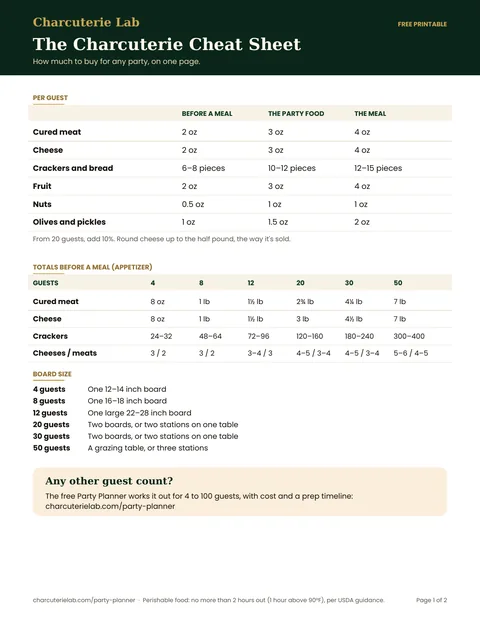
2–4 small squares per person (roughly 0.5oz) is the right quantity for a mixed board. This is a finishing accent element, not a featured component.
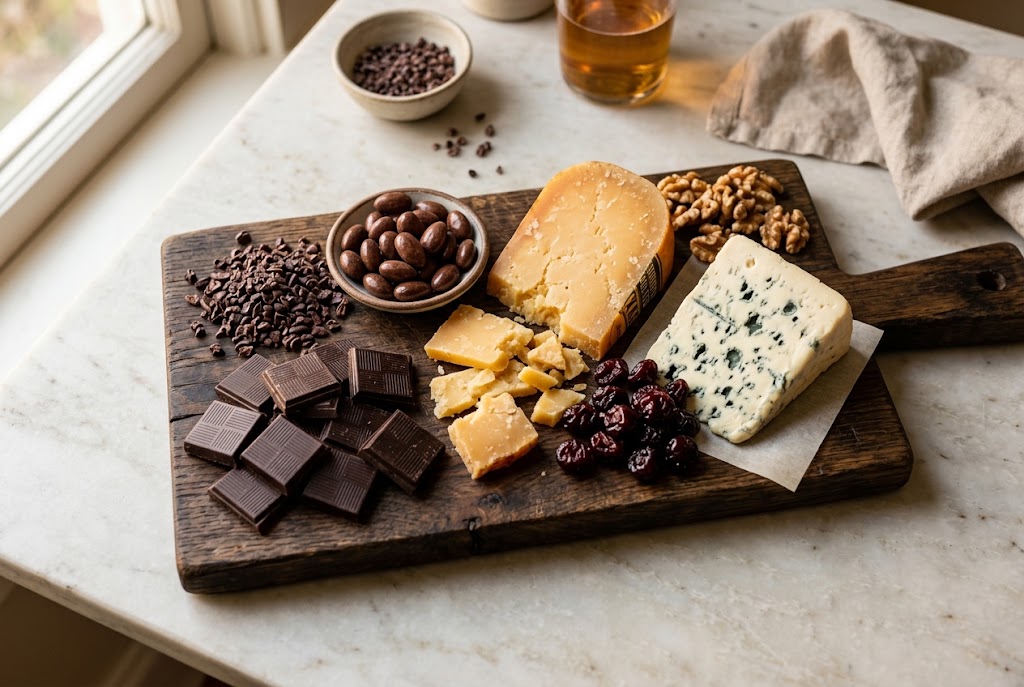
Break the chocolate into rough pieces rather than presenting whole squares or a intact bar. Rough-broken pieces look intentional and natural on a board; they also create size variety that gives guests a choice between small and large pieces.
For a board of 8 people: break one standard 3.5oz bar into roughly 20–25 pieces. That's the right visual cluster and the right per-person quantity.
Where to Position It on the Board
Chocolate has a specific position logic:
- Adjacent to blue cheese (the primary pairing)
- Near dried fruit — dried cranberries, apricots, and figs work with dark chocolate
- Away from soft, spreadable cheeses where contamination is likely
- Away from mustard and savory condiments
A small cluster of broken pieces in its own zone reads clearly as an intentional element rather than decoration. Avoid scattering individual pieces across the board.
Pairings That Work With Board Chocolate
- Blue cheese + dark chocolate + walnut: The three-way bitter axis pairing. Works consistently.
- Aged cheddar + dark chocolate + dried cranberry: The tannin-fat axis with a tartaric acid counterpoint from the cranberry.
- Aged gouda + salt-and-dark chocolate: Butterscotch notes in the gouda against the amplified bitter-salt of the chocolate.
- Salami + dark chocolate: Uncommon but functional — the Maillard notes in the cured meat resonate with the roasted cacao character.
Building more boards? The Charcuterie Lab ebook covers 50 boards with exact quantities and the science behind every pairing element.
The Charcuterie Lab Takeaway
Dark chocolate at 70%+ belongs on a charcuterie board as a specific, science-backed pairing element — not decoration. Use 2–4 rough-broken pieces per person, position near the blue cheese and dried fruit zones, and choose 70–85% cacao as the standard. Salt-and-dark is a worthwhile upgrade. Milk and white chocolate have no pairing logic on a traditional board.
FAQ
What chocolate goes on a charcuterie board?
Dark chocolate at 70% cacao or higher is the standard. Its bitterness pairs on the fat axis with aged and blue cheeses; its tannins interact with cheese proteins. Milk chocolate is too sweet and competes with condiments. White chocolate has no cacao solids and no logical pairing partner on a traditional board. Use dark, broken into rough pieces rather than whole bars.
How much chocolate do you put on a charcuterie board?
2–4 small squares per person (about 0.5oz). Chocolate is a finishing element, not a main component — enough to provide the dark bitter contrast and a few pairing opportunities, not enough to become a candy board. Break a standard 3.5oz bar into rough pieces; that covers 6–8 people as a board element.
What cheese pairs best with dark chocolate on a charcuterie board?
Blue cheese is the classic pairing — both share Maillard-derived bitterness, and cross-adaptation reduces sensitivity to each other's bitter compounds. Aged cheddar and aged gouda also work well through the fat-tannin axis. Avoid mild fresh cheeses, which are overwhelmed by dark chocolate's intensity.
Where do you put chocolate on a charcuterie board?
Position chocolate in its own small zone, ideally adjacent to the blue cheese and near dried fruit. Keep it away from soft, spreadable cheeses where it might get contaminated. Rough-broken pieces pile naturally and look intentional. A small cluster of 6–8 pieces is the right visual quantity for most boards.
Can you put flavored chocolate on a charcuterie board?
Salt-and-dark-chocolate works well — the salt amplifies the bitter-fat pairing with cheese and echoes the board's cured meat salt. Chili-dark chocolate pairs specifically with aged cheddar through a capsaicin-fat interaction. Avoid fruit-flavored chocolates, mint, or caramel chocolate — these compete with board condiments and produce flavor clashes.