Quick Answer: Put one blue cheese on your board, about 3 to 5 oz for 6 to 10 guests, at an edge rather than the center. Choose Gorgonzola dolce for a cautious crowd, Stilton for a mixed one and Roquefort for cheese lovers. Set honey or honeycomb right beside it, with figs, pear and walnuts within reach. Sweetness tempers blue's salt and sharpness.
The short version
Which blue
Gorgonzola dolce for a cautious crowdStilton for a mixed one, Roquefort for cheese lovers.
How much
3 to 5 oz for 6 to 10 guestsOne blue, at the edge of the board, not the center.
Put beside it
Honey or honeycombThen figs, pear and walnuts within reach.
Blue cheese often goes in as a token gesture, lands in the middle and gets avoided by half the guests. The right blue, in the right amount, with the right partners makes some of the best bites on the board.
What Is Blue Cheese?
Blue cheese is any cheese ripened with blue mold, usually Penicillium roqueforti, growing through the paste. Cheesemakers pierce the young wheels with steel needles to let air in. The mold needs oxygen, so it grows along those channels and forms the blue-green veins.
Two things happen as a blue ages:
- Protein breaks down (proteolysis), which softens the texture and builds savory, umami flavor. Blues are rich in free glutamate: the Umami Information Center lists about 471 mg per 100 g for Roquefort and 760 mg for Cabrales.
- Fat breaks down (lipolysis), releasing free fatty acids that give blue its sharp, peppery bite. The mold then turns some of those into methyl ketones, the compounds largely responsible for blue cheese's signature aroma.
How far those changes go, plus the milk and the salt level, decides whether a blue tastes mild and creamy or bold and pungent.
Best Blue Cheeses for a Board
Gorgonzola dolce (Italy, cow's milk): Creamy, soft and mildly sweet, with the blue spread gently through a spoonable paste. It sits on a cracker like a soft cheese. Your best bet for guests who are wary of blue.
Stilton (England, cow's milk): Firm, crumbly and balanced. Complex but not aggressive, it crumbles neatly and pairs with almost everything. The most versatile blue for a mixed crowd.
Roquefort (France, raw sheep's milk): Aged in the caves of Roquefort-sur-Soulzon. Sharp, salty, tangy and intense. A little goes a long way; choose it when you want the blue to be noticed.
Cambozola (Germany, cow's milk): A soft, bloomy-rind cheese like brie, with mild blue veining. The gentlest blue you'll find, and a good choice for guests who really don't like strong blue cheese.
Cabrales (Spain, cow's or mixed milk): Cave-aged, very pungent and complex. For adventurous boards and guests who go looking for bold flavor.
Can't find these? Most supermarkets carry a domestic Danish-style blue or a Gorgonzola piccante, a firmer, sharper Gorgonzola. Both work. Buy a wedge rather than pre-crumbled blue, which is drier, often has anti-caking starch added, and has less flavor.
How to Use It on a Board
Blue cheese works best as a supporting player, not the anchor.
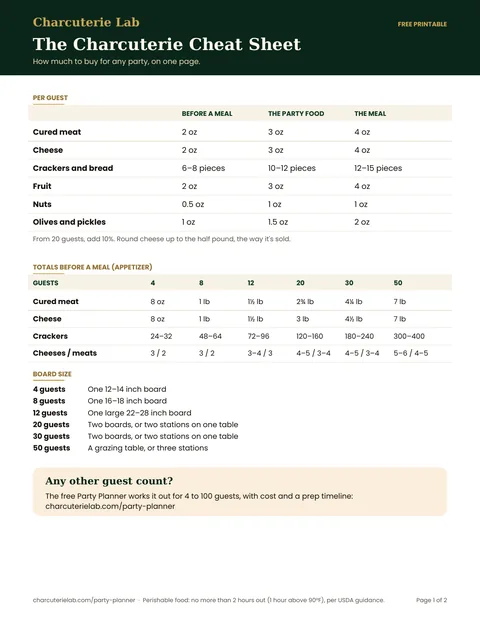
How much: About 3 to 5 oz for 6 to 10 guests, when blue is one of three or four cheeses. A full board runs about 2 oz of cheese per guest in total, so blue makes up a small share of that. See how much cheese for a charcuterie board for the full math.
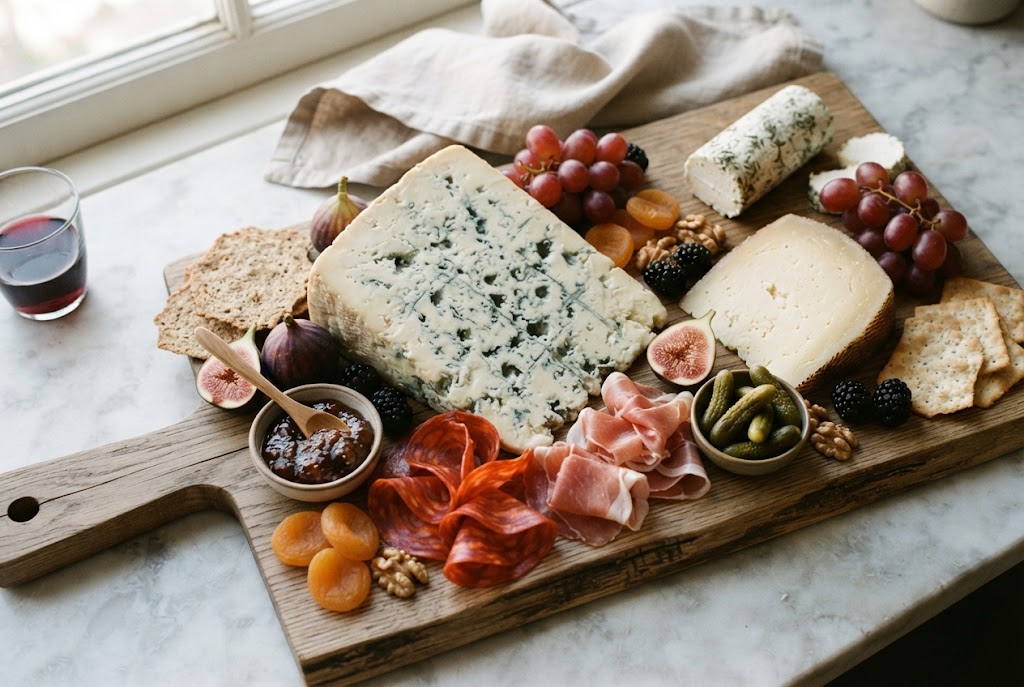
Where: Set it at a corner or edge, away from mild cheeses like fresh chèvre, triple-crème and brie. Its aroma and crumbs travel, and it's easier to avoid if it isn't in the middle.
How to cut it: Break a firm blue like Stilton into rough chunks with the tip of a knife rather than slicing it. The craggy surface looks more inviting. Leave a creamy blue like Gorgonzola dolce whole, with a small spreader beside it.
When: Take a creamy blue like Gorgonzola dolce out of the fridge 20 to 30 minutes before serving, and a firm one like Stilton 30 to 45 minutes before. Cold dulls taste and aroma; a blue at room temperature tastes creamier and more rounded. Stay within the USDA 2-hour rule once it's out.
What to Pair It With
Honey (first choice): Put a piece of honeycomb or a small dish of honey right beside the blue. Its sweetness tempers the cheese's salt and sharp edges. More on this in blue cheese and honey.
Figs, fresh or dried: Sweet, jammy figs do much of what honey does, and the seeds add a pleasant crunch. Fig jam works too; see Gorgonzola and fig jam.
Pear: Juicy, gently sweet and a little tart, pear cools blue's intensity and refreshes your palate. Slice it thin and place it next to the cheese. Our blue cheese, pear and walnut post covers the trio.
Walnuts: Rich and crunchy, with a slightly bitter, drying skin that contrasts with creamy cheese. Blue, walnut and honey together hit sweet, salty, bitter, creamy and crunchy in one bite.
Prosciutto: Salty, silky and savory. Blue and cured ham are both rich in umami, so together they taste deep and meaty. Wrap a sliver of prosciutto around a pear slice with a crumb of blue.
Port or sweet wine: A glass of tawny or ruby port is the classic partner for Stilton, and Sauternes is the classic for Roquefort. Both are sweet, which tempers the salt, the way honey does. See Stilton, port and walnut.
Which partner with which blue
| Blue | Strength | Best partners |
|---|---|---|
| Cambozola | Very mild | Pear, grapes, a light honey |
| Gorgonzola dolce | Mild, creamy | Honey drizzle, pear, walnuts |
| Stilton | Medium | Port, walnuts, dried figs, oatcakes |
| Roquefort | Strong, salty | Honeycomb, Sauternes, pear |
| Cabrales | Very strong | Fig jam, dark honey, dry cider |
For more combinations, browse our Gorgonzola pairings and Stilton pairings pages.
The Lab Section: Why These Pairings Work
Sweet against salty and sharp. Blue cheese is salty, and the free fatty acids from fat breakdown give it a sharp, slightly bitter edge. Sweetness tempers both saltiness and bitterness. That's a well-known taste interaction, and it's why honey, figs, pear and port all soften a blue and let its creamy, savory side come through. Read more in our salt and sweet principle post.
Contrast in texture. Crunchy walnuts, crisp pear and chewy figs give your mouth something to bite against a soft or crumbly cheese. Contrast keeps each bite interesting.
Acid and tannin against fat. Pear's gentle acidity and the slight dryness of walnut skins cut through blue's richness so it doesn't coat your palate. Port brings both sweetness and a little tannin, which is part of why it works so well with Stilton.
Umami on umami. Aged blues and cured meats are both rich in glutamate from protein breakdown. Pair them and the savory flavor feels fuller and longer. For more, see pairing by contrast and our guide to how pairing works.
Common Mistakes
Using too much. Blue cheese is intense. Around 4 oz is plenty for 8 people on a mixed board; a big wedge crowds everything else.
Putting it in the center. Guests who are wary of blue will steer around it, and the middle of your board ends up looking picked over. Put it at the edge.
Not labeling it. A small label with the name and milk type helps guests who are curious but cautious. See how to label cheese.
Serving it cold. Straight from the fridge, a blue tastes harsh and salty. Give a creamy blue 20 to 30 minutes out first, a firm one 30 to 45.
Building more boards? The Charcuterie Lab ebook covers 50 boards with exact quantities, shopping lists, and the science behind every pairing combination.
FAQ
What blue cheese is best for a charcuterie board?
Gorgonzola dolce is the easiest blue for a board: creamy, mild and spreadable, so it wins over guests who think they don't like blue cheese. Stilton is balanced and crumbles neatly, which makes it the most versatile. Roquefort is sharper, saltier and more complex. Cambozola, a soft German blue with a bloomy rind, is the mildest of all.
What pairs best with blue cheese on a charcuterie board?
Honey is the classic partner, because sweetness tempers blue cheese's salt and sharpness. Figs, fresh or dried, do the same with extra texture. Pear adds juicy sweetness and a little acidity, walnuts add crunch and a slightly bitter edge, and prosciutto adds salty, savory depth. Keep crackers plain so they don't compete.
How much blue cheese should you put on a charcuterie board?
About 3 to 5 oz for a board serving 6 to 10 people when blue is one of three or four cheeses. That works out to roughly half an ounce per guest, out of the 2 oz of cheese per guest a full board needs. Blue is intense, so a little goes a long way. Place it away from mild cheeses like fresh chèvre or triple-crème.
Why does honey pair so well with blue cheese?
Sweetness tempers the saltiness and sharp, slightly bitter notes of blue cheese, so the creamy, savory flavors underneath come forward. Blue cheese gets its bite from fat and protein breaking down as it ages, and its signature aroma from methyl ketones made by the blue mold. Honey softens that intensity without hiding it, which is why the two taste better together than apart.
Can you put blue cheese on a board with guests who don't like it?
Yes. Put it at a corner or edge of the board so it reads as optional, and label it. Choose a mild, creamy blue like Gorgonzola dolce or Cambozola rather than Roquefort. Serve it with honey or honeycomb beside it: that pairing wins over a lot of doubters.