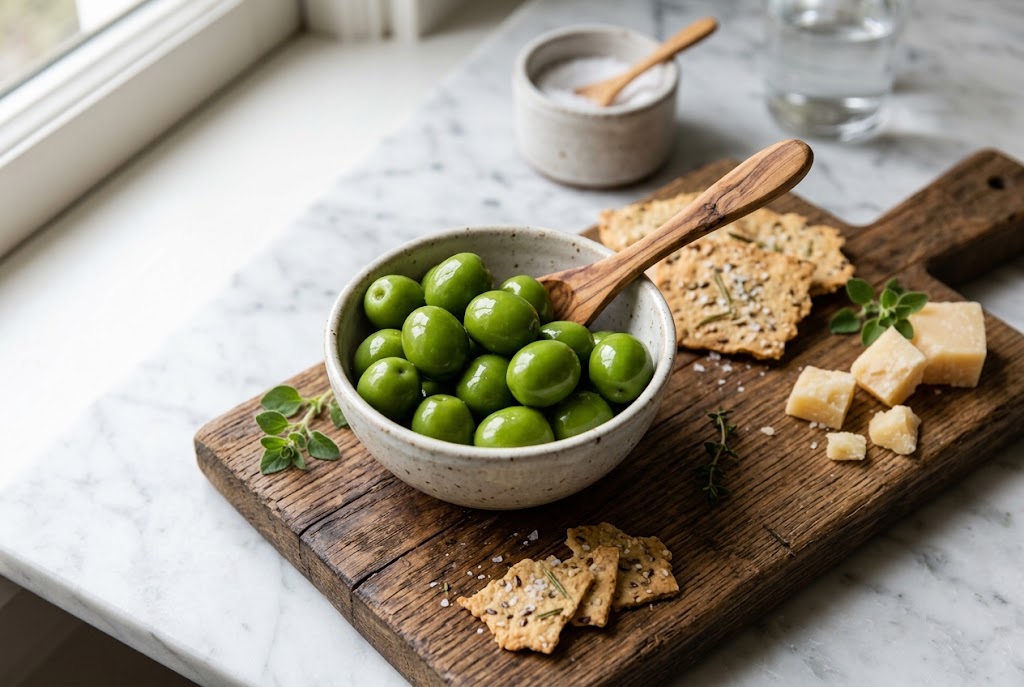
Quick Answer: Castelvetrano olives are picked young in western Sicily, which keeps them bright green, buttery and mild. On a board they're a gentle palate reset between rich bites. Serve one small bowl at room temperature, near semi-firm and aged cheeses like manchego, fontina, provolone or Gruyère.
What Is Castelvetrano?
Castelvetrano olives come from the Belice Valley in western Sicily, where the Nocellara del Belice cultivar has been grown for centuries. What separates them from virtually every other table olive is the harvest timing and curing method: they're picked young, before full ripening, which preserves their natural chlorophyll and keeps them bright green. Most commercial olives undergo lye curing, which strips bitterness quickly but also flattens flavor. Castelvetrano olives are brine-cured, a slower process that maintains their delicate sweetness and produces the characteristic buttery texture that makes them so versatile.
The flavor profile is mild and clean — a gentle brininess, a hint of grassiness from the chlorophyll, and a meaty, yielding flesh that gives way easily. There's very little of the sharp, bitter punch you get from Kalamata or Nicoise varieties. That mildness is precisely what makes Castelvetrano the correct choice for a charcuterie board — they complement rather than compete.
Best Use on a Charcuterie Board
Castelvetrano olives belong in a small bowl or clustered in a corner of the board. They function as a palate reset — their mild brininess cuts through fat from cheese or cured meat without introducing a strong competing flavor. Serve them at room temperature rather than straight from the refrigerator. Cold suppresses their buttery aromatics and makes the flesh firmer than it should be. Pull them out 30 minutes before serving.
Use pitted Castelvetrano for most board applications. The pit-in version has slightly more flavor (the pit prevents oxidation at the center of the olive) but requires a discard bowl and makes eating more awkward. The practical advantage of pitted olives outweighs the marginal flavor difference for a social setting.
One small bowl, 10–15 olives for a 4–6 person board, is the right quantity. They're not the centerpiece — they're the element that makes everything else taste better.
What to Pair It With
Castelvetrano's mild, buttery profile pairs across a wide range — one of its most useful board characteristics.
With cheese, it works best alongside semi-firm and aged options: manchego, fontina, mild provolone, and Gruyère. The olive's saltiness activates the salt-sweet principle against any honey or fruit on the board, and the mild bitterness creates just enough contrast against rich, fatty cheeses without overwhelming them.
With meat, prosciutto is the natural pairing. Both are mild and have a sweetness that plays off each other cleanly. Mortadella, with its pistachio-studded richness, is another excellent match.
With accompaniments, marcona almonds (buttery, salted) reinforce the Castelvetrano's own buttery quality. Fig jam or quince paste on the same board creates a sweet-salty interplay across multiple elements.
What to avoid: blue cheese. Castelvetrano is too mild to hold its own against gorgonzola or Roquefort — the olive gets lost and the blue dominates the bite.
The Lab Section: Why These Pairings Work
Castelvetrano's chemistry starts with its high oleic acid content — the same monounsaturated fat that defines olive oil. This creates a smooth, coating mouthfeel that carries flavor compounds across the palate without releasing them sharply. The result is a lingering, pleasant finish rather than an abrupt one.
The brine-curing process preserves glutamate-producing compounds in the olive flesh. Glutamate is the amino acid responsible for umami — savory depth. When Castelvetrano sits adjacent to prosciutto or manchego (both glutamate-rich through aging or curing), the umami compounds in each reinforce the other. This is umami synergy: two moderate umami sources producing a combined savory intensity greater than either alone.
The mild bitterness from the olive's natural oleuropein (significantly reduced through brine curing but not eliminated entirely) triggers a brief palate-cleansing effect between bites of fat-heavy cheese or meat. It's the same mechanism that makes wine's tannins work — a momentary astringency that resets the palate for the next bite.
Common Mistakes
Serving cold. Refrigerator temperature suppresses volatile aromatics and firms the texture. Let them come to room temperature before the board goes out.
Over-portioning. Olives can overwhelm a board visually and in flavor if over-represented. One small bowl or cluster is enough. They're a supporting element, not a centerpiece.
Pairing with bold, pungent cheese. Castelvetrano's mild profile gets lost next to strong blues or aged washed-rind cheeses. Position them near mild to medium-aged cheeses where the contrast is legible.
Using brine-free olives. Some stores sell Castelvetrano without brine, dried or marinated in olive oil. These behave differently — the texture is firmer, the flavor more concentrated. If you can find them in brine, that's the correct product for a board.
How Castelvetrano Olives Are Made
Castelvetranos are harvested young and cured using a lye process followed by brining in lightly salted water. This gentle curing preserves their bright green color and sweet flavor.
The process:
- Harvested young, still green
- Treated with lye to remove bitterness
- Rinsed thoroughly
- Brined in lightly salted water
- Sometimes finished with olive oil
What this process does:
- Removes harsh bitterness and keeps natural sweetness
- Preserves bright color and visual appeal
- Maintains firm texture and crisp bite
Castelvetrano Board Idea: "The Mediterranean Fresh Board"
Ingredients
- Castelvetrano olives, in a small dish
- Fresh mozzarella or burrata
- Prosciutto
- Cherry tomatoes
- Roasted red peppers
- Fresh basil
- Focaccia bread
- High-quality olive oil, for drizzling
- Balsamic glaze
This board feels fresh, bright, and Mediterranean, anchored by those beautiful green olives.
The Charcuterie Lab Takeaway
Castelvetrano is the one olive that reliably converts guests who claim they don't like olives. The sweetness, the butter texture, the mild brine — they're nothing like the sharp, briny Kalamata that most people picture when they think "olive." One small bowl, room temperature, positioned near prosciutto and manchego. That's the board move.
Going deeper on ingredients? The Charcuterie Lab ebook covers 50 boards built around specific ingredient pairings, with full pairing science for each element. Download free at charcuterielab.com/ebook.
FAQ
Why are Castelvetrano olives green when most table olives are black or dark?
Castelvetrano olives are harvested young, before they fully ripen and oxidize to dark colors. They're cured in brine (not lye, as many commercial olives are), which preserves their vibrant green color and natural mild flavor. The lack of full ripening and the gentler curing process are what give them their distinctive mellow sweetness rather than the stronger bitterness of most olive varieties.
How do Castelvetrano olives pair with wine?
Their mildness makes them unusually wine-friendly. They work with both whites and reds where many olive varieties would clash. Light to medium whites (Vermentino, Pinot Grigio) pair beautifully with their fresh, grassy note. Light reds (Barbera, light Chianti) work better than tannic heavyweights, which can amplify the olive's bitterness.
Do Castelvetrano olives have pits?
Most Castelvetrano olives sold for charcuterie boards are pitted for convenience. Pit-in olives have slightly more flavor (the pit prevents oxidation at the center) but require a discard bowl on the board. For board use, pitted versions are more practical and still excellent quality.
How long do Castelvetrano olives last in the fridge?
Once opened, keep them submerged in their brine and refrigerated. They stay at good quality for 2–3 weeks. The brine helps prevent oxidation and maintains their texture. Do not freeze — the texture becomes mealy after thawing.