Quick Answer: Capicola (also called coppa or gabagool) is whole-muscle cured pork neck and shoulder: richer than prosciutto, less assertive than salami. Slice it as thin as you can, let it come to room temperature, and fold it loosely beside provolone or aged cheddar with a small dish of hot honey.
What Is Capicola?
Capicola — also called capocollo, coppa, or gabagool in Italian-American dialect — is a whole-muscle cured meat made from the neck and shoulder of the pig. The name comes from the Italian capo (head) and collo (neck), describing the anatomical location of the cut. It occupies an interesting position in the charcuterie landscape: richer than prosciutto, more refined than salami, and more accessible than bresaola or culatello.
The distinguishing characteristic of capicola is its fat distribution. The neck and shoulder muscle group is heavily marbled — fat runs through the meat rather than existing only at the edges — which produces a buttery, yielding texture when sliced thin. The fat melts at or near body temperature, so capicola that has been brought to room temperature has a different eating quality than cold capicola: the fat softens, the spice aromatics open up, and the texture becomes genuinely silky rather than firm.
American capicola is typically seasoned with red or black pepper, wine, and a spice blend that varies by producer. The "hot" variety uses Calabrian chili or red pepper flakes for a moderate, lingering heat; the "sweet" variety is seasoned more gently, closer in character to Italian coppa DOP. Both are dry-cured for 60–90 days, during which enzymatic activity and moisture loss concentrate flavor and develop the characteristic aroma of the finished product.
Italian coppa DOP (from Calabria, Piacentina, or other certified regions) undergoes more strictly controlled production with regional specificity. American capicola, produced without DOP restriction, varies more widely in quality and flavor but is also more widely available and often more aggressively seasoned — which works well for a board context where capicola competes with other bold elements.
Best Use on a Charcuterie Board
Capicola earns its place on a board by occupying the space between prosciutto's delicacy and salami's assertiveness — it has more presence than the former without the fennel or garlic-forward character of the latter.
Slice it as thin as you can get it, ideally paper-thin from a deli counter. Pre-packaged thin-sliced capicola works well. At thin cuts, the fat marbling becomes translucent, the texture is supple, and the full aromatic character of the spice cure comes through. At thicker cuts, the fat stays firmer and the texture is chewier — less effective.
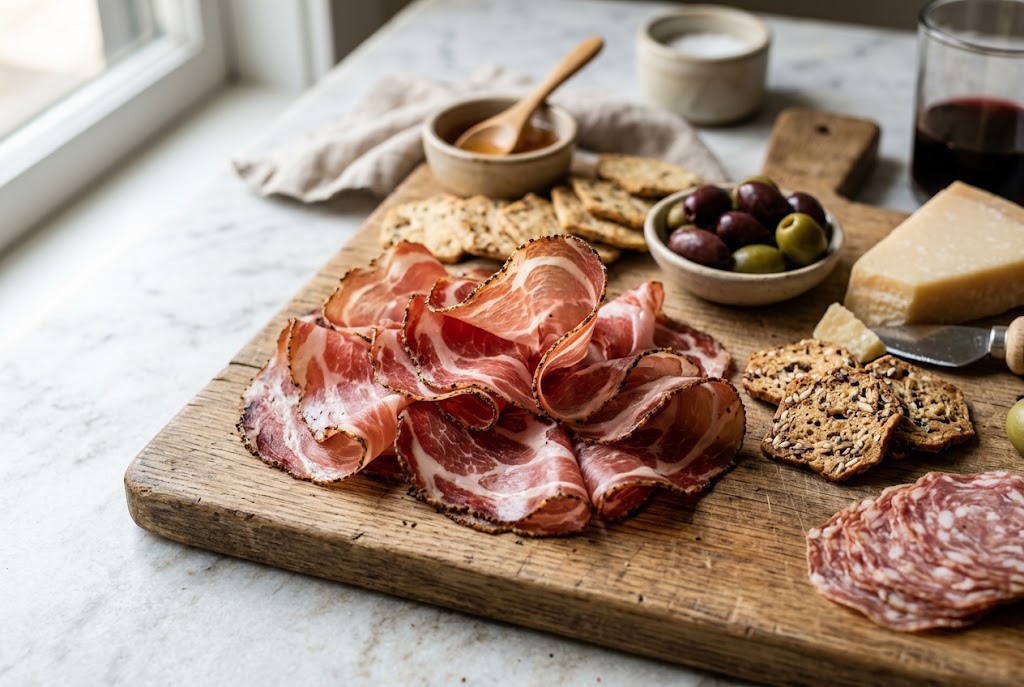
On the board, fold slices loosely into halves or quarters rather than layering flat. Folding creates visual volume, makes individual slices easier to pick up, and — importantly — exposes more surface area to air, which softens the fat slightly in the 20–30 minutes after plating. Position capicola adjacent to provolone, aged cheddar, or manchego — cheeses that can match its intensity without being overwhelmed.
For visual impact, fan four to five folded slices in a loose cluster. The red-pink color with visible white fat marbling photographs well and adds visual contrast against pale cheeses and crackers.
What to Pair It With
Cheese: Provolone is the canonical Italian-American pairing — slightly sharp, firm, with a mild smokiness that complements the spice cure. Aged cheddar stands up to the heat in hot capicola and provides salty contrast. Fontina, with its mild, buttery character, pairs well with sweet capicola. Avoid very soft, fresh cheeses — chèvre or burrata get overwhelmed by capicola's assertive flavor.
Accompaniments: Hot honey is the single most effective capicola pairing on a board — the sweetness from the honey and the heat from both the honey and the capicola stack into a sweet-spicy-fatty combination that guests return to repeatedly. Pickled peppers (pepperoncini, giardiniera) provide acid contrast. Grainy mustard works well for the same reason. Castelvetrano olives provide mild, clean contrast.
Bread and crackers: A sturdy cracker — something with enough structure to hold a fold of capicola and a slice of provolone — works better than thin wafers, which break under the weight. A toasted crostini or a thin focaccia slice is the best vehicle.
Wine: Medium-bodied Italian reds (Chianti, Barbera, Montepulciano) are the traditional pairing. The tannin-fat interaction softens capicola's richness and lets the spice come forward. For white, a full-bodied Pinot Grigio or Fiano d'Avellino manages the fat without fighting the spice.
The Lab Section: Why These Pairings Work
Capicola's fat composition is the key to understanding its pairing chemistry. The neck and shoulder fat is heavily loaded with oleic acid — the same monounsaturated fat that makes olive oil and marcona almonds so palatable. Oleic acid is liquid at room temperature and has a clean, smooth mouthfeel with minimal off-flavor contribution. When capicola is served at room temperature, this fat softens and coats the palate, extending flavor contact time and suppressing the immediate perception of salt and spice — making the pairing experience feel smoother than you'd expect given the ingredient's seasoning.
The fat also plays the central role in the pairing with red wine. Tannins — the polyphenol compounds in red wine responsible for the drying sensation — bind to proteins and salivary proteins in the mouth, creating astringency. Fat intercepts tannins at the molecular level, coating the receptor sites before tannin can bind, which is why fatty cured meat makes tannic red wine taste softer. The tannin, in turn, clears the fat coating from the palate after the bite, resetting for the next piece. This is the fat-tannin reciprocal effect in its most practical form.
The spice in capicola activates a different mechanism: capsaicin (in hot varieties) triggers TRPV1 heat receptors, and the body's response is increased saliva production and, paradoxically, increased sensitivity to sweetness. This is why hot honey on capicola is so effective — the heat primes sweetness receptors, making the honey taste more vivid than it would without the capicola's spice trigger.
Common Mistakes
Serving cold. Cold capicola is firm and waxy; the fat doesn't melt and the aromatics stay muted. Pull it from the refrigerator 30–45 minutes before serving. The difference at room temperature is substantial.
Pairing with soft, fresh cheeses. Capicola's spice and richness overwhelm fresh mozzarella, burrata, or mild chèvre. Save those for prosciutto or lighter elements. Position capicola near firm, aged cheeses that match its weight.
Skipping the hot variety entirely. Many hosts default to sweet capicola for safety. The hot version, properly paired with honey, is one of the most dynamic combinations on a board. Include both if possible; if only one, hot capicola with honey is the more interesting board contribution.
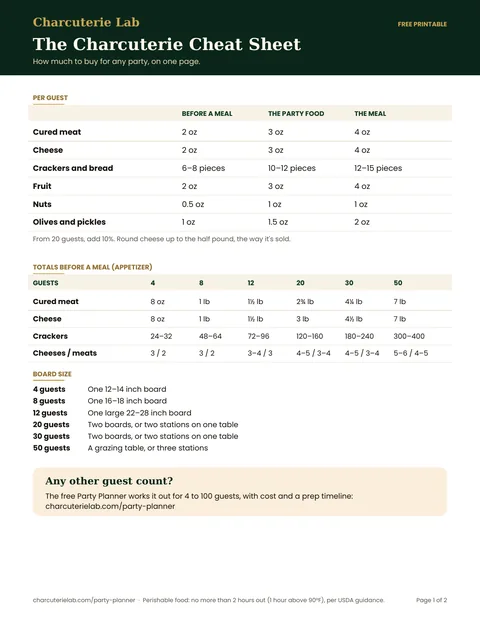
Over-portioning. Capicola is rich — 3–4 thin slices per person is the correct portion. More than that and it dominates the board's flavor profile. It should be present and appreciated, not so abundant that it becomes the only thing guests eat.
The Charcuterie Lab Takeaway
Capicola earns its spot through fat, spice, and flexibility — it bridges the gap between prosciutto's delicacy and salami's boldness in a way nothing else quite does. Thin-sliced, room temperature, folded loosely next to provolone and hot honey: that's the move. If you include one meat most guests haven't thought about before, make it capicola.
Building more boards? The Charcuterie Lab ebook walks through 50 boards across every occasion — each one with exact quantities, a shopping list, and the science behind why it works.
FAQ
What is capicola made from?
Capicola is made from the neck or shoulder of the pig — the muscle group running from the head (capo) to the shoulder (collo). The cut is rubbed with salt, red or black pepper, and a spice blend that varies by region, then dry-cured for 60–90 days. The result is a marbled, supple cured meat with more fat distribution than prosciutto.
What is the difference between capicola and coppa?
They're the same cut and the same product — capicola is the southern Italian and Italian-American term, coppa is the northern Italian name. The flavor profiles can differ: Italian coppa DOP versions tend to be more lightly spiced and delicate, while American-produced capicola often carries bolder red pepper seasoning and a more assertive heat.
Is capicola the same as ham?
No — capicola comes from the neck and shoulder, ham comes from the hind leg. Both are dry-cured, but the muscle groups differ, which means different fat-to-lean ratios and different flavor development. Capicola has more internal fat marbling than prosciutto or whole-muscle ham, giving it a richer, more supple texture.
How do you serve capicola on a charcuterie board?
Slice thin and fold loosely rather than lay flat — the fat marbling means capicola benefits from the air exposure of an open fold, which softens the fat slightly. Serve at room temperature. Pair it directly with provolone or aged cheddar, positioned close enough that guests naturally combine them.
How spicy is hot capicola?
Hot capicola uses Calabrian chili or red pepper flakes in the cure, producing a moderate heat — noticeable but not aggressive. On a Scoville scale it would fall well below jalapeño territory. The heat is part of the background flavor profile rather than the dominant sensation. On a board, the fat content mellows the spice significantly.