Quick Answer: Coppa is cured pork neck, the same meat as capicola: marbled, sweet and silky. Buy sweet (dolce) for most boards or spicy (piccante) for heat, sliced very thin.
Coppa in 30 seconds
What it is
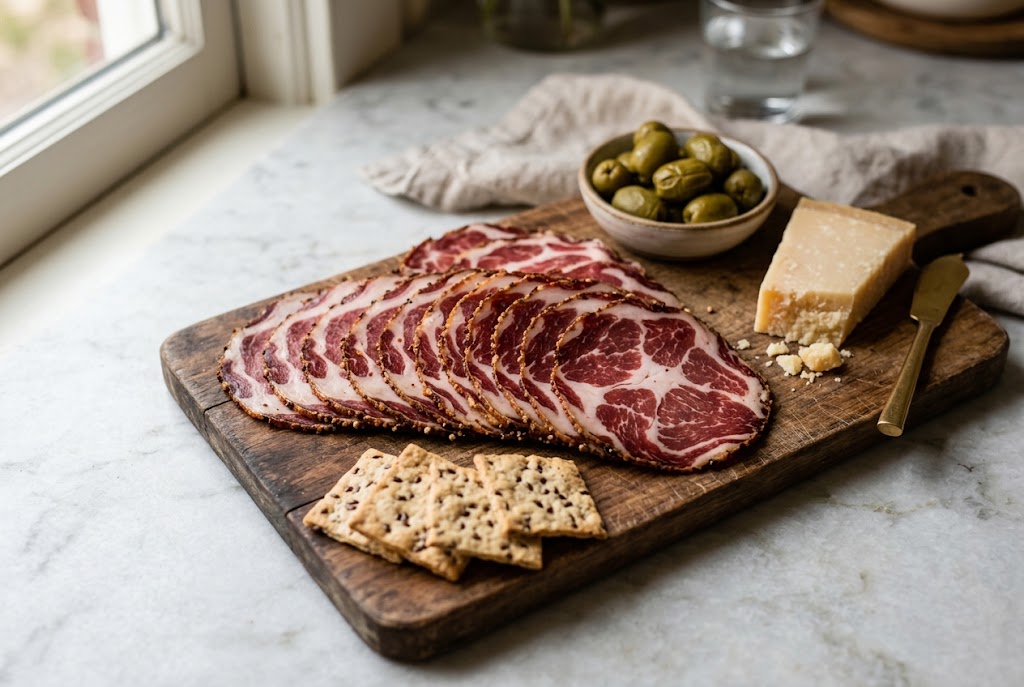
Cured pork neck and shoulderA whole muscle, so every slice shows a red-and-white marbled pattern.
Same as capicola?
YesCoppa is the northern Italian name; capicola, capocollo and "gabagool" are the others.
Is it raw?
Not cooked, but fully curedReady to eat, like prosciutto. Pregnant guests should have it heated.
On a board
Thin slices, folded into a riverWith dried figs or melon, provolone or aged cheddar.
It's the best-looking meat on a board and goes with everything from mild cheese to sharp blue.
What is coppa?
Coppa is a whole-muscle, dry-cured meat from the pig's neck and shoulder. Unlike salami, which is ground, it's cured in one piece. That keeps the neck's natural pattern of lean muscle and marbled fat, which is why a thin slice looks like a mosaic and folds into such good shapes.
It's made across Italy: spicy with Calabrian chili in Calabria, and as the protected Coppa Piacentina PDO in Piacenza. American "capicola" varies a lot in quality, and imported Italian coppa is generally better.
Coppa vs. capicola, prosciutto and salami
| Coppa / capicola | Prosciutto | Genoa salami | |
|---|---|---|---|
| Cut | Neck and shoulder, whole muscle | Hind leg, whole muscle | Ground pork |
| Seasoning | Black pepper, wine, herbs; chili if spicy | Salt only | Garlic, pepper, wine |
| Fat | Marbled all the way through | A fat cap along one edge | Specks of fat in every slice |
| Texture | Silky and tender | Soft, melts | Firm |
| Flavor | Sweet, rich, peppery | Sweet, delicate, salty | Tangy and garlicky |
| On a board | Folded slices, rivers and roses | Loose ribbons | Fans and folded quarters |
Coppa and capicola are the same meat. Coppa is the northern Italian name, capicola (or capocollo) the southern and Italian-American one, and "gabagool" the New Jersey and New York deli pronunciation. Check the label on American deli capicola: some is cooked rather than dry-cured. Which to buy: the best coppa and capicola.
Is coppa raw?
It isn't cooked, but it's fully cured. Salt and months of air-drying make it safe to eat straight from the package, the same way prosciutto and salami are. Once opened, wrap it in wax paper and keep it in the fridge.
Pregnant guests: the CDC advises heating deli meats and dry-cured meats until steaming hot during pregnancy. Offer cooked ham or another option instead.
How coppa is made
- Salted and seasoned. The neck is trimmed, salted and rubbed with black pepper, red wine and herbs (Calabrian chili for spicy). Salt and slow drying do the preserving.
- Cased and hung. It goes into a natural casing and dries for about 60–180 days, longer for artisan versions.
- The fat does the work. As it dries, the marbled fat slowly breaks down, much as fat does in aged cheese. That's where coppa's sweet, nutty, almost caramel flavor comes from, and the fat carries the spices through every slice.
Types of coppa
| Type | What it's like |
|---|---|
| Sweet (dolce) | Black pepper, red wine, mild herbs; no heat. Round, rich and nutty. The most versatile for a board |
| Spicy (piccante / calabrese) | Calabrian chili or red pepper. The heat spreads through the fat and builds slowly; milder than hot soppressata |
| Coppa Piacentina PDO | The protected version from Piacenza, aged at least six months. Sweeter and more complex |
| Coppa di testa | Not the same thing: a head cheese of cooked pork in gelatin. Not for a standard board |
How to serve it
- Slice 1.5–2 mm thin. Thin enough to fold without cracking and show the marbling; thicker feels fatty.
- Fold and drape: fold each slice loosely in half and overlap them at an angle. The most common way.
- River: the same folds in a winding line. Coppa makes a more colorful river than salami.
- Rose: the wine-glass rose works well, with more color than a prosciutto rose.
- Out of the fridge 20–30 minutes before serving. Cold fat hides the sweetness.
What to pair with coppa
Coppa is rich and moderately salty, so it loves something sweet and something sharp.
| With | Pick | Why |
|---|---|---|
| Sweet | Honeydew or cantaloupe, dried figs, mild wildflower honey, grapes | Sweetness boosts the salt; melon's juice cleans up the fat |
| Sharp | Cornichons, mustard, tart fruit | Acid cuts the richness and brings out the spice |
| Cheese | Provolone (the Italian classic), aged cheddar or Manchego, brie or Camembert, Fontina | Nutty, sharp cheese complements it; soft cheese doubles the richness |
| Bread | Ciabatta or focaccia, rosemary crackers, plain water crackers | Olive oil bread is the Italian default |
| Drinks | Barbera d'Asti or Dolcetto, Lambrusco, dry rosé, lager or pilsner | Bright acid and low tannin suit the fat |
Board ideas:
| Board | Coppa with |
|---|---|
| Italian | Sweet coppa, provolone, dried figs, ciabatta |
| Melon | Coppa, cantaloupe, mild honey, plain crackers |
| Red wine | Coppa, aged cheddar, Barbera, rosemary crackers |
| Crowd-pleaser | Sweet coppa, brie, grapes, water crackers |
| Bold | Spicy coppa, Manchego, fig jam, focaccia |
Guests seeing coppa for the first time often ask what it is, so have the answer ready: pork neck, cured whole, the same as capicola.
Get weekly ingredient guides in the Charcuterie Lab Report newsletter.
FAQ
What is coppa exactly — is it the same as capicola?
Yes — coppa and capicola (or capocollo) are the same product under different regional names. "Coppa" is common in northern Italy; "capicola" is standard in southern Italy and in Italian-American tradition. The name derives from capo (head) and collo (neck), referring to the head and neck muscle from which it's made. The New Jersey/New York deli pronunciation "gabagool" is a regional Americanization of "capocollo."
What does coppa taste like?
Sweet, rich and gently nutty, with black pepper and a little wine in the sweet (dolce) style. Spicy coppa adds Calabrian chili heat that builds slowly.
Is coppa raw?
It isn't cooked, but it is fully dry-cured with salt and air-dried for months, so it's ready to eat sliced thin, like prosciutto or salami.
What's the difference between coppa and prosciutto?
Coppa is the neck and shoulder, marbled all the way through and seasoned with pepper and wine. Prosciutto is the leg, cured with salt only, with a fat cap along one edge.
How do you pronounce coppa?
KOH-pah. Capicola is kah-pee-KOH-lah, and capocollo is kah-poh-KOH-loh.
How is coppa different from salami?
Salami is a fermented and dried sausage made from minced or ground meat stuffed into a casing. Coppa is whole-muscle — the entire neck and shoulder muscle is cured and dried intact. This means coppa shows visible muscle grain and marbling rather than the uniform interior of salami. The flavor of coppa is more nuanced and less heavily spiced; salami has more fermentation character and acidity.
How do you slice coppa for a board?
Coppa is sliced thin — 1.5–2 mm — on a slicer or by hand with a sharp knife. The cross-section should show the marbled fat and muscle clearly. For board presentation, fan the slices or fold them into rosettes. The marbling shows beautifully in the rosette layering.
What's the shelf life of coppa once opened?
Once a package is opened, wrap it tightly in wax paper and refrigerate. Sliced coppa is best within 3–5 days, like other opened deli meat; a whole piece keeps 2–4 weeks once cut. The fat can turn slightly rancid-tasting with long air exposure — wax paper breathes better than plastic without drying out the surface.