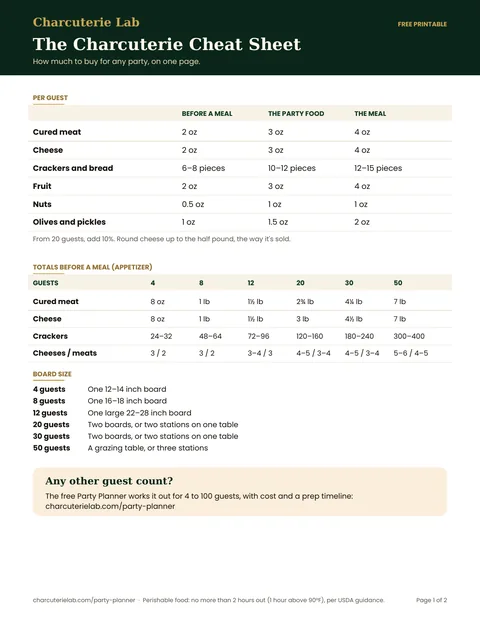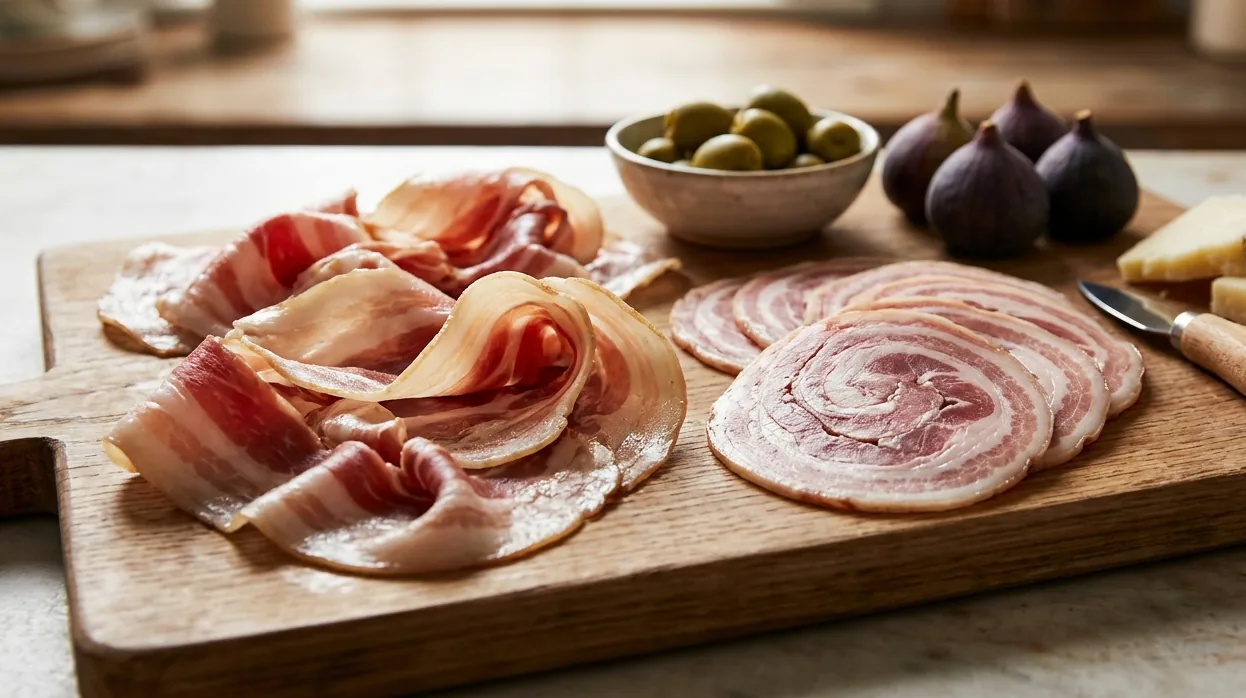
Quick Answer: Pancetta is Italian pork belly that's salt-cured, spiced and air-dried rather than smoked, so it tastes cleaner and sweeter than bacon. On a board, drape thin slices of flat pancetta so the fat stripes show. It sits between prosciutto's delicacy and salami's intensity.
"Italian bacon" is the most common description of pancetta, and it's accurate in the same way that "Italian sparkling wine" describes both Lambrusco and Franciacorta — technically correct, meaningfully incomplete.
Pancetta and American bacon are both cured pork belly. After that, they diverge in process, flavor, and purpose in ways that matter both in cooking and on a board.
What Pancetta Is
Pancetta is salt-cured, spiced pork belly that is air-dried rather than smoked. The belly is rubbed with a mixture of salt, pepper, and aromatics (nutmeg, juniper, cloves, bay — varying by producer and region), then cured for 10–14 days, and hung to dry for 2–3 months minimum.
The result is a product with:
- No smoke character
- More delicate, sweet-fatty flavor than smoked products
- Firm texture that slices cleanly
- A fat-to-lean ratio that reflects the belly's natural striations
Tesa vs. Arrotolata
Pancetta comes in two main forms:
Pancetta Tesa (flat): The belly cured and dried flat, in roughly rectangular slabs. Sliced thin, it's the form most commonly used raw on a charcuterie board.
Pancetta Arrotolata (rolled): The belly rolled tightly during curing and drying, creating a cylindrical log that produces circular cross-sections when sliced — the familiar pink-and-white spiral. This is the form most visually striking on a board and most widely available pre-sliced.
The Fat Profile
Pork belly fat is stratified in layers — alternating bands of fat and lean muscle running through the belly. Unlike guanciale (which is nearly all fat) or bresaola (which is nearly all lean), pancetta is inherently a balanced meat-fat product.
The largest share of pork belly fat is monounsaturated oleic acid, the same fat as olive oil, with saturated fat (palmitic and stearic acid) close behind and a smaller share of polyunsaturated fat.
The slightly lower monounsaturated content compared to jowl fat (guanciale) means pancetta's fat is firmer at room temperature and melts slightly less readily on the palate. This gives it a more structured, chewy quality compared to guanciale's dissolving silkiness.
At room temperature on a board, thin-sliced pancetta tesa softens to a pleasant, slightly yielding texture — the fat stripes become translucent at the edges while the lean portions retain more structure.
How Pancetta Tastes
Aroma: Savory, slightly sweet pork, with aromatic spice notes (black pepper dominant, faint nutmeg in some styles). No smokiness — the cleaner smell of air-dried cured meat vs. the more complex smoked product.
Flavor arc:
- Immediate: Sweet, clean cured pork — the fat delivers immediately without the delicacy of prosciutto or the intensity of salami
- Middle: Black pepper and spice notes emerging from the cure; slight saltiness
- Finish: A clean, savory finish without the prolonged complexity of longer-aged products
Compared to prosciutto: Less refined, more accessible. Prosciutto's delicate fat cap and long aging produce a more complex product; pancetta is more straightforwardly "cured meat."
Compared to salami: Milder, less spiced, less fermented tang. Pancetta is unfermented (no lactic acid bacteria involved), so it lacks the pH-drop tang that characterizes most salamis.
Compared to bacon: Dramatically different. Bacon's smoke character (phenols, guaiacols) defines its flavor; pancetta's absence of smoke makes it taste cleaner, sweeter, and simpler in the smoke dimension while retaining the pork character.
Pancetta on a Board
Pancetta occupies a specific niche on a board: it's approachable, familiar to guests who know bacon, but meaningfully different and more refined.
Best Uses
Thin-sliced tesa (flat pancetta):
- Draped loosely — the fat stripes show through beautifully at 1–2mm thickness
- Slightly folded or layered, showing the cross-section of fat and lean
- Pairs with mild cheeses (young Manchego, Fontina, Gruyère) that won't overwhelm its relatively mild flavor
Sliced arrotolata (rolled):
- The spiral cross-section is visually distinctive and immediately recognizable as something different
- Sliced 2–3mm, arranged in overlapping rounds
- The rolled form can be sliced thicker than flat pancetta and still be pleasant to eat
Pairings
Melon or fig: The sweet-salt fruit pairing is slightly less dramatic than with prosciutto (less refined product) but works well. The pancetta's clean fat sweetness against ripe melon or fresh fig is genuinely good.
Aged Pecorino: The Tuscany-Umbria pairing of pancetta with medium-aged Pecorino Toscano is traditional — the sheep's milk sharpness against the belly fat's sweetness.
Grainy mustard: The vinegar acidity and seed texture of grainy mustard provides a fat↔acid contrast and the textural interest of whole seeds against smooth fat.
Honey: The sweet-salty pairing, as with all cured meats.
Olives (Castelvetrano): The olives' buttery fat echoes the belly fat; their mild brininess provides salt contrast.
Pancetta vs. Guanciale vs. Bacon: Quick Reference
| Pancetta | Guanciale | American Bacon | |
|---|---|---|---|
| Cut | Pork belly | Pork jowl/cheek | Pork belly |
| Process | Dry-cure + air-dry | Dry-cure + air-dry | Cure + smoke |
| Fat character | Layered (fat + lean striations) | Nearly all fat, very soft | Layered, smoke-infused |
| Flavor | Sweet, mild, clean pork | Sweet, very delicate, dissolves | Smoky, assertive |
| Board use | Thin-sliced, draped | Paper-thin on crostini | Usually cooked |
| Age | 2–3 months | 3–6 months | Minimal (days-weeks) |
Where to Find It
Pancetta is one of the more widely available Italian cured meats:
- Grocery stores: Many mid-range and upscale grocery stores stock sliced pancetta (often arrotolata) in the deli or specialty section
- Deli counter: Better to buy from the counter freshly sliced — you control thickness
- Italian specialty shops: Wider selection of producers and styles, including tesa
- Online: La Quercia, Olympia Provisions, and other artisan producers
The Takeaway
Pancetta is cured pork belly, air-dried without smoke — Italy's answer to the cured belly, with a clean flavor profile that reads as sweet, savory, and gently spiced. On a board, it occupies the middle ground between prosciutto's delicacy and salami's intensity: approachable, familiar in concept, meaningfully different in execution.
The "Italian bacon" label is a useful introduction. What the label misses is everything the smoke isn't there — the clarity of pork fat and spice without the phenolic overlay of the smokehouse.
Subscribe to The Charcuterie Lab Report for weekly ingredient guides.