Quick Answer: Soppressata is a coarse-ground, dry-cured Italian salami with more fat, spice and presence than Genoa, sold sweet or hot. Slice it on a bias to show the fat pattern, and pair it with a dairy buffer like provolone or fresh mozzarella, plus dried apricots or honey for sweetness.
Most charcuterie boards that include salami reach for Genoa — mild, accessible, familiar. Soppressata is the version of Italian cured meat that assumes you want more: more spice, more fat, more presence. It's the salami that changes the character of a board rather than simply contributing to it.
If you've been building boards with only mild cured meats and want to add a more assertive element without reaching for 'nduja or a heavily spiced product, soppressata is the right answer. Here's everything you need to know to use it well.
What Is Soppressata?
Soppressata (also spelled sopressata or soppressata) is a dry-cured Italian salami with significant regional variation. The name derives from "soppressare" — to press or compress — which refers to a traditional production step in some regional styles where the sausage is weighted during curing, producing a flattened rather than cylindrical shape. In most modern commercial production, the pressing step is either omitted or symbolic, and the sausage retains a rounder cross-section.
Soppressata originated in southern Italy — Calabria, Basilicata, and Campania are the most historically significant regions — and the southern tradition typically produces the spicier, more assertive version (often made with Calabrian chili). Northern Italian and Venetian versions (Sopressa Vicentina, which has PDO designation) are typically milder, with a coarser grind, more fat, and less heat, and are sometimes seasoned with wine, rosemary, and garlic rather than chili.
For charcuterie board purposes, the most commonly available versions in the U.S. fall into two categories: sweet/mild soppressata (seasoned with black pepper, garlic, and wine) and hot/spicy soppressata (with Calabrian chili or red pepper). Both belong on boards, but for different reasons.
How Soppressata Is Made: The Science of the Cure
Soppressata is a coarsely ground pork salami, meaning the fat and lean meat are mixed and ground more coarsely than Genoa-style salami, resulting in a more heterogeneous texture with visible fat globules and distinct lean sections. This coarser grind is part of what makes soppressata's eating experience different from mild salami — you get distinct textural variation in each slice.
The curing and fermentation process:
Like all dry-cured salami, soppressata undergoes lactic acid bacterial (LAB) fermentation in the early stages of curing. Salt and curing agents (sodium nitrate/nitrite) are mixed with the ground pork, which creates an environment that selects for LAB while inhibiting spoilage organisms. As LAB ferment the available sugars (added in the form of dextrose), they produce lactic acid, which drops the pH of the meat and creates the characteristic tangy foundation underlying the dominant spice notes.
Simultaneously, the salt and nitrates suppress spoilage bacteria and, over weeks and months of controlled drying, dehydrate the product to a water activity low enough to ensure microbiological stability. The result is shelf-stable without refrigeration when sealed.
Fat distribution and flavor: The coarse fat distribution in soppressata matters. The fat serves as the primary flavor delivery system — spices and garlic are fat-soluble, meaning the marbled fat in soppressata is saturated with flavor compounds in a way that leaner cuts aren't. This is why a thick-cut slice of high-quality soppressata has a more intense flavor impact than a thin slice — you're getting a meaningful amount of fat-delivered flavor with each bite.
Calabrian chili (hot soppressata): The spice in spicy soppressata comes primarily from Calabrian chili pepper — a medium-heat, fruity, deeply savory chili with more complexity than simple heat. The active compound is capsaicin, which binds to TRPV1 receptors on the tongue and creates the sensation of heat. The heat level in well-made hot soppressata is assertive but not overwhelming — it builds across bites rather than spiking. This sustained heat is the primary reason hot soppressata needs a dairy or sweet counterpoint on the board.
Soppressata Varieties for Your Board
Sweet/Mild Soppressata: Seasoned with black pepper, garlic, red wine, and sometimes fennel or rosemary. No significant heat. Deep savory flavor with a distinctly coarser, fattier texture than Genoa salami. This is the best choice for boards where you want bold Italian cured meat character without adding heat.
Hot Soppressata (Calabrian-style): Adds Calabrian or red chili pepper. The heat is part of the flavor profile, not just intensity. Makes the best case for having a dairy buffer and a sweet element nearby. The most versatile option for boards built around contrast.
Sopressa Vicentina (PDO): The northern Italian style — very large diameter, coarsely ground, with a mild, almost lard-like richness. When available, this is the most impressive visual piece on a board — thick, marbled slices that showcase the fat-to-lean ratio clearly. Not widely available in the U.S. but worth seeking out at specialty Italian importers.
How to Serve Soppressata on a Board
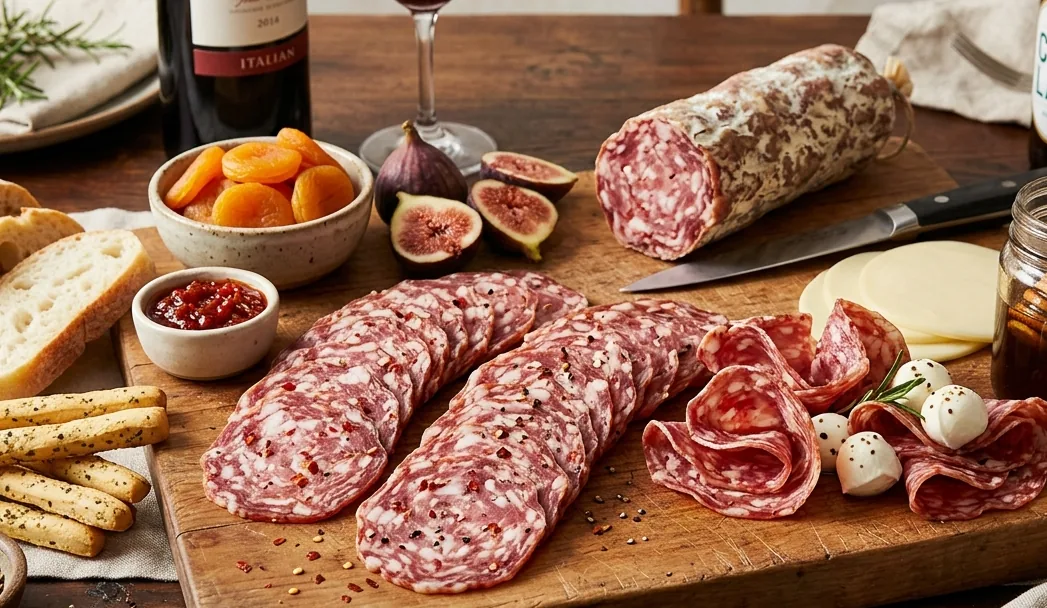
Slicing: Soppressata is typically sold pre-sliced or in larger pieces you'll slice yourself. For board presentation, cut on a bias (diagonal) to maximize the visual surface area and expose the fat distribution pattern. Thickness is important: slices should be around 2–3mm — thick enough to taste the fat, thin enough to eat in one bite.
Presentation options:
- Stacked overlap: Lay 5–7 slices slightly overlapping in a line or curve. Clean, graphic presentation.
- Fanned or rolled: Roll individual slices into loose cylinders or quarter-folds for height and texture variation.
- Draped: Let slices fall naturally over a small wedge of cheese or the edge of a ramekin. Works particularly well if the soppressata has natural casing with slight wrinkle.
Temperature: Like all cured meats, soppressata is best served at room temperature, not straight from the refrigerator. Cold fat mutes the flavor and alters the texture in an unpleasant direction. 20–30 minutes at room temp before serving is sufficient.
Quantity: 1–1.5 oz per person on a multi-meat board.
Pairing Soppressata
The dairy buffer principle: Soppressata — particularly the hot version — benefits from dairy elements that buffer the heat and fat intensity. The fat in cheese binds to capsaicin molecules and reduces their binding to TRPV1 receptors, effectively reducing the perceived heat. This is a different mechanism from the salt-sweet interaction but equally functional.
Sweet pairings (activating the salt-sweet principle):
- Dried apricots — the tartness and sweetness of dried apricot cuts directly through the fat and provides a clean, bright contrast to the spice. The best fruit pairing for hot soppressata.
- Fresh or dried figs — rich, concentrated sweetness that holds up to soppressata's intensity.
- Honey — specifically a robust amber or buckwheat honey. Light honey is overwhelmed by soppressata's saltiness and spice. Dark honey creates a proper contrast.
- Calabrian chili jam — if you want to lean into the heat rather than buffer it, a sweet-hot chili jam alongside hot soppressata is a bold, coherent pairing.
Cheese pairings:
- Provolone — the mild, slightly sharp Italian cheese is a natural companion. The fat in provolone buffers the heat; the cheese's mild saltiness doesn't compete.
- Fresh mozzarella — the high moisture content and milky neutrality provide a clean dairy contrast to soppressata's intensity.
- Aged asiago or mild pecorino — firmer, slightly nutty. Works for more robust board combinations.
- Avoid: very aged or very sharp cheeses alongside hot soppressata — two strong flavors competing produce fatigue rather than pleasure.
Bread and cracker pairings:
- Ciabatta or focaccia — the olive oil and open crumb of ciabatta provides a satisfying fat-on-fat combination with soppressata's marbled slices.
- Breadsticks — neutral, crunchy, classic Italian companion.
- Crackers with herbs — rosemary crackers echo the garlic-herb character of mild soppressata.
Drink pairings:
- Barbera or Sangiovese — high-acid Italian reds that cut through soppressata's fat beautifully. The fruity, savory character of these wines mirrors the meat's flavor profile.
- Lambrusco — sparkling red wine that pairs exceptionally well with all forms of cured Italian pork. The slight sweetness of many Lambrusco styles provides a version of the salt-sweet contrast in liquid form.
- Craft lager or pilsner — the clean, crisp, slightly bitter character of lager cuts fat and refreshes the palate between bites of spicy soppressata.
- Aperol Spritz or Campari-based cocktails — the bitter orange and herbaceous notes of Campari create a complex contrast with the fat and spice of hot soppressata.
Soppressata at a Glance
| Property | Description |
|---|---|
| Meat | Coarsely ground pork (fat + lean) |
| Origin | Southern Italy (Calabria, Campania, Basilicata) |
| Texture | Firm, slightly chewy; visible fat distribution |
| Flavor | Garlic-forward, savory, spice-dependent; lactic acid tang |
| Varieties | Sweet/Mild; Hot/Calabrian-spiced; Sopressa Vicentina (PDO) |
| Best board role | Bold, assertive cured meat; flavor contrast anchor |
| Heat level | None (sweet) to medium-high (Calabrian hot) |
| Sweet pairing | Dried apricots, dark honey, fresh figs |
| Cheese pairing | Provolone, fresh mozzarella, mild asiago |
| Bread pairing | Ciabatta, breadsticks, herbed crackers |
Quick Pairing Reference
| Board Type | Soppressata Pairing |
|---|---|
| Classic Italian board | Hot soppressata + provolone + dried apricots + ciabatta |
| Contrast/bold board | Hot soppressata + dark honey + fig jam + fresh mozzarella |
| Red wine board | Mild soppressata + asiago + Barbera + breadsticks |
| Heat-forward board | Hot soppressata + chili jam + aged pecorino + crackers |
| Beer board | Hot soppressata + fresh mozzarella + lager + dried figs |
Putting It on the Board
Soppressata earns its spot on any board that needs a backbone — something with enough presence to anchor the flavor profile and give guests something assertive to work with. Place it adjacent to provolone or fresh mozzarella (dairy buffer), with dried apricots or dark honey nearby (sweet contrast), and let the rest of the board's milder elements provide relief.
If you're building a board where everything is mild and approachable, soppressata is the element that prevents it from being forgettable.
Weekly ingredient guides in the Charcuterie Lab Report newsletter.