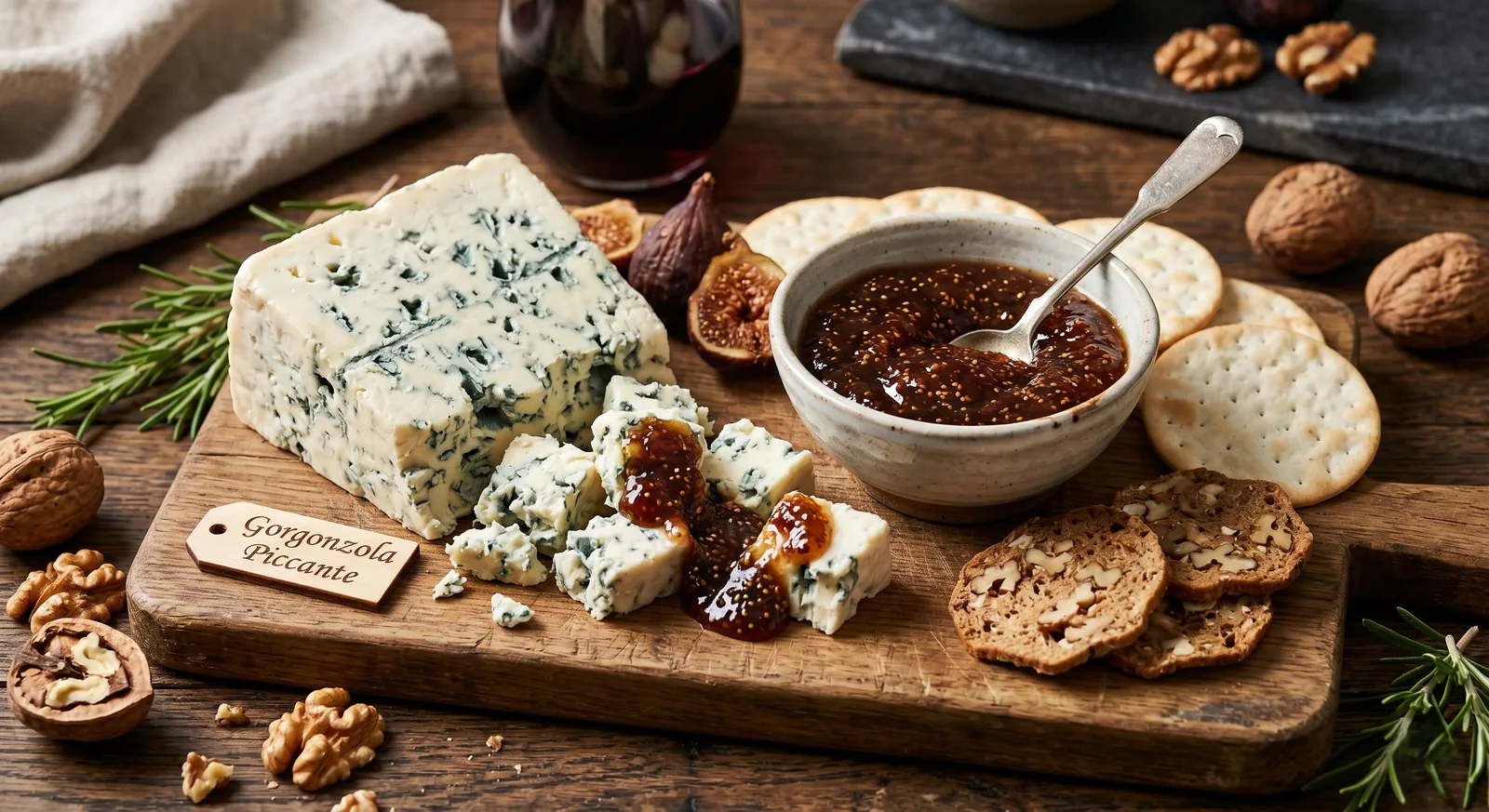
Quick Answer: Fig jam is more mechanistically complete against Gorgonzola than honey because it brings two active pairing compounds rather than one. Fructose inhibits the TAS2R bitter receptors that register Gorgonzola's methylketone sharpness. Hydrolyzable tannins bind the casein proteins responsible for blue cheese astringency. Honey only covers the first mechanism. Fig jam covers both.
The Direct Answer
Gorgonzola's intensity comes from Penicillium glaucum (or P. roqueforti in some productions) developing the characteristic blue-green veins through the paste. This mold produces methylketones — specifically 2-heptanone and 2-nonanone — during fat metabolism. These compounds activate TAS2R bitter receptors and produce the sharp, pungent, lingering quality that defines all blue cheese character.
Extended aging in Piccante-style Gorgonzola also produces casein protein breakdown products through proteolysis — the same astringency-generating process that occurs in other aged cheeses, but more pronounced due to the mold activity accelerating protein breakdown.
Fig jam's two active compounds address these two phenomena from different directions. Fructose blocks the TAS2R receptor before the methylketone bitter signal is processed. Hydrolyzable tannins bind the casein breakdown products before they reach the palate's mucosal surface. Two mechanisms, two targets, one condiment.
Gorgonzola vs. Other Blues: Why the Pairing Logic Is Specific
Gorgonzola is produced from full-fat cow's milk, giving it a creamier fat base than Roquefort (sheep's milk) or Stilton (cow's milk but drier). Gorgonzola Dolce is deliberately aged short — the methylketone profile is present but lighter, and the paste is soft and spreadable rather than firm. Piccante is aged longer — the methylketone concentration is higher, the paste has dried and firmed, and the casein breakdown products are more significant.
The fig jam pairing applies to both styles, but the mechanism loads differently. Against Dolce, the fructose TAS2R inhibition does the heavier work — the methylketones are the primary intensity source and there's less casein astringency. Against Piccante, both mechanisms are more consequential — higher methylketone concentration and more casein breakdown products mean both the receptor inhibition and the tannin-casein binding are doing substantial work.
Assertiveness of fig jam should match cheese intensity. A lighter, sweeter fig jam with lower tannin content is appropriate for Dolce — the suppression needed is lighter. A richer, more concentrated fig jam (Italian fig confiture, darker in color, more complex in flavor) has higher tannin content and is better matched to Piccante's more aggressive profile.
Why Fig Jam Over Honey
Honey against blue cheese is common and works — fructose TAS2R inhibition is effective against methylketone bitterness regardless of which honey delivers it. But honey's mechanism is limited to receptor inhibition. It doesn't address the casein-based astringency from aged blue cheese, and it has no tannin-protein binding capacity.
Fig jam adds the tannin dimension. Hydrolyzable tannins in fig flesh (ellagic acid, gallic acid) bind to casein proteins through tannin-protein interaction — the same molecular binding that makes fig jam, walnut, and red wine effective condiments for aged hard cheeses. The tannins intercept casein breakdown products before they create astringency on the palate.
Against Gorgonzola Piccante specifically, the tannin-casein binding from fig jam provides a second suppression layer that honey cannot replicate. The astringency in aged blue cheese is real enough to matter — without tannin binding, receptor inhibition alone leaves a dry, persistent mouth feel that undermines the fat and aromatic complexity of the cheese.
The difference is most apparent against Piccante. Dolce is creamy enough that the casein astringency is mild; honey and fig jam perform comparably against it. Piccante's higher astringency is where fig jam's dual mechanism becomes demonstrably superior.
How to Serve
Gorgonzola Dolce: Spread or scooped, not sliced — the paste is too soft to hold a slice shape. Serve in a small ramekin or as a generous spread directly on the board surface. Room temperature 30–40 minutes.
Gorgonzola Piccante: Crumbled or cut into irregular wedges. More structural than Dolce, it can be plated as a cheese wedge. Room temperature 45–60 minutes.
Fig jam: In a small condiment bowl alongside, or applied directly to the cheese surface immediately before service. Seeded fig jam for textural contrast. 1–2 teaspoons per 1oz cheese.
Ratio per person: 1oz Gorgonzola (either style), 1–2 teaspoons fig jam. Plain water crackers or walnut crackers as vehicles.
Extending the Pairing
Walnuts: Ellagitannin casein binding adds a third mechanism alongside fig jam's tannins — a second overlapping protein-binding source for more complete astringency suppression. The combination of fig jam and walnut covers casein binding from two compound classes simultaneously.
Pear slices: Malic and citric acid palate reset between bites. Pear's gentle acidity clears fat accumulation without fighting with fig jam's suppression function — the mechanisms are complementary.
Honey drizzle alongside fig jam: Honey's fructose reinforces the TAS2R inhibition beyond what fig jam's fructose content alone provides. The combination of fig jam (tannins + fructose) plus honey (additional fructose) provides the most complete suppression available against assertive blue cheese.
Prosciutto nearby: Cured salt triggers salivation that pre-wets the palate — the salivary layer optimizes fat contact from Gorgonzola's cream fat on the following bite.
The Charcuterie Lab Takeaway
Gorgonzola and fig jam is a more complete pairing than Gorgonzola and honey because fig jam brings both TAS2R fructose inhibition and tannin-casein binding. Against Dolce the fructose mechanism dominates; against Piccante the tannin binding becomes equally important.
Seeded fig jam for texture. Match jam assertiveness to cheese age. 1–2 teaspoons per 1oz. Room temperature cheese — non-negotiable for both styles.
Building more boards? The Charcuterie Lab ebook walks through 50 boards across every occasion — each one with exact quantities, a shopping list, and the science behind why it works.
FAQ
Why does fig jam pair better with Gorgonzola than honey?
Fig jam brings two active mechanisms: fructose for TAS2R bitter receptor inhibition (same as honey) and hydrolyzable tannins (ellagic and gallic acid) for tannin-casein binding that neutralizes astringency. Honey only performs receptor inhibition. Against Gorgonzola's methylketone-driven sharpness and aged casein astringency, fig jam addresses both dimensions simultaneously.
What is the difference between Gorgonzola Dolce and Gorgonzola Piccante?
Gorgonzola Dolce is aged 2–3 months — creamy, spreadable, lighter methylketone profile, milder sharpness. Gorgonzola Piccante is aged 6–12 months — firmer, crumblier, more intense methylketone concentration, pronounced sharpness and pungency. Fig jam works with both but Dolce is the accessible pairing; Piccante rewards a more assertive fig jam with stronger tannin content.
Should fig jam be seeded or smooth with Gorgonzola?
Seeded fig jam provides textural contrast to Gorgonzola's creamy (Dolce) or crumbly (Piccante) paste — the seed crunch registers as a distinct sensory event in the bite. Smooth fig paste can substitute but removes this textural dimension. For Dolce specifically, seeded jam creates more contrast since the cheese itself is uniformly smooth.
How much fig jam per serving with Gorgonzola?
1–2 teaspoons of fig jam per 1oz of Gorgonzola is the functional ratio. More jam shifts the pairing toward sweet and loses Gorgonzola's aromatic complexity. The jam is a targeted suppression tool — enough to inhibit the bitter receptors and bind the casein astringency, not enough to dominate the profile.
What crackers work best with Gorgonzola and fig jam?
Plain water crackers are the neutral standard — they don't add competing aromatics to the pairing. Walnut crackers can work and extend the tannin-casein binding mechanism through walnut's ellagitannins. Avoid strongly flavored or sweetened crackers that compete with the fig jam's suppression function.