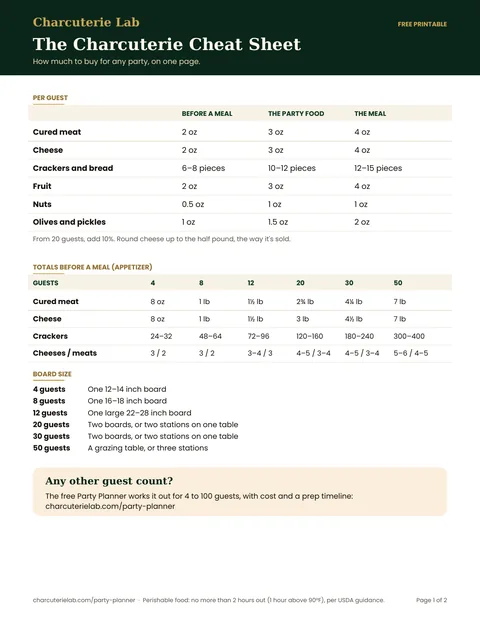
Quick Answer: Plan 2 oz of cheese per person for a board that comes before a meal, 3 oz when the board is the party food, and 4 oz when it's dinner. Add 10% from 20 guests up. Divide the total across three cheese types: one soft, one semi-firm, one aged hard. When uncertain, over-buy — leftover cheese stores well and a sparse board is the larger mistake.
For your exact guest count, the Party Planner works out meat, cheese, crackers, cost and a timeline for 4 to 100 guests.
The most common charcuterie board mistake isn't wrong pairings or bad placement. It's buying the wrong quantity of cheese. A board that runs low by the end of the event looks forgotten. A board with extra looks generous.
Here is the complete quantity formula.
The Core Formula
Pre-meal appetizer board: 2 oz cheese per person Party-food board (no meal): 3 oz cheese per person Dinner board (the board is the meal): 4 oz cheese per person Extended grazing (3+ hours): 3 oz per person, with a refill tray kept cold
These weights reflect edible cheese after rind removal where applicable.
Quick Reference Table
| Guests | Pre-meal | Party food | Dinner |
|---|---|---|---|
| 4 | 8 oz | 1 lb | 1 lb |
| 6 | 1 lb | 1½ lb | 1½ lb |
| 8 | 1 lb | 1½ lb | 2 lb |
| 10 | 1½ lb | 2 lb | 2½ lb |
| 12 | 1½ lb | 2½ lb | 3 lb |
| 15 | 2 lb | 3 lb | 4 lb |
| 20 | 3 lb | 4½ lb | 5½ lb |
| 30 | 4½ lb | 6½ lb | 8½ lb |
Rounded up to the nearest half pound, the way cheese is sold. From 20 guests the amounts include a 10% buffer.
For 30+ guests: build two boards and replenish rather than scaling a single board. Visually, two moderate boards beat one enormous one.
How to Divide Across Cheese Types
Three cheeses is the standard for most boards. Divide the total weight roughly as follows:
Soft cheese (brie, chèvre, triple cream): 35–40% of total cheese weight Soft cheese creates visual abundance and serves as the creamy anchor. Slightly larger allocation because it spreads and portions easily.
Semi-firm cheese (manchego, Gruyère, aged gouda): 35–40% of total The most versatile category — pre-sliced, easy to pair with everything, crowd-pleasing.
Aged hard cheese (aged cheddar, parmesan, aged manchego): 20–30% of total Intense flavor means smaller quantities satisfy. A 4oz chunk of aged parmesan provides more flavor impact than 8oz of mild cheese.
Example for 10 guests as party food (30 oz total):
- Brie: 10oz (a standard wedge or small wheel)
- Aged manchego: 9oz
- Extra-aged cheddar: 6oz
Adding a Blue Cheese
If you're including a blue cheese, allocate 2–4oz regardless of party size. Blue cheese is intense — more than 4oz starts to dominate the board.
Reduce the aged hard cheese allocation by the blue cheese weight. Example: 10 guests, including blue: 6oz brie, 8oz manchego, 3oz blue, 4oz aged cheddar.
Budget Planning
Cheese cost at board quantities varies significantly by selection.
Lower cost per ounce ($0.50–0.80): Sharp domestic cheddar, domestic brie, basic gouda, fresh mozzarella
Mid-range ($0.80–1.50): Aged manchego, domestic Gruyère, imported provolone, bucheron, Gorgonzola dolce
Premium ($1.50–3.00+): AOC Brie de Meaux, Roquefort AOC, Parmigiano-Reggiano DOP 24mo, aged Gruyère, Comté
Practical approach: Budget for 1–2 premium cheeses (these become the flavor centerpieces) and use accessible, quality domestic options for the remaining selections. A board with one exceptional Comté and two solid domestic cheeses outperforms a board of three mediocre imports.
When to Adjust the Formula
Increase quantities when:
- The crowd is enthusiastic cheese eaters (adjust upward by 25%)
- There is limited or no other food being served
- The event runs longer than originally planned
- Soft cheeses are the majority (they get eaten faster than hard)
Decrease quantities when:
- Substantial other appetizers or a full meal follows
- The crowd is mixed and cheese is not the main event
- The board is primarily visual (e.g., a photo opportunity board, not for eating)
Meat Quantity Reference
Cheese and meat quantities relate to each other. For reference:
Cured meat: the same weight as the cheese: 2 oz per person before a meal, 3 oz as the party food, 4 oz as dinner.
Crackers/bread: 6–8 pieces per person before a meal, 10–12 as the party food (2 types: one box water crackers + one baguette for 10 people covers adequately).
The Cost of Under-Buying
A sparse board — one where guests can see the board surface through the ingredients — communicates that the event is understocked, regardless of the quality of what's there.
The cost of buying an extra 8oz of cheese (roughly $4–8 depending on type) is negligible compared to the visual impact of a board that looks full throughout the event. Over-buy on the cheaper cheeses and use precise quantities only on the premium selections.
The Charcuterie Lab Takeaway
The cheese formula is 2 oz per person before a meal, 3 oz when the board is the party food, and 4 oz when it's dinner. Divide across three types: 35–40% soft, 35–40% semi-firm, 20–30% aged hard. Add 2–4oz of blue cheese if including one. Budget for 1–2 premium selections and fill the rest with quality accessible cheeses. When uncertain, over-buy — leftover cheese stores well and a sparse board is the error you can't fix at the event.
Building more boards? The Charcuterie Lab ebook covers 50 boards with exact quantities, shopping lists, and the science behind every combination — for groups from 2 to 50.
FAQ
How much cheese do you need per person for a charcuterie board?
2 oz per person when the board comes before a meal. 3 oz when the board is the party food. 4 oz when the board is dinner. These are weights of served cheese after any rind or inedible portions are removed. When in doubt, round up — leftover cheese is better than a sparse board.
How many types of cheese should be on a charcuterie board?
Three is the standard for most boards — one soft, one semi-firm, and one aged hard cheese. This covers the full textural and flavor range without overwhelming guests or creating redundancy. For a large board (15+ people), four cheeses adds one more profile (often a blue or a second soft option). Two cheeses work for mini boards (1–2 people). Five or more creates diminishing returns on variety.
How much does cheese cost for a charcuterie board?
Budget $8–15 per person on cheese for a quality board, depending on selections. Sharp cheddar and domestic brie are the most affordable quality options ($5–8 per 6oz wedge). Imported aged manchego, Gruyère, or AOC brie doubles the per-ounce cost. Jamón Ibérico or aged Parmigiano-Reggiano at board quantities can run $20+ for a single selection. Prioritize quality in 1–2 cheeses and use accessible, affordable options for the rest.
How do you calculate cheese for a large party?
Multiply your guest count by 2 oz before a meal or 3 oz as the party food, add 10% from 20 guests up, then divide across your cheese types. For 20 guests as the party food: 66 oz total, roughly 22 oz of each of three cheeses. Round to the nearest common package size (most cheese is sold in 6oz, 8oz, 10oz, or 1lb blocks). For 30+ guests, plan for 2 boards rather than scaling one board indefinitely — it's easier to manage and replenish.
Can you make too much cheese for a charcuterie board?
Practically speaking, no — leftover cheese is easy to use after the event. Excess cheese from a board can be rewrapped and refrigerated for up to a week (hard cheeses), 3–5 days (semi-firm), or 1–2 days (soft/fresh). The greater risk is under-buying and having a visually sparse board. Err toward more cheese, especially for soft cheeses that create visual abundance and cost less per ounce than aged selections.