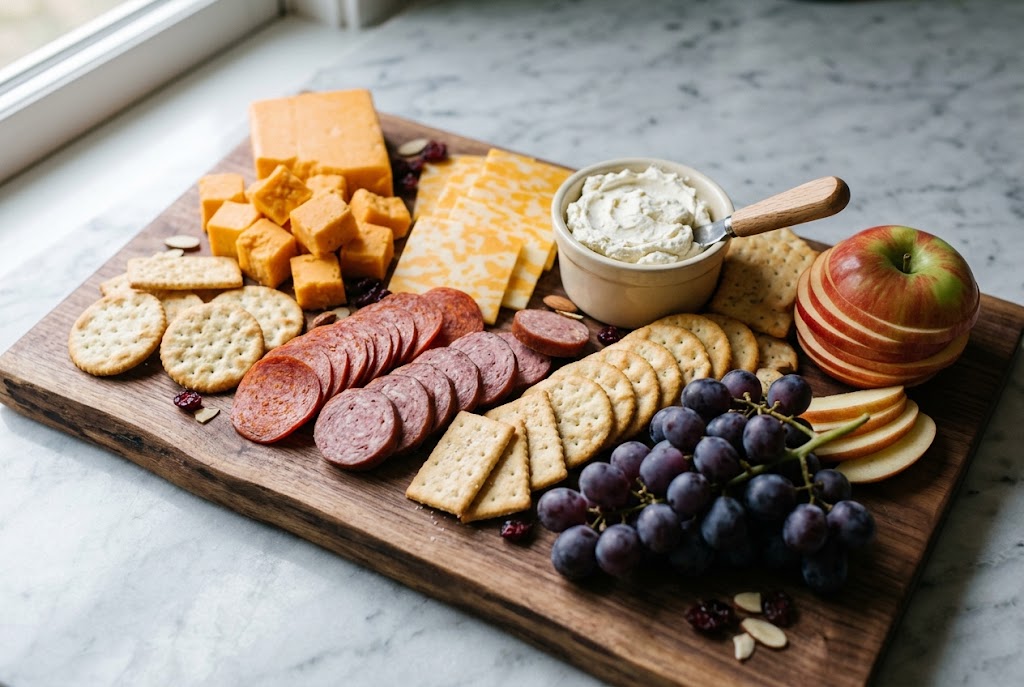
Quick Answer: A great charcuterie board doesn't require imported cheese or specialty cured meats. The principles that make a board work — salt-sweet contrast, texture variation, color contrast — function equally well with grocery store ingredients. The $25 formula: one good sharp cheddar, dry salami, one soft element (cream cheese or mozzarella), baguette crostini, grapes, apple slices, honey, and whatever nuts you have. Presentation does more work than price.
The Budget Board Philosophy
Expensive ingredients don't make a good charcuterie board. The science of what makes a board satisfying — bidirectional salt-sweet contrast, texture variation between creamy, crunchy, and firm, visual color contrast — doesn't care whether your manchego cost $12 or $4 per ounce. What matters is whether the elements are well-chosen, served at the right temperature, and arranged to create visual flow.
This guide builds a board for 6–8 people at appetizer quantities for $25, using ingredients available at any grocery store.
The $25 Ingredient List
Cheese (spend ~$10):
- Sharp cheddar, 8 oz — $4–5. The highest-value cheese on any board. Aging develops sharp, complex flavor without requiring imports. Look for at least 1-year aged.
- Cream cheese or soft spreadable cheese, 8 oz — $3–4. This is your soft, creamy element. Whipped cream cheese in a small dish mimics the role of brie at a fraction of the price.
Cured Meat (spend ~$6):
- Dry salami (Genoa or hard salami), 4–6 oz — $4–6. Pre-sliced from the deli counter or packaged. Strong flavor, good color, holds well at room temperature.
Bread / Crackers (spend ~$3):
- Baguette — $2–3. Slice thin on a diagonal, brush lightly with olive oil, bake at 400°F for 8 minutes. You get 25–30 crostini from one baguette. Toasted bread is functionally and often sensorially superior to expensive artisan crackers.
Produce / Fillers (spend ~$6):
- Grapes, one bunch — $2–3. The best charcuterie value in the produce section. Red or green, they fill visual space, provide sweetness, and taste good.
- Apples (2) — $1.50. Slice thin and toss with a drop of lemon juice to prevent browning. Malic acid in apples provides the acidic contrast element.
- Grocery store honey — $1–2 for a small squeeze bottle. One tablespoon in a ramekin is enough.
- Roasted almonds or walnuts, small handful — $1–2 from the bulk bin.
Where to Splurge vs. Where to Save
Splurge on (if you have $5 more): The cheese. Upgrade from standard cheddar to a 3-year aged cheddar, or add a 3 oz wedge of parmesan. The sharpness and complexity of a genuinely aged hard cheese is the single most noticeable quality upgrade on a budget board.
Save on: The cracker. Homemade crostini outperforms $10 artisan crackers. The Maillard reaction from toasting a baguette develops complex flavor that expensive crackers often don't have.
Save on: The board surface. A wooden cutting board you already own, a large piece of parchment on a baking sheet, or a cheap slate tile from a hardware store ($3–5) works as well as a $50 marble board for presentation purposes.
Presentation: Where $25 Looks Like $75
Fan-slice the cheese. Don't put a block of cheddar on the board. Use a sharp knife to slice 1/4-inch pieces and fan them in an overlapping row. This looks intentional and makes the cheese appear more abundant than it is.
Fold the salami. Pick up each slice and fold it in half twice, creating a quarter-circle "taco" shape. Stack 5–6 folded pieces leaning against each other or against the cheese. Folded meat reads as sophisticated; flat-stacked slices read as a deli platter.
Fill space strategically. Grapes and apple slices occupy visual real estate efficiently. Cluster grapes in one section, fan apple slices in another. Scatter nuts in gaps between sections. A full-looking board reads as abundant and generous regardless of total cost.
Use a small dish. A ramekin or small bowl filled with honey adds a visual focal point and texture variety. One small dish elevates any board from "food on a cutting board" to "curated spread."
The Science Behind the Cheap Board
The pairing principles are identical to expensive boards:
Salt-sweet: Sharp cheddar + honey creates bidirectional amplification — salt makes the honey taste sweeter, honey rounds the cheddar's sharp edges. Same mechanism as $40/lb aged gruyère with artisan honey.
Acid contrast: Apple slices provide malic acid that resets the palate between bites. The same function as expensive cornichons or artisan fruit preserves.
Texture contrast: Crunchy crostini + creamy soft cheese + firm cheddar + chewy salami hits the four-texture framework. No ingredient in that list requires specialty sourcing.
The Charcuterie Lab Takeaway
A $25 board can genuinely impress. Sharp cheddar, dry salami, baguette crostini, grapes, apples, and honey — chosen with pairing science in mind and presented with intention — outperforms a randomly assembled expensive board every time. The investment that matters isn't money. It's the two minutes it takes to fan the cheese, fold the meat, and pour the honey into a ramekin.
Building more boards? The Charcuterie Lab ebook walks through 50 boards across every occasion — each one with exact quantities, a shopping list, and the science behind why it works.
FAQ
How do you make a cheap charcuterie board look good?
Presentation matters more than price. Use a wooden cutting board or a slate tile from a hardware store as your board surface. Fan-slice cheese in overlapping rows rather than leaving it in a block. Fold cured meat rather than laying it flat. Fill visible gaps with whatever inexpensive fruit, nuts, or crackers you have. Height and visual flow make a $25 board look curated — not the price of individual ingredients.
What is the cheapest cheese for a charcuterie board?
Sharp cheddar consistently delivers the best value: strong flavor, good shelf life, crowd-pleasing, and $5–7 per pound at any grocery store. Domestic manchego-style cheese, mozzarella (for soft texture variety), and cream cheese (as a spreadable base) are other strong budget options. Avoid buying expensive cheese in small quantities — a good sharp cheddar outperforms a mediocre expensive import.
What inexpensive cured meat works on a charcuterie board?
Dry salami (Genoa or hard salami) is consistently the best value cured meat — flavorful, widely available, and $4–6 for enough to serve 6–8 people. Pre-sliced prosciutto-style products from the deli counter are another option. Pepperoni is crowd-pleasing but tends to pool fat at room temperature — use it as a secondary meat, not the anchor.
What can I use instead of expensive crackers on a charcuterie board?
Slice a baguette thin and toast it in the oven for 8 minutes at 400°F — you'll have 20–30 crostini for under $3. Sliced thin bread rounds (from a boule), simple Ritz crackers, or any plain cracker from the grocery store performs the same structural function as artisan crackers at a fraction of the cost. The cheese is the point; the cracker is the vehicle.
How do you make a budget charcuterie board feel abundant?
Fill space strategically. Grapes, apple slices, and baby carrots are inexpensive and occupy visual real estate effectively. A small ramekin of honey (even grocery store honey) adds visual complexity. Scatter nuts (roasted almonds or walnuts from the bulk bin) to fill gaps. A board that looks full and varied reads as generous, regardless of whether every ingredient is artisan.