Quick Answer: A charcuterie board is built around cured meats and cheese, with crackers, fruit and condiments in support. A grazing board is any large spread guests pick at over time: it can include charcuterie, but also dips, vegetables, sandwiches and desserts. Every charcuterie board can be part of a grazing board; not every grazing board is a charcuterie board.
What is a grazing board?
A grazing board (or grazing table) is a large, abundant spread of finger foods laid out for guests to help themselves over an hour or more. It's defined by its format, not its ingredients: cured meats and cheese often anchor it, but anything you can eat with your fingers belongs.
| Charcuterie board | Grazing board | |
|---|---|---|
| Built around | Cured meats and cheese | Anything eaten by hand |
| Size | One board, 4–12 guests | Board or whole table, 10–100+ guests |
| Typical extras | Crackers, fruit, nuts, jam, pickles | Dips, vegetables, bread, sliders, desserts |
| How long it's out | 1–2 hours | 2–4 hours, restocked |
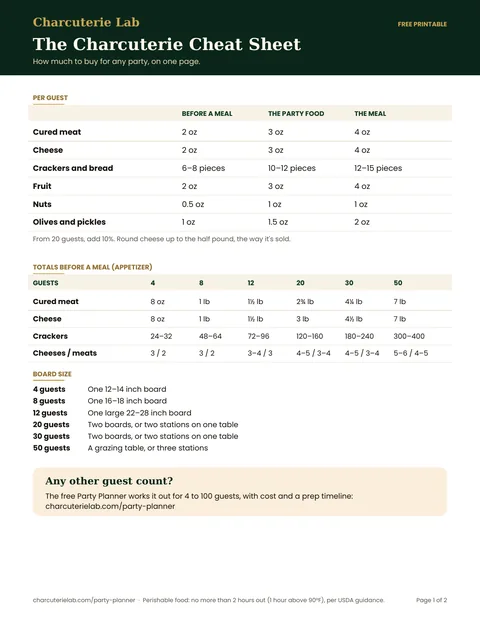
| Food per guest (appetizer) | About 2 oz cheese + 2 oz meat | The same, plus dips, bread and produce |
Planning one? See how to build a grazing table and how much charcuterie per person.
The terms have blurred significantly in social media and food culture, to the point where many people use them interchangeably. They're not identical, and understanding the distinction helps you plan the right build for the right occasion.
Defining the Terms
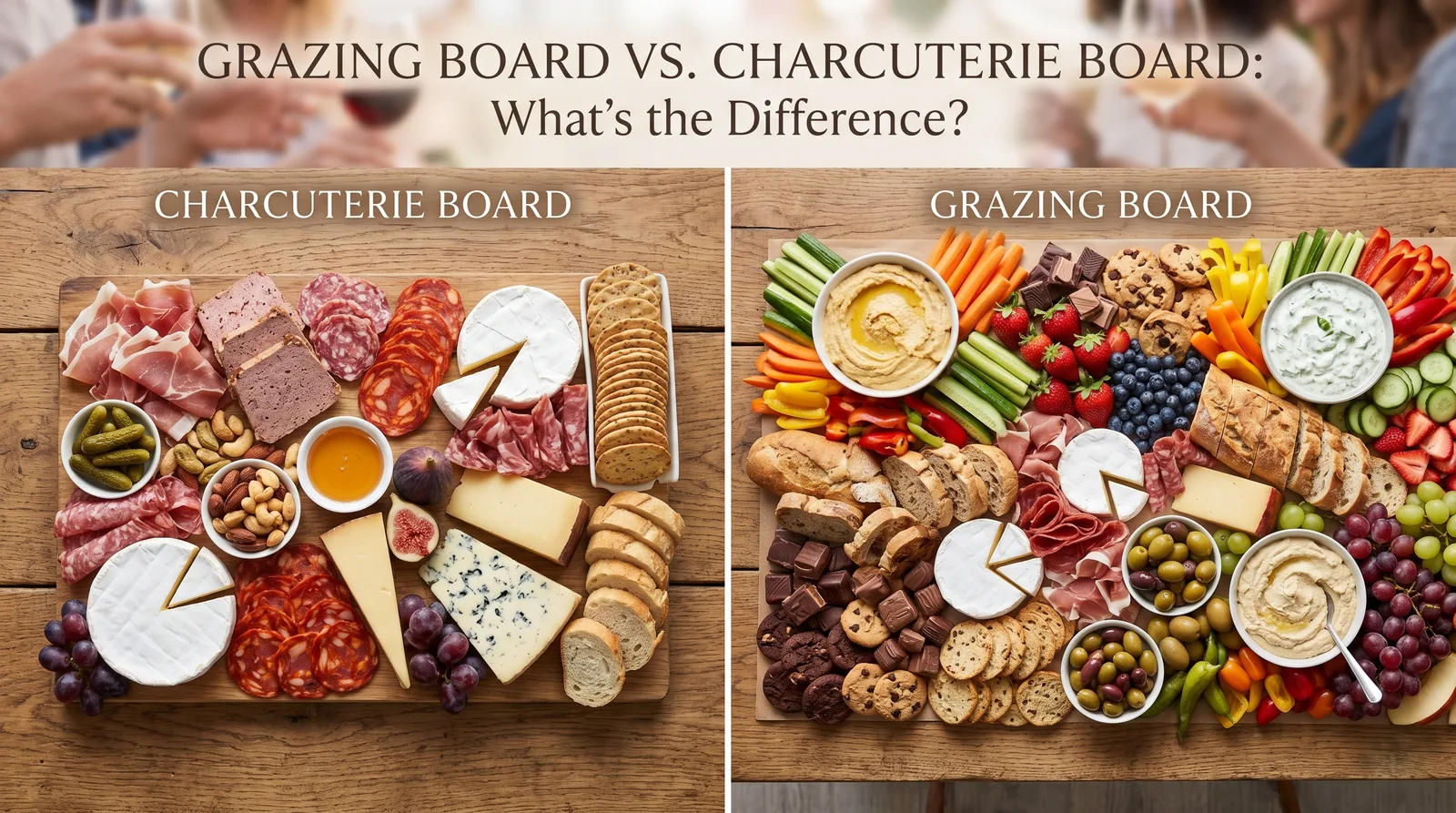
Charcuterie board: A board centered on charcuterie — the craft and product of cured meats. Traditionally includes salumi, jambon, pâté, or other preserved meat products alongside cheeses, with condiments, fruit, and crackers in supporting roles. The defining element is the cured meat and cheese pairing.
Grazing board: A format, not a food category. Any large platter or board where guests can help themselves continuously over an extended period. Can include charcuterie elements, but can also include fresh sandwiches, wraps, hot items, desserts, raw vegetables and dips, fruit arrangements, or any combination.
The overlap: a board that has cured meats, cheeses, and supporting elements is both a charcuterie board and a grazing board. The distinction matters when you're deciding what to include and how to plan quantities.
When to Build a Charcuterie Board
A charcuterie board is the right choice when:
The cured meat and cheese pairing is the point. If you're trying to showcase a specific Ibérico jamón, an exceptional Comté, or an interesting selection of Italian salumi, the charcuterie board format keeps the focus on those elements.
The occasion is a cocktail hour or wine-focused event. Charcuterie pairs naturally with wine — the salt, fat, and fermented complexity of cured meat enhances most wine styles. A board designed specifically to accompany wine should focus on the charcuterie elements rather than diluting with unrelated food categories.
You want quality over quantity. A focused charcuterie board of three excellent cheeses and two excellent meats is more impressive than a sprawling grazing board with twenty mediocre elements.
When to Build a Grazing Board
A grazing board is the right choice when:
Variety and volume for a diverse crowd. A large family gathering with varied dietary preferences benefits from the broad format — include charcuterie for meat-eaters, a vegetable section with dips for vegetarians, a sweet section for dessert preferences, and bread-heavy sections for everyone.
The occasion is casual and social. A birthday brunch, a casual gathering, a kids' party — these benefit from the informal, pick-what-you-want format that a grazing board enables better than a more curated charcuterie board.
You're feeding people a meal, not an appetizer. A grazing board can function as the meal itself with enough food volume. A charcuterie board typically functions as an appetizer or a focused accompaniment.
Budget requires strategic planning. A grazing board can be built more economically by extending with fresh produce, bread, and lower-cost elements alongside a smaller amount of premium charcuterie items.
Building Each Format
Charcuterie board build:
- Cheese anchors (3 types, 3 oz per person in total as the party food)
- Meat sections (2–3 types, 3 oz per person in total)
- Condiment bowls (honey, mustard, jam)
- Fruit (2–3 types, placed near pairing cheeses)
- Crackers (2 types, along board edges)
- Accent elements (olives, nuts, cornichons)
Grazing board build:
- Large anchor elements: dip bowls, cheese wheel, bread section
- Protein zone: charcuterie meats, possibly cooked proteins
- Fresh produce zone: crudités with dip, fresh fruit arrangements
- Bread and cracker zone: more substantial than a charcuterie board
- Sweet zone (if included): chocolates, cookies, seasonal dessert items
- Fill gaps with smaller elements
Quantity Differences
Grazing boards are typically larger in total volume because they cover more food categories. For the same guest count:
Charcuterie board for 10 (standalone): 25–30oz cheese, 20oz meat, 2 boxes crackers, 2–3 fruit types, condiments.
Grazing board for 10 (replacing a meal): 15–20oz cheese, 12–15oz meat, substantial bread, a dip, a full vegetable crudité section, fruit arrangement, possibly a sweet section. More total food, but the cheese and meat amounts are lower because other categories fill volume.
The Overlap
Most boards built in home entertaining contexts are hybrid — they include the charcuterie elements of cured meat and cheese as anchors, but extend into the broader grazing format with substantial produce, dips, and bread. This is neither wrong nor particularly worth categorizing precisely.
The practical question is: what is the primary experience? If the answer is "tasting great cured meats and cheeses," build a charcuterie board. If the answer is "everyone eats something and grazes for two hours," build a grazing board.
The Charcuterie Lab Takeaway
Charcuterie board: cured meat and cheese-centered, focused selection, paired with wine, three cheeses and two meats as the primary investment. Grazing board: broad format, any food elements, designed for maximum variety and volume across a crowd. Most boards built at home combine both — the distinction matters when you're deciding how to allocate budget and which elements to invest in.
Building more boards? The Charcuterie Lab ebook covers 50 boards in both formats with exact quantities, shopping lists, and build sequences.
FAQ
What is the difference between a grazing board and a charcuterie board?
A charcuterie board centers on cured meats and cheeses as the primary elements, with produce, condiments, and crackers in supporting roles. A grazing board is a broader concept — it can include all of those elements plus full sandwiches, wraps, cooked items, dips, desserts, and any other food that suits the occasion. Charcuterie is a category of food; grazing board describes a serving format. All charcuterie boards are grazing boards; not all grazing boards are charcuterie boards.
Which is better for a large party — a grazing board or a charcuterie board?
For large parties (20+ guests) grazing over 2–3 hours, a grazing board is more practical — it can include more food variety, accommodate different dietary needs in one format, and scale more easily. A charcuterie board is better when you want a focused, high-quality selection of cured meats and cheeses rather than a comprehensive spread. For a cocktail party appetizer, a charcuterie board. For a casual brunch feeding a crowd, a grazing board.
How do you build a grazing board?
A grazing board typically includes: cured meats and cheeses (as in charcuterie), plus a bread or cracker section, a fresh fruit section, a vegetable and dip section, and often a sweet section (chocolates, cookies, truffles, candied nuts). The format is usually larger than a charcuterie board and covers more food categories. Start with the largest elements (dip bowls, cheese wheels), then add meat, then fruit and vegetables, then fill gaps with smaller elements.
Can a grazing board replace a meal?
Yes — a well-built grazing board with sufficient variety and volume can serve as a light meal or a complete appetizer spread. A rule of thumb: to replace a meal for 10 guests, plan 3–4oz cheese, 3oz meat, substantial bread, a dip, and generous produce. A pre-meal board should be smaller to avoid filling guests before the main course.
What's the difference in cost between a grazing board and a charcuterie board?
Grazing boards are typically less expensive per person because they use more affordable elements (fresh vegetables, bread, crackers, seasonal fruit) to fill volume alongside the premium ingredients. A charcuterie board focused on aged cheeses and quality cured meats can cost $15–20+ per person. A grazing board that extends with produce, hummus, and bread might achieve similar visual impact at $8–12 per person while still including quality cheese and meat anchors.