Quick Answer: Burrata and prosciutto is a fat-on-fat pairing managed by salt chemistry. Prosciutto's sodium triggers salivary flow that primes the palate for burrata's cream, bridges residual lactic acid in the fresh cheese shell, and creates a salt-sweet contrast loop. The cured fat and cream fat share a lipid chemistry axis that produces aromatic resonance rather than richness competition. The pairing feels light because salt handles the balance.
Why Fat-on-Fat Works Here
Pairing two high-fat ingredients usually risks richness fatigue — the palate gets coated and dulled quickly, and the combination feels heavy rather than satisfying. Burrata (cream-filled) and prosciutto (significant intramuscular fat throughout) should have this problem. They don't, because prosciutto's salt manages the pairing at every stage.
The Lab Section: Why These Pairings Work
Salivary priming: Sodium chloride at the concentrations present in prosciutto (approximately 1,500–2,000mg per 100g in DOP products) is a potent salivary stimulant. Salivary flow is triggered by sodium in the oral cavity, and it begins before significant food breakdown has occurred. When prosciutto is eaten first in a bite, the salt initiates salivary flow that pre-wets the palate. When burrata's cream filling follows, the moisture-primed palate allows the cream to distribute more fluidly across receptor surfaces, producing a sensation of smoothness rather than heaviness.
Lactic acid bridging: Burrata's outer shell is fresh mozzarella, produced through the same heat-stretch process as traditional mozzarella. This involves heating curd in acidified whey and stretching at approximately 80–90°C. The fresh cheese retains some residual lactic acid and acetic acid from the acidification process, which can produce a slight sharp edge. Prosciutto's sodium ions complete salt bridges with these acidic compounds, reducing their perceived sharpness and allowing the cream filling's mild, milky sweetness to come forward.
Salt-sweet contrast: With the acidity bridged, the dominant contrast is between prosciutto's salt and burrata's cream sweetness. This is a classic salt-sweet contrast loop: sodium amplifies sweet perception, making the burrata's delicate sweetness more pronounced; the sweetness makes the salt seem cleaner and less aggressive. The loop is self-reinforcing over multiple bites.
Fat resonance: Prosciutto's intramuscular fat (primarily oleic acid, with significant palmitic and stearic) and burrata's cream fat (dairy fat with similar fatty acid profile) share a lipid chemistry axis. Fat-soluble aromatic compounds in prosciutto's cured fat are compatible with the cream fat matrix — they can distribute between the two fat phases rather than competing. The result is aromatic coherence: the combined fat profile reads as one unified flavor rather than two separate fat sources layering on each other.
How to Serve This on a Board
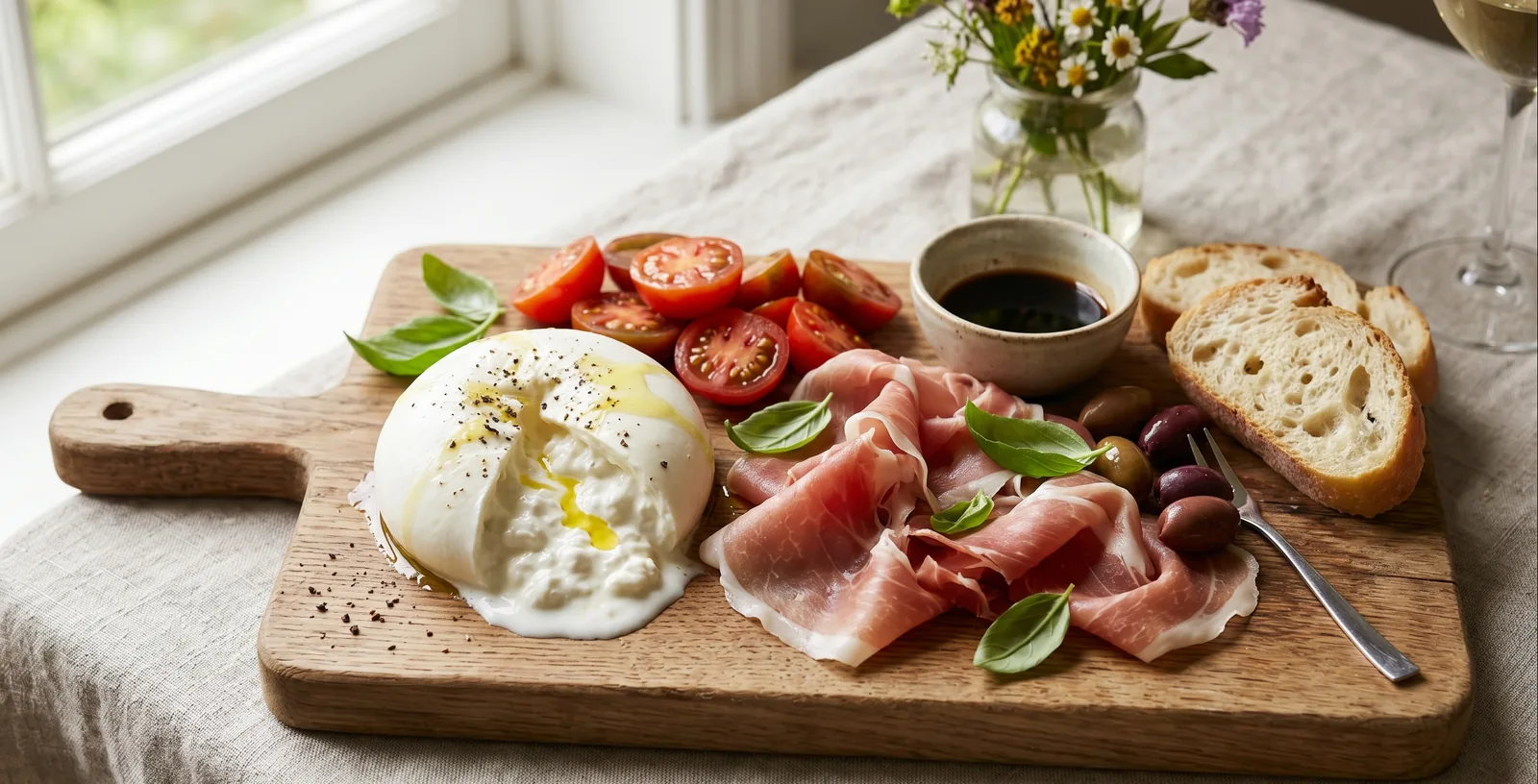
Burrata: One ball (125–150g) per 3–4 people. Serve whole at room temperature — guests break it open themselves. The visual of cream filling flowing onto the board is expected and part of the experience. Remove from refrigeration 20–30 minutes before serving; the cream needs to loosen.
Prosciutto: Paper-thin slices draped loosely around or next to the burrata. Prosciutto di Parma for clean, neutral pairing; San Daniele for a sweeter, more delicate profile. 3–4 slices per ball of burrata. Loose draping maintains texture — flat-pressed prosciutto loses its structural character.
Board placement: Burrata at center or anchor position; prosciutto immediately adjacent. The pairing works best when both components are reachable in a single reach, making it natural to eat them together.
Quantities for 4 people: 1 ball burrata (125–150g), 80–100g prosciutto (6–8 slices).
Variations Worth Trying
Add cherry tomatoes. Tomato's glutamate synergizes with both burrata's milk proteins and prosciutto's sodium amplification, deepening the savory dimension. Halved cherry tomatoes at room temperature are the easiest execution.
Add fresh basil. Basil's linalool is lipophilic and dissolves into burrata's cream fat, extending the aromatic experience. Tear leaves immediately before serving to minimize linalool oxidation.
Add a drizzle of olive oil. Olive oil's oleocanthal compounds interact with burrata's cream fat and extend aromatic release. This is the Italian tradition — light, good-quality olive oil over the broken burrata.
Building more boards? The Charcuterie Lab ebook covers 50 boards with exact quantities, shopping lists, and the science behind every pairing.
The Charcuterie Lab Takeaway
Burrata and prosciutto is a fat-on-fat pairing held together by salt chemistry: salivary priming, lactic acid bridging, and salt-sweet contrast. The cured fat and cream fat resonate on a shared lipid axis rather than competing. Serve both at room temperature, drape prosciutto loosely, and let guests break the burrata open. The pairing scales from a simple two-ingredient board to the full Italian four (add tomato and basil) without losing coherence.
FAQ
Why does prosciutto pair so well with burrata?
Prosciutto's sodium triggers salivary flow that primes the palate for burrata's cream, bridges residual lactic acid in the fresh cheese shell, and creates a salt-sweet contrast loop with the burrata's mild sweetness. The cured fat and cream fat also resonate on a shared lipid axis, producing aromatic coherence rather than competing richness.
Should I use Prosciutto di Parma or San Daniele?
Both work well. Prosciutto di Parma has a cleaner, more neutral cure that lets burrata's delicate cream flavor lead. San Daniele is slightly sweeter and more delicate, which pairs particularly well with burrata's sweetness. Avoid prosciutto that is overly salty or aggressively dry-aged — it can overpower burrata's subtlety.
How should I plate burrata and prosciutto together?
Serve the burrata whole and allow guests to break it open — the visual of the cream spilling onto the board is part of the experience. Drape prosciutto slices loosely around the burrata rather than underneath it; flat-pressed prosciutto loses texture. Serve at room temperature: burrata 20–30 minutes out of refrigeration, prosciutto at ambient.
What temperature should burrata be when served?
Room temperature — remove from the refrigerator 20–30 minutes before serving. Cold burrata has dense cream that doesn't flow and suppressed fat volatility. At room temperature, the cream loosens to a pourable consistency and the aromatic compounds in the fat become more volatile and accessible.
What else can I add to burrata and prosciutto on a board?
Tomatoes add glutamate that synergizes with the salt amplification mechanism. Basil adds fat-miscible linalool that distributes through burrata's cream for aromatic extension. The full Italian four — burrata, prosciutto, tomato, basil — uses four simultaneous mechanisms and is one of the most complete board pairings available.