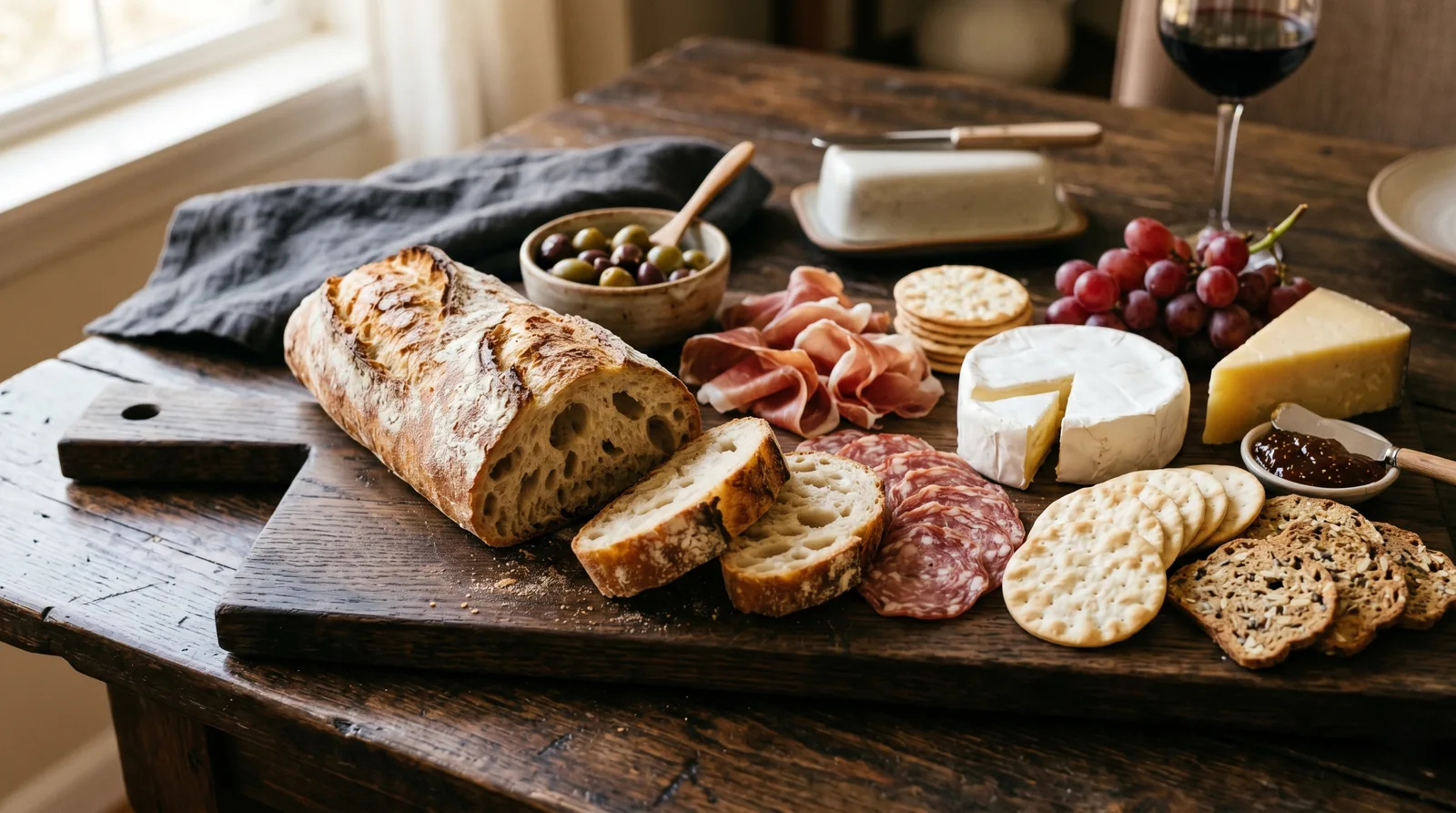
Bread on a charcuterie board is structural and functional — it's not decoration. The right choice depends on what's sitting next to it on the board: a spreadable, rich brie needs different support than a dry, crystalline aged cheddar. Getting the bread right means understanding what it's supposed to do.
Quick Answer: Sliced sourdough baguette is the best default bread for a charcuterie board. Its fermentation notes complement cured meats, its crust holds up under toppings, and its neutral flavor doesn't compete with bold cheese. Add a second option — flatbread or focaccia — for variety. Keep both off the board until just before guests arrive, and replenish from reserve rather than over-piling at the start.
The Two-Category Rule
Every charcuterie board needs two types of carbohydrate carrier:
Neutral crackers (one or two varieties) — thin, relatively flavorless, whose job is to carry the topping without adding complexity. Water crackers, plain rice crackers, and simple flatbreads do this well.
Bread with character (one type) — sourdough baguette, focaccia, or dark rye — whose fermentation or grain notes actively contribute to the flavor of the bite.
A board with only neutral crackers tastes one-dimensional. A board with only character bread can overwhelm more delicate elements. Use both.
The Best Bread Options
Sourdough baguette is the strongest default. Sliced into ½-inch rounds, it provides a firm base with enough crust integrity to support brie, aged cheddar, or prosciutto without collapsing. The lactic and acetic acids from fermentation resonate with the fermentation notes in cured meats — this is not incidental. Sourdough and salami were made for each other.
Focaccia is the right choice when the board includes spreadable elements — nduja, whipped ricotta, or any runny soft cheese. Its open crumb absorbs fat without disintegrating, and the olive oil base provides a savory bridge between bread and topping.
Dark rye or Scandinavian crispbread works for boards built around smoked salmon, gravlax, or northern European cheese. Dense, slightly bitter, with malt notes that amplify smoked proteins.
Irish brown bread for boards with an Irish or British character — particularly appropriate alongside Stilton, smoked salmon, or aged cheddar.
Flatbread — baked or grilled — is the most neutral of the bread options and works where you want bread's texture without adding flavor. Good for boards with several strong flavors already present.
What to Avoid
Soft sandwich bread. It has no structural integrity. It goes soggy the moment anything touches it. It belongs nowhere near a charcuterie board.
Heavily flavored artisan breads. Sun-dried tomato bread, olive bread, and heavily herb-crusted loaves compete with the board's cheeses and meats. Unless the board is explicitly built around those flavors, keep the bread neutral.
Sweet bread. Brioche and challah are excellent in many contexts. On a charcuterie board, their sweetness clashes with salty cured meats and makes dry cheeses taste even more abrasive.
Pre-sliced packaged bread. Soft, uniform, and structurally flimsy. Slice fresh.
Crackers Alongside Bread
The best boards use 2 cracker types alongside 1 bread type:
Cracker 1 — neutral: Water cracker, plain rice cracker, or simple flatbread cracker. The base for mild cheeses and anything where you don't want competition.
Cracker 2 — slightly flavored: Rosemary crackers, sesame seed crackers, or seeded crispbread. Adds visual texture and works alongside aged hard cheeses where the cracker's flavor is a complement, not a distraction.
Timing and Replenishment
Bread and crackers are the most time-sensitive elements on the board:
Crackers begin to soften within 30–45 minutes of contact with moisture from neighboring cheese or meats. Do not pile them on the board an hour before guests arrive.
Bread holds up longer but dries out if sliced too far in advance. Slice within 30 minutes of serving.
The correct approach: Keep backup bread and crackers off the board. Set out a moderate amount, replenish every 20–30 minutes. The board looks actively maintained rather than depleted.
Crackers last. In the assembly sequence — cheese first, meat second, condiments third, crackers and bread last — crackers are placed immediately before service.
Portion Guide
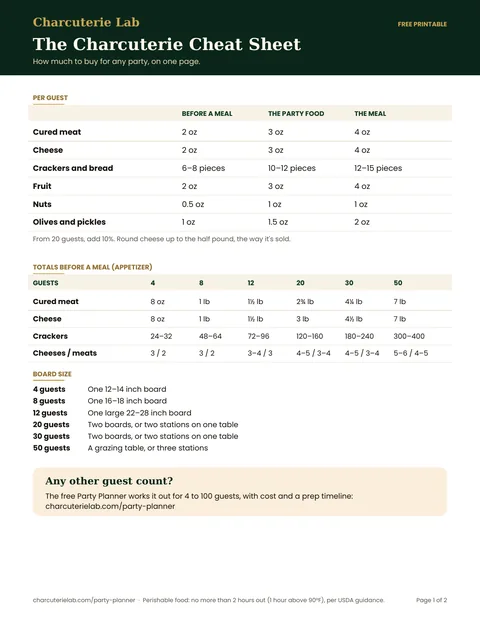
For an appetizer board:
- 3–4 slices of bread per person
- 6–8 crackers per person (across both types)
Keep 30–40% of the total in reserve for replenishment.
Building more boards? The Charcuterie Lab ebook walks through 50 boards across every occasion — each one with exact quantities, a shopping list, and the science behind why it works.
The Charcuterie Lab Takeaway
Use a sourdough baguette as the board's primary bread — its fermentation character is an active contributor, not a neutral filler. Add two cracker varieties: one neutral, one with slight character. Keep everything off the board until immediately before service, replenish from a reserve supply, and never use soft sandwich bread or heavily flavored artisan loaves. The bread is the foundation; treat it like one.
FAQ
What is the best bread for a charcuterie board?
Sliced sourdough baguette is the most versatile choice — its crust holds up under toppings, its fermentation notes complement cured meats, and its neutral flavor doesn't compete with bold cheeses. For a board with varied elements, a baguette covers most situations. Focaccia works as a secondary option when you want something softer.
Should you use crackers or bread on a charcuterie board?
Both — they serve different functions. Crackers are neutral and structural, best under mild cheeses and meats where you don't want the base to add flavor. Bread adds fermentation complexity, is better for spreadable elements like nduja or brie, and provides textural contrast. A board with only one or the other is missing something.
How much bread do you need for a charcuterie board?
Plan 3–4 slices of bread or 6–8 crackers per person for an appetizer board. Bread and crackers disappear faster than guests expect — keep extras nearby and replenish rather than over-piling at the start, as crackers go soft within 30 minutes on a board.
Can you use toasted bread on a charcuterie board?
Yes — lightly toasted bread holds up better under spreadable toppings like brie or nduja, and the toasting adds a subtle caramelization that complements aged cheeses. Do not over-toast; hard, crunchy toast slabs are difficult to eat with toppings. Aim for lightly golden, not brittle.
What bread should you avoid on a charcuterie board?
Avoid soft sandwich bread — it has no structural integrity and becomes soggy immediately under any topping. Avoid heavily flavored artisan breads (sun-dried tomato, olive, herb-heavy) unless you're building around those specific flavors. These compete with the board's cheeses and meats rather than supporting them.