The most reliable pairing advice in charcuterie is also the most counterintuitive: choose ingredients that differ from each other. Not just in flavor, but in texture, intensity, and taste register. The conventional logic suggests that similar things pair well because they share common ground — but on a board, it's the gaps between elements that create the most satisfying eating experience.
The reason is neurological and chemical, and it's worth understanding if you want to build boards that work consistently rather than by accident.
Quick Answer: Contrast pairings work because opposing flavors — salty with sweet, rich with acidic, creamy with firm — activate different taste receptors that amplify each other through mutual inhibition and enhancement. A sharp aged cheese tastes sharper next to honey, and the honey tastes more complex next to the cheese. This bidirectional amplification is why contrast-built boards satisfy more per bite than harmony-built ones.
How Taste Perception Works
The tongue and palate contain taste receptor cells organized into papillae. Each receptor type — sweet, salty, sour, bitter, umami — responds to specific chemical stimuli. Critically, these systems don't operate in isolation. They interact through inhibition and enhancement: signals from one receptor type influence how others fire.
The most studied interaction is salt and sweet. At low-to-moderate concentrations, sodium chloride (salt) inhibits bitter taste receptors through a mechanism involving amiloride-sensitive ion channels. This suppression of bitterness makes sweetness more prominent — you're not adding sweet, you're removing the competing bitter signal. Simultaneously, sweet compounds at low concentrations reduce the perceived intensity of saltiness. The result is a mutually amplifying system: each element makes the other taste more vivid.
This explains why prosciutto and melon is a classic, why blue cheese and honey is one of charcuterie's most reliable pairings, and why salted caramel registers as more complex and satisfying than either plain caramel or plain salt alone.
The Role of Sensory Adaptation
A less intuitive reason contrast works involves sensory adaptation. When a taste receptor fires repeatedly in response to the same stimulus, it downregulates — the signal gets quieter the longer it's sustained. This is why the third cracker with the same cheese tastes less intense than the first.
Contrast interrupts adaptation. When you move from a salt-forward element to a sweet one, you're activating a different receptor population. The salty receptors, briefly rested, fire strongly again when you return to the salty element. Each shift between contrasting flavors resets the relevant receptors, keeping perception sharp across an extended grazing period.
This is a practical argument for contrast over complementary pairing on a board specifically. Complementary pairings — similar flavor registers grouped together — create harmony but accelerate adaptation. Boards grazed over an hour benefit from contrast because it keeps the eating experience engaging. Guests don't notice this consciously; they just notice that the board holds interest.
Fat, Acid, and the Palate Cleanse
Rich, fatty elements and acidic elements work together through a different mechanism. Fat coats the palate — it creates a film over taste receptors that temporarily mutes incoming flavor signals. Acid cuts through fat by breaking down the coating physically and chemically. After a bite of rich aged cheddar or fatty salami, a squeeze of lemon, a bite of acidic fruit, or a sip of wine with tartaric acid clears the palate and restores receptor sensitivity.
This is why acidic accompaniments — fruit preserves, cornichons, pickled vegetables, wine — appear on charcuterie boards and cheese plates across every food culture. They're not decorative. They're palate-clearing tools that maintain flavor clarity across multiple bites.
The practical implication: include at least one acidic element on every board. Grapes, apple slices, fig preserves with natural tartness, or a small dish of cornichons all serve this function. Without an acid counterpoint, the board gets heavy faster.
Texture Contrast and Tactile Satisfaction
Flavor contrast has a tactile parallel. The mouth registers not just taste but texture — firmness, creaminess, crunch, chewiness. Research in food science shows that textural variety increases eating satisfaction and perceived flavor intensity even when the flavor profile is held constant.
The mechanism is partly mechanical: different textures require different jaw pressures and rates of saliva production, which changes how flavor compounds are released and reach taste receptors. A soft creamy cheese releases flavor quickly and uniformly; a hard crystalline cheese releases flavor in concentrated bursts as the crystals break down.
On a board, textural contrast means pairing a creamy soft element with a firm crunchy one. Brie on a flaky cracker. Blue cheese with a hard candied walnut. Smooth fig jam against the dry crumb of a water cracker. The contrast in texture makes each bite feel more complete — and the variety prevents the textural fatigue that comes from eating the same mouthfeel repeatedly.
How to Apply This on a Board
Contrast pairing logic translates to five practical decisions when building a board:
Choose one soft and one aged cheese. The textural and flavor contrast between them (creamy + crystalline, mild + sharp) forms the foundation of contrast pairing on the cheese side.
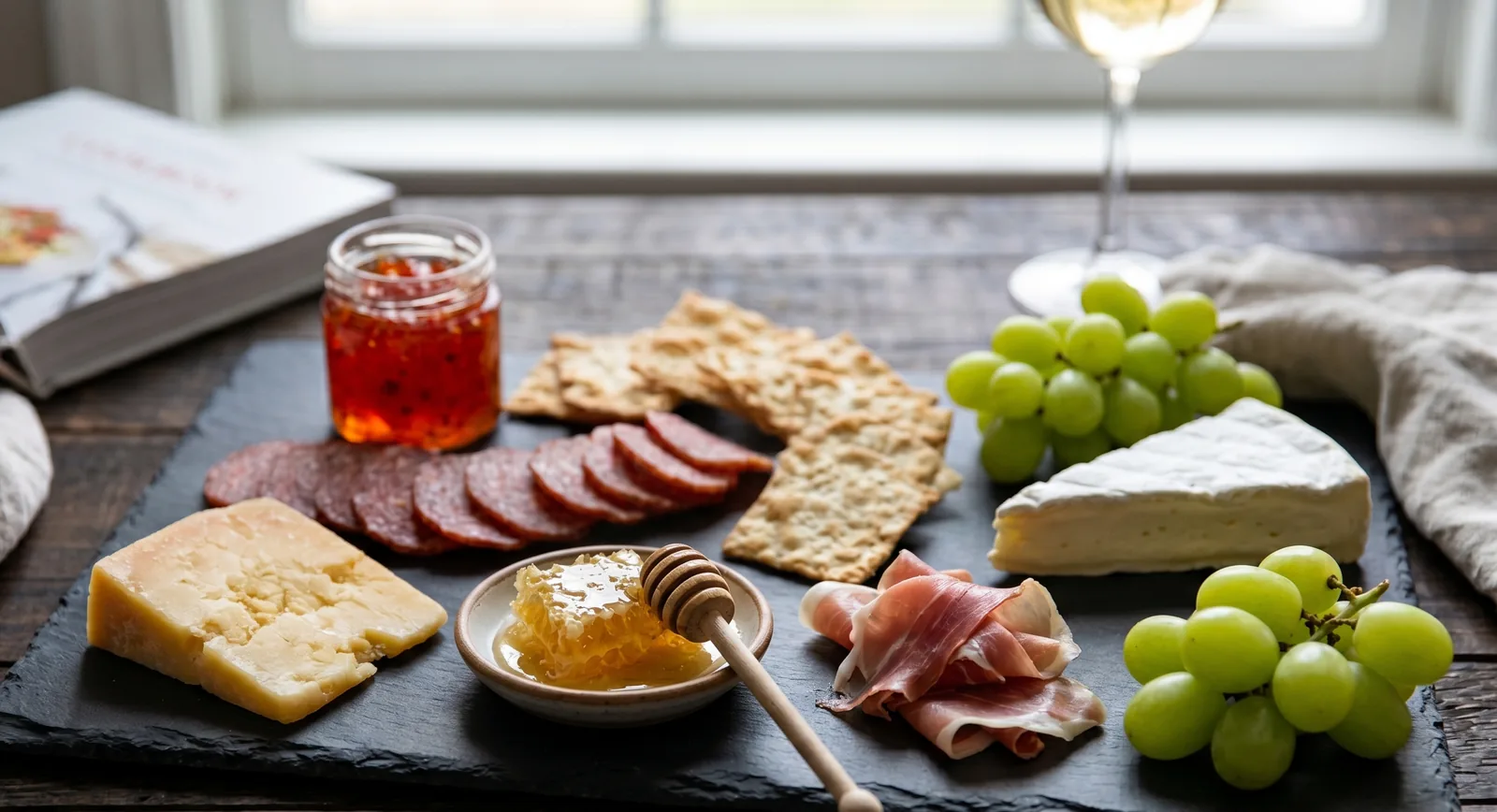
Choose one mild and one assertive meat. Prosciutto and soppressata. Bresaola and finocchiona. The quiet one amplifies the bold one and vice versa — each tastes more like itself next to the other.
Include one sweet accompaniment. Honey, fig jam, fruit compote, or fresh fruit. Salt-sweet contrast is the most reliable amplifier on a board and the one guests notice most clearly.
Include one acidic element. Cornichons, fresh grapes, apple slices, or a tart preserve. This clears fat from the palate and resets receptor sensitivity for the next bite.
Use texture-contrasting crackers. Offer at least two cracker types with different textures — a flaky one and a firm one. This extends contrast into the vehicle layer of each bite.
The Charcuterie Lab Takeaway
Contrast pairings work because flavor perception is a system, not a sum. Opposing elements don't cancel each other — they amplify each other through receptor interactions, adaptation cycles, and palate-clearing chemistry. A sharp cheese tastes sharper next to something sweet. A sweet accompaniment tastes more complex next to something salty and aged. The gap between elements is where flavor happens.
Build every board around contrast first. Add complementary elements to fill gaps. And always include an acid — it's the reset mechanism that keeps the board engaging from first bite to last.
Building more boards? The Charcuterie Lab ebook walks through 50 boards across every occasion — each one with exact quantities, a shopping list, and the science behind why it works.
FAQ
What does pairing by contrast mean on a charcuterie board?
Pairing by contrast means choosing elements that differ from each other in flavor intensity, texture, or taste register — salty with sweet, creamy with firm, rich with acidic. The opposing qualities don't cancel each other out; they amplify each other. A sharp aged cheese tastes sharper next to a sweet jam, and the jam tastes more complex next to the cheese.
Why does salt and sweet taste so good together?
Salt suppresses bitterness and enhances sweetness perception by inhibiting bitter taste receptors at low concentrations. Meanwhile, sweet signals reduce the perceived intensity of saltiness. The result is a mutually amplifying loop — each element makes the other more vivid without either dominating. This is why prosciutto and melon, blue cheese and honey, and salted caramel all work so well.
Is contrast pairing better than pairing similar flavors?
For charcuterie boards, yes — because the board is grazed over time. Complementary pairings (similar flavors) create harmony that's pleasant in small doses but leads to palate fatigue during extended grazing. Contrast pairings reset perception between bites, keeping the palate engaged longer. Both approaches have value; contrast is more functional for boards specifically.
What are the best contrast pairings on a charcuterie board?
The most reliable contrast pairings: aged sharp cheese + sweet honey or jam, salty prosciutto + mild fresh fruit, funky blue cheese + sweet accompaniment, creamy brie + acidic fruit preserves, spiced salami + mild soft cheese. In each case, one element is high-intensity and the other provides a counterpoint that amplifies rather than overwhelms.
Can you over-contrast on a charcuterie board?
Yes. Contrast works through amplitude — a mild sweet next to a sharp salty. If every element is extreme (intensely salty, intensely sweet, intensely bitter, intensely acidic), there's no baseline to contrast against. The board becomes overwhelming rather than balanced. Anchor the board with one or two neutral elements — plain crackers, mild fresh cheese — that give the palate a reset point.