Quick Answer: Grapes (no prep, universal pairing), sliced pear or apple (acid contrast with aged cheese), and strawberries or blackberries (color and light acidity) are the core fruit selection for any board. Fresh figs and dried apricots add range. Fruit should cover 15–20% of the board surface — accent, not equal to cheese and meat in volume. Place juicy fruit away from soft cheese.
The Four Roles of Fruit on a Board
Fruit isn't decoration. Every piece of fruit that earns a place on a charcuterie board fills at least one functional role:
1. Acid contrast: The primary job. Fruit acids — malic acid in apples and pears, citric acid in berries, tartaric acid in grapes — cut through the fat saturation of cheese and cured meat, resetting the palate between bites. Without acid contrast, a board of rich cheese and fatty meat becomes monotonous quickly.
2. Sweet bridge: Fruit sweetness bridges the saltiness of cured meats and the sharpness of aged cheeses. The fructose in ripe fruit activates sweet receptors that temporarily suppress bitter receptor sensitivity, which is why a slice of pear after aged cheddar makes the next bite of cheddar taste less sharp.
3. Color and visual variation: Charcuterie boards are largely monochromatic (beige, cream, pale yellow, pink). Fruit provides the most efficient color injection — dark red strawberries, deep purple blackberries, bright green grapes, orange dried apricots.
4. Textural contrast: The crisp snap of a fresh apple slice, the burst of a grape, the chew of a dried apricot — these textural elements break up the consistent softness of cheese and the tender chew of cured meat.
The Core Fruit Selection
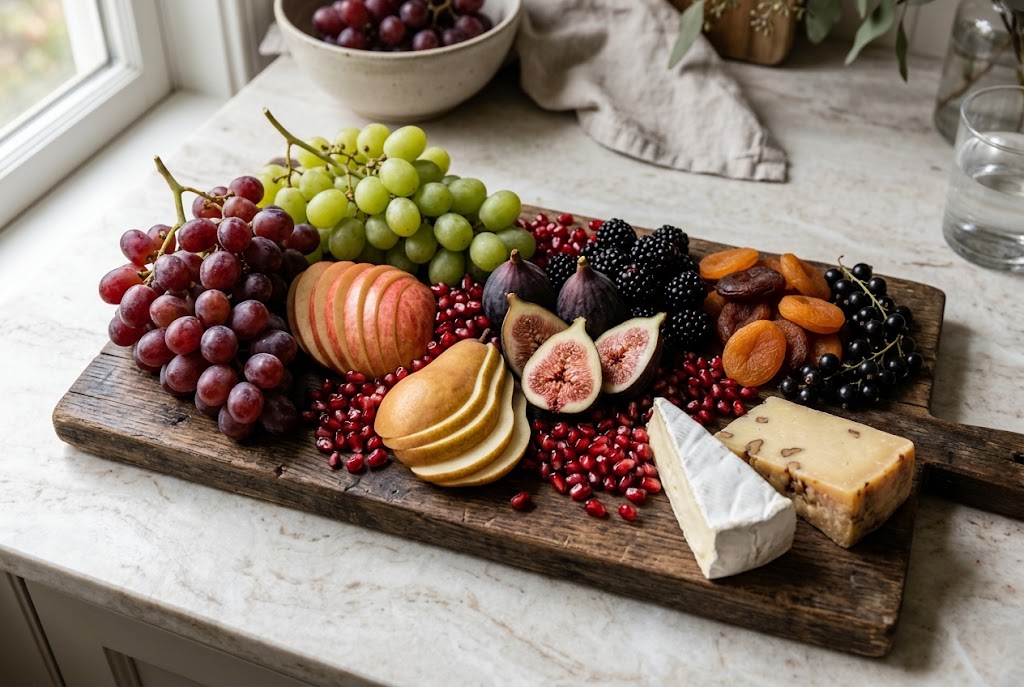
Grapes: The board standard and the safest choice. Grapes require no cutting, stay fresh for 2–3 hours at room temperature, pair with virtually every cheese and meat on the board, and provide color. Red and black grapes are more visually interesting than green on most boards, but any color works. Use a small cluster — not a large mound.
Sliced pear: The strongest pairing fruit for aged cheese (cheddar, Manchego, Parmigiano) and soft-rind cheese (brie, camembert). Contains both malic acid and small amounts of tartaric acid — a multi-acid profile that creates more textural contrast with fat than single-acid fruits. Bartlett and Bosc pears are the board standard. Cut no more than 20 minutes before serving to prevent oxidation; a squeeze of lemon juice slows browning if cutting further in advance.
Apple wedges: Similar logic to pear but more familiar to most guests. Granny Smith provides sharper malic acid contrast; Honeycrisp adds sweetness alongside the acid. Apple and aged cheddar is one of the most reliable combinations on any board.
Strawberries: The primary berry choice for boards. Their combination of visual impact (deep red against pale cheeses), mild citric-malic acidity, and approachable sweetness makes them versatile. Pair with brie, chèvre, and prosciutto. Leave the hull on — it's a natural handle and adds visual character.
Blackberries: The most visually dramatic fruit option. Deep purple, almost black — they photograph exceptionally well on boards with a dark surface or pale cheeses. Their malic-citric acidity pairs well with aged cheddar and Manchego. More assertive than strawberries.
Fresh figs: When in season, one of the best fruit choices — their tannin-sweetness balance works with a wider range of cheeses than almost any other fruit (see the fig jam post for the mechanisms). Halve them for visual impact. Outside of peak season (August–October), dried figs are the year-round alternative.
Dried apricots: Tartaric acid, concentrated sweetness, chewy texture, and vivid orange color. Pairs well with aged hard cheeses. The tartaric acid provides a slightly more complex acid profile than malic alone.
Dried cranberries: Tart, chewy, visually distinct. Works well with aged cheddar and Manchego. A small quantity goes a long way — they can dominate if over-represented.
Dried Fruit on Boards
Dried fruit earns a separate category because it functions differently from fresh fruit.
Concentrated sweetness: Dried fruit has had most of its water removed, concentrating the sugars. A dried fig is much sweeter per bite than a fresh fig — a little goes further.
Extended shelf life at room temperature: Unlike fresh-cut fruit that begins oxidizing and softening within 20–30 minutes, dried fruit holds its quality for the duration of most events.
Chewy texture: The chewy texture of dried apricots, dried figs, and dried cranberries provides a textural element fresh fruit doesn't.
The most useful dried fruits for boards: dried apricots (color, tartaric acid, sweet-tart balance), dried figs (year-round alternative to fresh), and dried cranberries (tart punctuation). Medjool dates are excellent when you want a more luxurious, intensely sweet element near aged cheese.
Placement Logic
Keep juicy fruit separated from soft cheese. Strawberries, blackberries, and halved fresh figs release juice that accelerates soft cheese breakdown after 15 minutes of direct contact. Place these fruits in their own zone or at the board's edge.
Position sliced fruit near its pairing cheese. Pear slices adjacent to brie or aged cheddar signal the pairing. Apple wedges near Manchego. The proximity tells the story without labels.
Grapes as fill. Grapes can go anywhere on the board — use them to fill gaps between elements and to bridge the distance between distinct sections. A small grape cluster at the corner of the board signals abundance.
Dried fruit near aged cheese. Dried apricots and figs belong near the hard cheese section where their sweetness and tannins interact most productively.
Building more boards? The Charcuterie Lab ebook covers 50 complete boards — each with specific fruit selections, quantities, and placement logic matched to the cheese and meat selections.
The Charcuterie Lab Takeaway
Fruit is the element that does the most work per square inch on a charcuterie board — acid contrast, sweet bridging, color, and textural variation, all from a small amount of space. Grapes and sliced pear are the foundation for most builds. Strawberries or blackberries add color and acidity. Fresh figs in season are exceptional; dried apricots fill the role year-round. Keep the total fruit volume at 15–20% of the board surface — enough to accent, not enough to overwhelm.
FAQ
What fruit goes best on a charcuterie board?
Grapes are the board standard — they stay fresh for hours, require no cutting, and pair with nearly every cheese and meat. Sliced pears and apple wedges are the strongest pairing fruit (malic acid contrast with aged cheese). Strawberries, blackberries, and fresh or dried figs round out the fruit section. Each adds distinct flavor logic, not just color.
Should you use fresh or dried fruit on a charcuterie board?
Both. Fresh fruit (grapes, berries, sliced pear) provides acidity, color, and textural contrast. Dried fruit (dried apricots, dried cranberries, dried figs) provides concentrated sweetness and a chewy textural element that fresh fruit doesn't. Using at least one of each gives the board more range.
How much fruit should be on a charcuterie board?
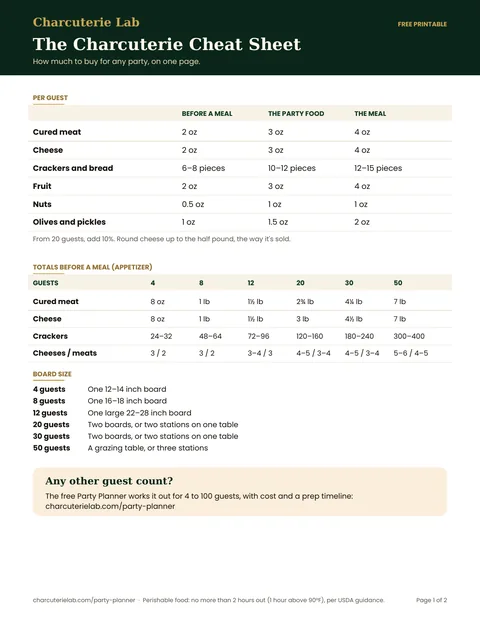
Fruit should cover approximately 15–20% of the board surface — present but not dominant. Grapes (a small cluster) plus one or two other fruit types is the standard. Over-loading with fruit makes the board look like a fruit platter with cheese; the fruit should accent the cheese and meat, not equal them in volume.
Where do you place fruit on a charcuterie board?
Place fruit adjacent to the cheeses it pairs with best — sliced pear or apple near aged cheddar or brie; grapes as fill across multiple sections; dried apricots near aged hard cheeses. Keep juicy fruit (strawberries, blackberries, halved figs) in their own zone or on the board edge — juice from cut fruit can accelerate soft cheese breakdown after 15 minutes of contact.
Can you put citrus on a charcuterie board?
Use citrus as a garnish and flavor accent rather than a primary fruit. Lemon slices near smoked salmon, thin orange slices as color accents, or small mandarin segments work well. Avoid placing whole-cut citrus directly against soft cheeses — the high acidity breaks down soft cheese faster than other fruit acids. A small ramekin of lemon wedges near smoked salmon is the practical citrus application.