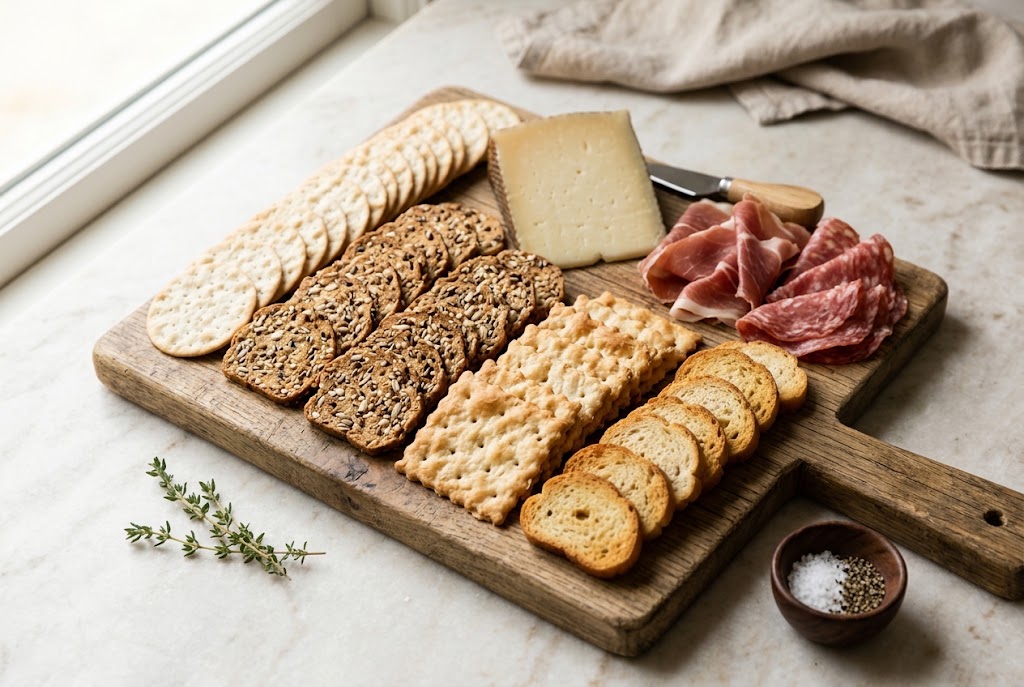
Quick Answer: A charcuterie board needs two types of crackers: one neutral (water crackers, plain flatbread) that works with every element on the board, and one flavored or textured (sesame, multigrain, rye, rosemary) that adds its own register. One neutral is non-negotiable. The flavored cracker is secondary. Three cracker types is the maximum — more than that and the crackers dominate the board.
The Two-Category Rule
Every cracker on a charcuterie board falls into one of two functional categories:
Category 1 — Neutral carrier: A cracker that doesn't add its own flavor, only structure. Water crackers, plain flatbreads, and unseasoned melba toast fall here. These crackers exist to deliver cheese and meat to the mouth without contributing anything of their own. They work with every element on the board — from the most delicate soft cheese to the most assertive aged hard cheese.
Category 2 — Flavored or textured: A cracker that adds its own flavor register. Sesame crackers, rosemary crackers, multigrain crackers, rye crispbreads, and seeded flatbreads. These provide more interest but have limitations — a strongly rosemary-flavored cracker overwhelms a delicate fresh chèvre but works well with aged cheddar.
The two-category approach ensures that every guest can build a bite with any element on the board (using the neutral cracker) while having an option that adds complexity where it's appropriate (using the flavored cracker).
Category 1: Neutral Crackers
Water crackers: The board standard. Crisp, light, virtually flavorless. Pairs with every cheese and meat on any board. The default choice when in doubt. Look for versions without added sugar or strong seasoning.
Plain flatbreads / lavash: Slightly more substantial than water crackers, with a mild wheaty note that doesn't interfere with cheese. The larger surface area works well with soft cheeses like brie — you can get a meaningful spread in one bite.
Unseasoned melba toast: Thinner than flatbread, with a slight toasted note. Pairs particularly well with aged hard cheeses and pâté.
Plain rice crackers: A lighter option with a neutral flavor. Works for guests who need a gluten-free option.
Category 2: Flavored and Textured Crackers
Sesame crackers: The most versatile flavored cracker for boards. The sesame's nutty, slightly sweet character works with a range of cheeses without overpowering anything except the most delicate soft cheeses.
Rye crispbreads: The strongest match for smoked salmon, aged cheddar, and anything in the bold-and-assertive register. Their earthy, slightly bitter flavor provides genuine contrast rather than neutral support. Not ideal for soft cheeses.
Multigrain crackers: A middle-ground option. More interesting than plain but not as assertive as rye. Works with semi-firm cheeses (Manchego, Gouda), aged cheddar, and hard salami.
Rosemary or herb crackers: Pair well with aged hard cheeses and lamb-based charcuterie. Can overwhelm delicate cheeses — use with caution near brie or chèvre.
Dark seeded crackers (black sesame, poppy seed): Visually distinctive and flavorful. Best with aged and assertive cheeses; visually strong against lighter cheeses on the board.
Matching Crackers to Cheese
| Cheese type | Best cracker |
|---|---|
| Fresh soft (chèvre, brie, camembert) | Water crackers, plain flatbread |
| Semi-firm (Manchego, young Gouda) | Water crackers, sesame, multigrain |
| Aged hard (cheddar, Parmigiano, Manchego Viejo) | Rye, multigrain, sesame, seeded |
| Blue cheese | Water crackers, plain flatbread, rye |
| Smoked salmon | Rye crispbreads, water crackers |
The neutral cracker is always appropriate. The flavored cracker is selective.
Bread vs. Crackers: The Functional Difference
Bread and crackers are not the same category on a board, even though both serve as carriers.
Bread (sourdough baguette slices, focaccia, pain de campagne) has its own flavor — specifically fermentation flavor from the sourdough cultures. This fermentation resonance works exceptionally well with aged cured meats and hard cheeses where the fermentation chemistry echoes. Bread also has moisture, which softens the eating experience and makes it easier to eat larger portions of richer elements.
Crackers are crisp, dry, and neutral or controlled in flavor. Their dryness contrasts with the fat and moisture in cheese and meat, creating a textural experience bread doesn't provide.
Both belong on a complete board. Add bread in small batches and replenish as it dries out; crackers last longer at room temperature.
Quantity and Placement
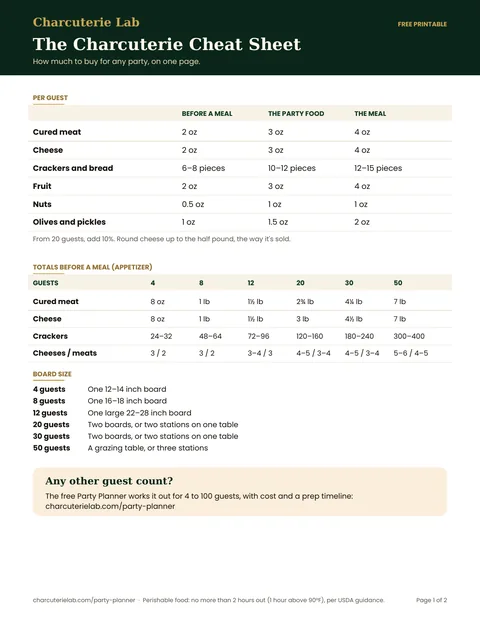
Quantity: 6–8 cracker pieces per person as a starting point. Crackers are the element most frequently replenished — guests take more than they think. Keep reserve crackers nearby and add in small amounts rather than loading the full quantity upfront. A pile of crackers that's sat out for an hour absorbs humidity and goes soft.
Placement: Crackers don't need to be grouped together. Distribute them in sections around the board, adjacent to the elements they pair with best. Neutral crackers can go anywhere; rye crackers placed near the smoked salmon or aged cheddar signals their pairing context.
Don't obscure food: Crackers are a common culprit for obscuring the cheese and meat they're meant to accompany. Avoid building walls of crackers that block the view of what's behind them.
Building more boards? The Charcuterie Lab ebook covers 50 complete board builds — each with specific cracker selections, quantities, and placement logic for every occasion.
Common Mistakes
Only one cracker type. A board with only water crackers works but misses the opportunity for the flavored cracker to add complexity. A board with only rye crackers will overwhelm soft cheeses.
Too many cracker types. Three is the maximum. More than that and the board becomes a cracker display rather than a cheese board. Restraint signals confidence.
Stale crackers. Crackers absorb humidity from the cheese, the board, and the air. Don't load the full quantity upfront — add small amounts at a time and replenish from a sealed bag.
Crackers that compete with the cheese they're next to. Heavily seasoned crackers (strong garlic, very intense rosemary) next to a delicate brie eliminate the cheese's flavor. Match the intensity level of the cracker to the intensity of the cheese nearby.
The Charcuterie Lab Takeaway
The two-category cracker rule is the simplest framework for getting crackers right: one neutral, one flavored, maximum three total. The neutral cracker does the essential work of pairing with every element; the flavored cracker adds a secondary register where it's appropriate. Keep them fresh by adding in small batches, position them near the elements they complement, and resist the urge to over-represent crackers on the board.
FAQ
How many different crackers should I put on a charcuterie board?
Two types is the practical standard: one neutral cracker (water crackers, plain flatbread) and one flavored or textured cracker (sesame, rosemary, multigrain, rye). One neutral cracker works with every element on the board. The flavored cracker adds a secondary register for guests who want more complexity. Three cracker types is the maximum before the board becomes a cracker display.
What crackers go best with soft cheese on a charcuterie board?
Thin water crackers or plain flatbreads are the strongest match for soft cheeses — they don't compete with the delicate flavor profile of brie, camembert, or chèvre. A cracker with rosemary or strong seasoning overwhelms soft cheese entirely. Keep the cracker neutral when the cheese is the star.
What crackers pair with aged hard cheese on a charcuterie board?
Aged hard cheeses (cheddar, Manchego, Parmigiano) can handle more assertive crackers — multigrain, seeded, or rye crispbreads all work well. The stronger flavor profile of aged cheese doesn't get lost next to a seeded cracker the way a soft cheese would. Rye crackers are particularly good with anything in the aged-and-bold register.
Should you put bread and crackers on the same charcuterie board?
Yes, but treat them as separate categories. Bread (sourdough baguette slices, focaccia) and crackers serve different functions — bread has a fermentation flavor that resonates with cured meats and aged cheese, while crackers provide a neutral or textured base. Include both if space allows; add bread in small batches since it dries out faster than crackers.
How much cracker per person on a charcuterie board?
6–8 cracker pieces per person as a starting quantity, assuming 2 oz each of cheese and meat per person before a meal (10–12 pieces if the board is the party food). Crackers are the most frequently replenished element on a board — keep reserve portions nearby and add them in small amounts rather than loading the full quantity upfront. Stale crackers from over-exposure are a common board problem.