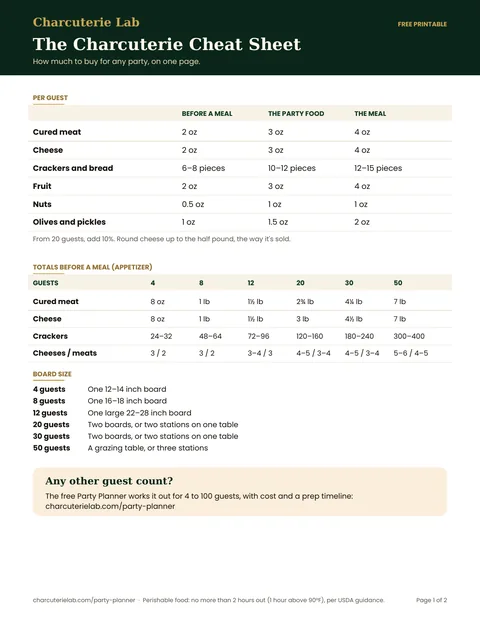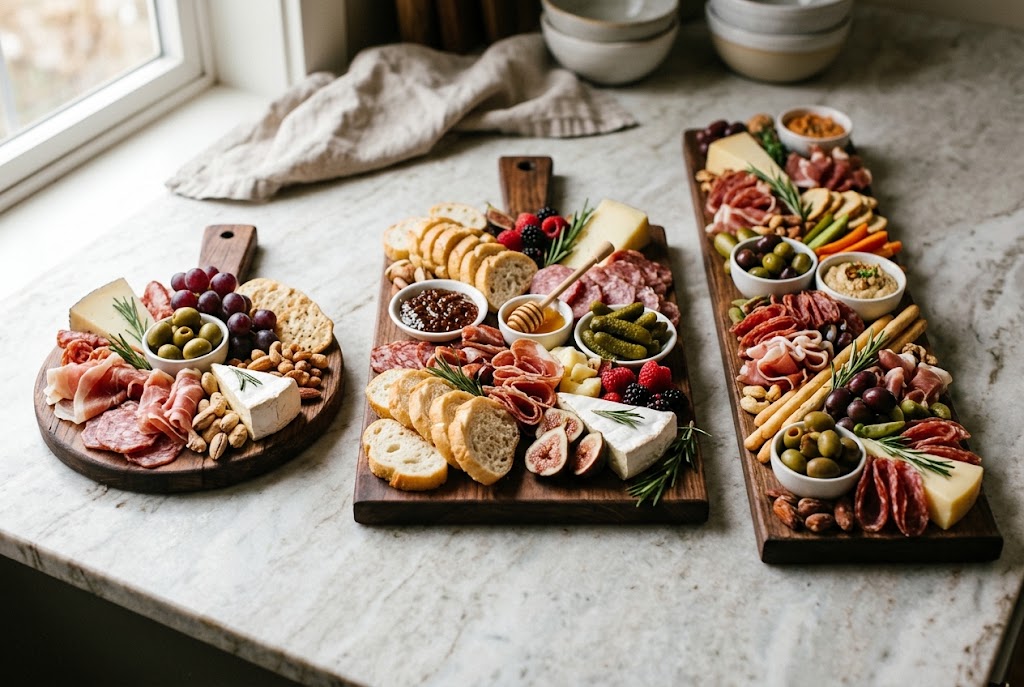
Quick Answer: For 2 people, use an 8–10 inch board. For 4–6, a 12–14 inch board. For 8–10 people, use a 16–18 inch board or two medium boards. The 80% coverage rule: food should cover most of the board surface with natural gaps — not stacked high. When in doubt, go one size larger.
For your exact guest count, the Party Planner works out meat, cheese, crackers, cost and a timeline for 4 to 100 guests.
Why Board Size Matters
A board that's too small forces stacking — cheese slices layered on top of each other, meats wedged in at angles. This makes individual elements hard to identify and harder to take. Guests can't see what's available, can't access the back half of the board, and the visual logic of the build disappears.
A board that's too large creates empty space. A sparse board looks unfinished, which communicates either under-preparation or poor planning. Neither is the impression you want.
Getting the size right before you shop means your build goes onto the board intentionally, without compromise.
Size Guide by Guest Count
2 people: 8–10 inch board Two anchoring cheeses, one meat, three or four accompaniment elements. Fits cleanly on an 8–10 inch round or a small rectangular board. A 6-inch board is too small unless you're doing a minimal build with a single cheese focus.
4–6 people: 12–14 inch board The most versatile size range. Three cheeses, two meats, crackers, two condiments, and fruit fit on a 12x16 inch rectangular board without compromise. This is the board size that most entertaining recipes are calibrated for.
8–10 people: 16–18 inch board or two 12-inch boards Single large boards in this range exist but can be awkward to position on a dining table. Two 12-inch boards placed adjacent is often a more practical solution — it also allows you to separate flavor regions (e.g., one bold board, one mild board).
12–20 people: Multiple boards At this scale, use three or four medium boards arranged as stations around the table rather than one oversized board. Guests can access all sides of smaller boards more easily, and replenishment is simpler — you're replacing one of four boards rather than reloading a single enormous surface.
20+ people: Station-based approach Think in terms of stations, not boards. A self-contained station for each 8–10 guests, each with its own cheese knife, condiment spoon, and visual logic. This scale requires advance planning for quantities.
The 80% Coverage Rule
The most reliable rule for evaluating whether your board is loaded correctly: food should cover approximately 80% of the visible board surface.
Too sparse (under 60% coverage): The board looks under-prepared. Accompaniments float in empty space. Consider a smaller board or adding volume with crackers and fruit.
Correctly loaded (75–85% coverage): The board looks full and intentional. Individual elements are still visible and accessible. Small natural gaps exist between elements.
Overcrowded (over 90% coverage): Elements overlap and stack. Guests can't see what's available at the back. The visual logic of the build is lost.
The 80% rule applies regardless of board size — calibrate your food quantity to the board, not the other way around.
Board Material and Its Effect on Use
Walnut: Dense, durable, resists knife scoring better than most hardwoods. Rich dark grain looks professional. The go-to for boards used frequently.
Acacia: Lighter in color and weight, with distinctive grain variation. More affordable than walnut and widely available. Good for general use.
Marble: Heavy and stays cooler than wood — useful in summer or for cheeses that benefit from a cooler surface. Harder to store and transport.
Slate: Lighter than marble, holds temperature similarly. Works as a visual contrast to a wood board — some builds use a slate board as a dark background for lighter-colored cheeses.
Softwoods and bamboo composites: Avoid. These absorb odors and are harder to clean between uses. The surface degrades faster under knife contact.
Shape Considerations
Rectangular: Most practical. Offers the highest usable surface area per inch of board dimension, fits most tables naturally, and is easiest to build on using a logical left-to-right or corner-to-corner sequence.
Round: Visually striking for 2–4 person builds. Forces a radial build structure — anchors at the center, accompaniments radiating outward. Works well for intimate settings.
Long and narrow (paddle-style): Best for 2-person builds or as an accent board alongside a main board. Useful at cocktail parties where the board sits on a narrow surface.
Building more boards? The Charcuterie Lab ebook covers 50 complete board builds — every one specifying the right board size, food quantities, and placement logic for the occasion.
The Charcuterie Lab Takeaway
Get the board size right before you shop, not after. Match dimensions to guest count, apply the 80% coverage rule to evaluate load, and default to one size up when uncertain. A well-loaded medium board is more effective than a sparse large board every time. Material matters, but size matters more.
FAQ
What size charcuterie board do I need for 4 people?
A 12–14 inch board works for 4 people. That gives you enough surface to place 3 cheeses, 2 meats, and a handful of accompaniments without overcrowding. The 80% coverage rule applies — food should cover most of the board with small natural gaps, not be stacked in layers to fit.
What is the best material for a charcuterie board?
Walnut and acacia wood are the most durable and visually suited to boards. Walnut is denser and resists knife scoring better; acacia is lighter and has attractive grain variation. Marble and slate are strong alternatives — they stay cooler than wood, which is useful in summer. Avoid softwoods like pine, which absorb food odors.
Can I use a cutting board as a charcuterie board?
Yes, if it's made from hardwood (walnut, maple, cherry) and is at least 12 inches in its longest dimension. The distinction is primarily aesthetic — a dedicated charcuterie board usually has a handle or decorative edge, but functionally any clean hardwood board works. Avoid plastic boards; they absorb stains and don't present as well.
What shape charcuterie board is best?
Rectangular boards are the most practical — they offer the most usable surface area per inch and fit more naturally on a table. Round boards are aesthetically striking for 2–4 person builds and intimate settings. Long and narrow boards (paddle-style) work well for 2 people or as a supplementary accent board. Shape is a secondary concern after size.
How much food fits on a 12-inch charcuterie board?
A 12-inch round or 12x16 rectangular board comfortably holds food for 4–6 people: 3 cheeses (3–4 oz each), 2–3 meats (3–4 oz each), plus crackers, fruit, and 2 condiments. Apply the 80% coverage rule — the board should look full and intentional, not sparse, but individual elements should still be identifiable.