A charcuterie board for four is easy. A charcuterie board for thirty is a logistics problem dressed up as a food problem. The flavor decisions are the same — the setup, quantities, and replenishment strategy are completely different.
Here's how to scale a board for a large group without running out of food, creating a traffic jam, or spending the whole party managing the spread.
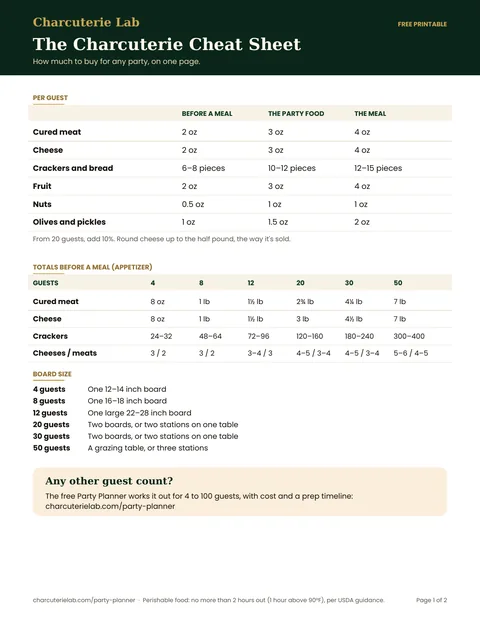
Quick Answer: For a large group appetizer board, plan 2 oz meat and 2 oz cheese per person (3 oz each if the board is the party food), add a 10% buffer, use 2–3 meat varieties and 3–4 cheese types, and build multiple stations rather than one oversized board. Multiple access points move guests faster and keep the spread looking fresh longer.
For your exact guest count, the Party Planner works out meat, cheese, crackers, cost and a timeline for 4 to 100 guests.
The Quantity Formula
The per-person math doesn't change with group size — but the buffer does.
Appetizer board (a meal follows):
- 2 oz meat per person
- 2 oz cheese per person
- 6–8 crackers or bread slices per person
Party-food board (no meal):
- 3 oz meat per person
- 3 oz cheese per person
- 10–12 crackers or bread slices per person
Dinner board: 4 oz each of meat and cheese per person.
The buffer: For groups of 20+, add 10% above your calculation. Large groups have more variable eaters — some people barely touch the board, others make three trips. The buffer covers both ends.
Quick reference:
- 20 guests → 2¾ lb meat, 3 lb cheese as an appetizer; 4¼ lb and 4½ lb as the party food (full plan)
- 30 guests → 4¼ lb meat, 4½ lb cheese as an appetizer; 6¼ lb and 6½ lb as the party food (full plan)
- 50 guests → 7 lb meat, 7 lb cheese as an appetizer; 10½ lb and 10½ lb as the party food (full plan)
Meat runs out before cheese. If you're uncertain, add another half pound of meat.
What to Buy
Variety matters more than quantity. At scale, two pounds of prosciutto and two pounds of salami outperforms four pounds of a single meat. Guests want to graze across options, not stack up one thing.
Meats (choose 2–3):
- Prosciutto — mild, fat-forward, universally liked
- Genoa salami or hard salami — familiar, accessible
- Coppa or soppressata — adds Italian character for guests who want something different
Pre-packaged sliced meats are practical at this scale. Deli-sliced is better for smaller boards; for 25+ guests, the time savings of pre-packaged are worth it.
Cheeses (choose 3–4):
- One soft: brie or triple-crème (crowd-pleaser, easy to spread)
- One semi-firm: manchego, Gruyère, or Havarti
- One aged hard: aged cheddar or aged gouda
- One optional blue: Gorgonzola Dolce (the most approachable)
Crackers and bread: Buy more than you think you need. Crackers disappear fast at large boards. Keep a backup supply and replenish rather than over-piling at the start — stacked crackers go soft and look sloppy.
Layout Strategy: Multiple Stations
The biggest large-group mistake is building one giant board and expecting guests to flow around it. They don't — they bunch up at one end, the board gets raided unevenly, and half the cheese sits untouched while prosciutto runs out in the first ten minutes.
The fix: two or three identical stations.
For 20 guests, build two boards with the same elements. For 30–40, build three. Each station has the same meats, cheeses, crackers, and condiments. Guests spread across multiple access points, the board stays looking fresh longer, and no single element runs out dramatically before others.
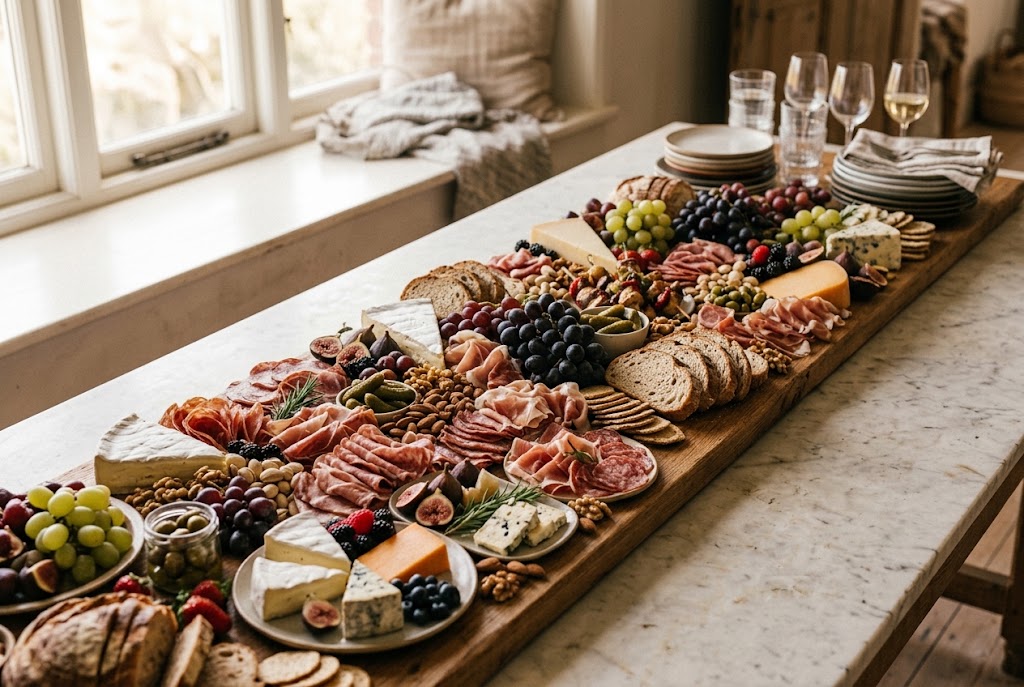
If you have a long table, set the board in a line — meats on one end, cheeses in the center, crackers and bread at the other end. Guests move in one direction and serve themselves without collision.
Timing and Replenishment
Large-group boards graze faster than you expect. The first fifteen minutes are the busiest — prosciutto and crackers disappear first.
Build the timeline this way:
- 30–60 minutes before guests arrive: assemble the board
- Cover with plastic wrap and refrigerate until 30 minutes before serving
- Remove wrap and let cheeses come to room temperature
- Add crackers at the last possible moment — they soften fastest
- Check the board every 20–30 minutes during the event; replenish from your backup supply
Keep extra prosciutto, crackers, and one type of cheese in reserve. Replenishing a board mid-party takes two minutes and makes the spread look actively curated rather than slowly depleted.
Common Mistakes
One giant board. A single 4-foot board for 30 people creates a traffic problem. Multiple stations solve it.
Over-piling at the start. A mountain of food looks impressive; it also goes soft, sloppy, and unappetizing within an hour. Start with a well-edited spread and replenish.
Forgetting to label. At large gatherings, guests often don't know what they're eating. Small labels on cheese varieties help people make decisions faster and reduce bottlenecks while someone describes what Stilton is.
Not accounting for dietary restrictions. At large groups, there will be vegetarians, people avoiding pork, and guests with nut allergies. Keep at least one strong vegetarian section (cheese, fruit, crackers, jam) and label anything with nuts.
Building more boards? The Charcuterie Lab ebook walks through 50 boards across every occasion — each one with exact quantities, a shopping list, and the science behind why it works.
The Charcuterie Lab Takeaway
Scale changes the logistics, not the flavor logic. Stick to 2 oz each of meat and cheese per person (3 oz as the party food), add a 10% buffer, and use multiple stations instead of one oversized spread. Replenish rather than over-pile. Label the cheeses. And buy more crackers than you think you need — they're always the first thing to run out.
FAQ
How much food do you need for a charcuterie board for 20 people?
For 20 guests at an appetizer board: about 2¾ lb of meat and 3 lb of cheese, including a 10% buffer. As the party food with no meal: about 4¼ lb of meat and 4½ lb of cheese. Use 2–3 meat varieties and 3–4 cheese varieties — variety matters more than quantity for large boards.
How do you set up a charcuterie board for a large group?
Use multiple boards or a long surface instead of one oversized board. Zone by flavor: put cheeses in the center, meats around them, crackers and bread at the edges. Build 2–3 identical stations rather than one giant spread — guests move faster through multiple points than they do through a single line.
What meats are best for a large charcuterie board?
Prosciutto, salami, and one additional variety (coppa, soppressata, or bresaola) cover the widest range. Buy sliced from the deli counter for large quantities — pre-packaged is fine for 10+ guests when deli slicing isn't practical. Replenish the board rather than over-piling at the start.
Can you make a large charcuterie board ahead of time?
Build the board 30–60 minutes before guests arrive, then cover with plastic wrap and refrigerate. Remove 30 minutes before serving so cheeses reach room temperature. Keep crackers separate and add them at the last moment — they soften quickly on a board.
How many types of cheese for a large charcuterie board?
Three to four varieties covers the range: one soft (brie or triple-crème), one semi-firm (Gruyère or manchego), one aged hard (aged cheddar or aged gouda), and optionally one blue (Gorgonzola or Stilton). More than four varieties at scale creates waste — guests gravitate to 2–3 favorites anyway.