Quick Answer: Choose a board sized to your group, plan about 2 oz each of meat and cheese per person for an appetizer, and take the cheese out of the fridge before you start. Then build in order: cheeses spaced apart, meats folded between them, condiments and fruit in the gaps, crackers last.
Step 1: Choose Your Board Size and Surface
The physical surface determines how much food you need and how the layout works.
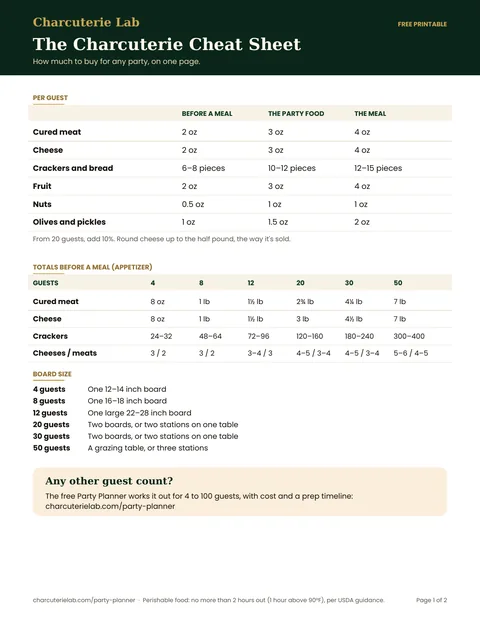
Board size by guest count:
- 4–6 guests: 12×16" board or similar
- 8–12 guests: 18×24" board or a large wooden cutting board
- 14+ guests: two separate boards, or a tray-style surface
Material considerations: Hardwood (walnut, maple, cherry) is the standard — food-safe, visually warm, and durable. Slate adds graphic contrast but is heavier and less forgiving if dropped. Marble stays cool longer, which is useful for soft cheese in warm conditions.
No dedicated board? A clean wooden cutting board, a large ceramic platter, or parchment paper on a baking sheet all work. The food is the point.
Step 2: Shop with a Ratio in Mind
The per-person ratio that works for a starter or appetizer charcuterie board:
- Meat: 2 oz per person (3 oz as the party food), 2–3 varieties
- Cheese: 2 oz per person (3 oz as the party food), 3 varieties (soft + semi-firm + aged)
- Crackers: 6–8 per person, 2 types
- Fruit: 1 small handful per person (grapes + 1 other)
- Condiments: 2–3 total for the board (not per person)
For 8 guests: approximately 1–1.5 lb each of meat and cheese total. One large bunch of grapes plus a secondary fruit. One to two boxes of crackers. Two to three small jars of condiment.
Cheese selection rule of three: one soft (brie, chèvre, camembert), one semi-firm (manchego, aged gouda, gruyère), one bold or aged (blue cheese, aged cheddar, parmigiano). Different textures and intensities create a board that's more interesting to graze than three similar cheeses.
Meat selection rule of contrast: one delicate (prosciutto, bresaola), one medium-fat (coppa), one fermented/sliced (salami, soppressata). Variety across fat level and cure method keeps the board from tasting one-dimensional.
Step 3: Prepare Your Components
Do this 1–2 hours before guests arrive.
Cheese: Remove from refrigerator 45–60 minutes before serving. Cold cheese is flat and dense. Room-temperature cheese is alive. This one step matters more than any other preparation.
Slicing and portioning:
- Slice semi-firm cheese into thin wedges, fans, or batons — not cubes
- Leave soft cheese whole or as a large wedge with a knife for spreading
- Break aged/hard cheese into irregular chunks with a cheese spade or knife heel
- Slice salami and other whole meats thin if not pre-sliced
Fruit prep:
- Wash and dry grapes, leave in small clusters
- Slice apple or pear thin; toss in lemon juice to prevent browning
- Halve figs or leave whole
- Pit and halve cherries if using
Crackers: Open packaging but don't put them on the board yet — add them in the last 30 minutes before serving to keep them crisp.
Step 4: Assemble in the Right Sequence
This is where most charcuterie boards go wrong — people put crackers on first, then fill in around them. Crackers should go on last.
The correct sequence:
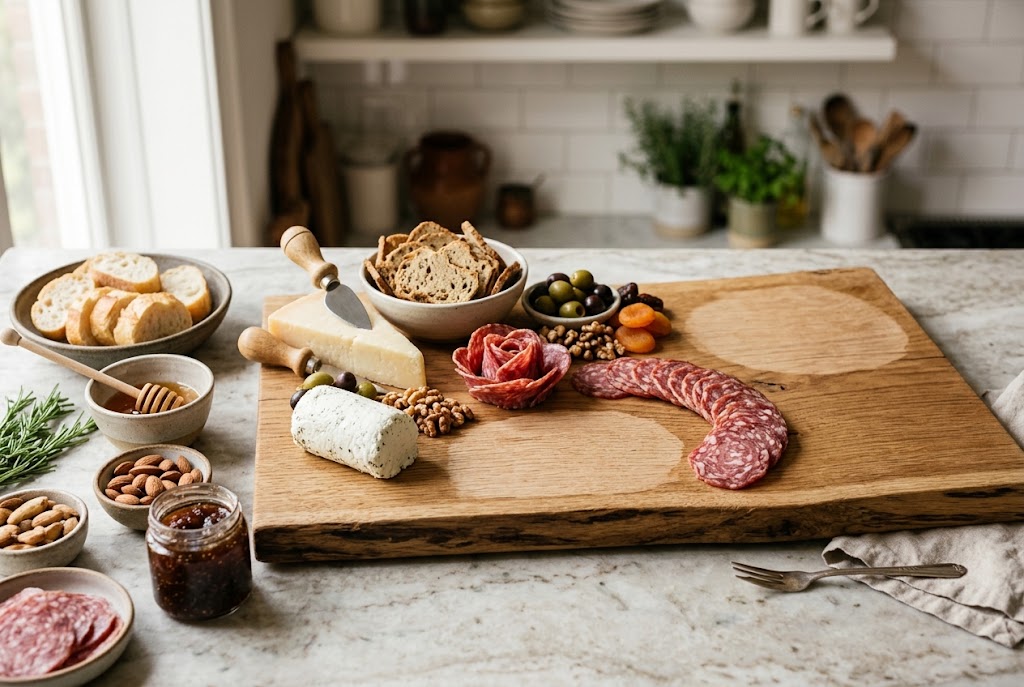
- Anchor with cheese — place the three cheese elements first, spaced apart across the board so they divide the surface into distinct zones. These are your compositional anchors.
- Add meats near each cheese — fan prosciutto or fold salami into rose shapes or S-curves. Place each meat variety near one of the cheese anchors so they form natural pairing clusters.
- Add condiments in small dishes or pools — place honey, jam, and mustard in small ramekins or spoon directly onto the board in defined spots. Position them between cheese and meat pairings they complement.
- Fill with fruit — place grape clusters to fill gaps, add secondary fruit in clusters near complementary cheese. Whole grapes should be left attached to small stems for visual impact.
- Crackers last — lay crackers in fans or stacked rows around the cheese anchors, filling remaining gaps. Some crackers leaning against cheese, some fanned flat.
- Garnish — fresh rosemary sprigs, edible flowers, or a few extra nuts fill any remaining gaps and add visual texture.
Step 5: Presentation Details That Elevate Any Board
Odd numbers: Place items in groups of 3 or 5, not 4 or 6. Odd groupings look natural; even groupings look arranged.
Vary the presentation shape: Don't put all sliced meat flat. Fan some, fold some, roll one into a rose. Don't cube any cheese — wedges, fans, and shards all look more considered.
Intentional negative space: Don't fill every inch of the board. A board with some breathing room looks abundant; a completely packed board looks cluttered.
Height variation: Small ramekins for condiments, a wedge of cheese propped against a cracker stack, a bunch of grapes piled slightly higher than the flat items — variation in height adds visual interest.
Common Mistakes
All one texture: A board with three similar semi-firm cheeses, one type of salami, and crackers is technically complete but boring. The contrast between a soft brie, a firm manchego, and a crumbly blue is what makes guests keep reaching back.
Crackers on too early: Crackers go stale and soft within 30–45 minutes of exposure to moisture from the board. Add them last.
Forgetting the condiments: Honey, mustard, and jam do more pairing work than any other single element. A board without condiments is missing its connective tissue.
Skipping temperature prep: Cold cheese is the most common mistake. 45–60 minutes out of the fridge. Non-negotiable.
The Charcuterie Lab Takeaway
The sequence is the skill: cheese anchors first, meats next, condiments and fruit in the gaps, crackers last. The ratio is the foundation: 2 oz each of meat and cheese per person before a meal, 3 oz as the party food. And temperature is the ingredient: cheese at room temperature is a different product than cheese from the fridge.
Building more boards? The Charcuterie Lab ebook covers 50 boards with exact shopping lists, quantities, and assembly logic for every occasion.
FAQ
How do you start building a charcuterie board?
Start with your cheese anchors — place the largest cheese elements first, spaced apart across the board. Then add cured meats near each cheese. Fill in with crackers, then fruit, then condiments in small dishes. The sequence (cheese first, crackers last) prevents the crackers from going stale while you build and gives you a structure to fill around.
How many people does a charcuterie board serve?
Plan on 2 oz of meat and 2 oz of cheese per person as a starter or appetizer, 3 oz of each if the board is the party food. For 8 people as an appetizer, that's about 1 lb each of meat and cheese. If the board is the party food at a longer event, plan 3 oz of each — continuous access means more eating than a defined serving.
What board or surface should you use?
Hardwood boards (walnut, maple, cherry) are the most practical — they're food-safe, durable, and visually warm. Slate boards add a graphic contrast element. Marble stays cool, which is useful for soft cheese in warm conditions. A clean cutting board or sheet of parchment on a baking sheet works equally well for the food.
How do you make a charcuterie board look professional?
Three techniques: use odd numbers of items in each cluster (3 or 5, not 4 or 6), leave intentional negative space between elements, and vary the presentation shape of each item — fan the cheese, fold or ruffle the meat, pile the fruit. Symmetry looks planned; variation looks considered.
How far in advance can you make a charcuterie board?
You can prep components up to 24 hours ahead — slice cheese, portion crackers, prep fruit. Assemble the board 1–2 hours before serving, but add crackers last (30 minutes before serving) to keep them crisp. Don't add cut fruit more than 2 hours ahead — it browns and weeps.