Quick Answer: Build in order: cheese anchors first, then condiment bowls, meats, fillers, garnish, and crackers last. Fold meat loosely instead of rolling it tight, repeat each color in several spots, add height with standing crackers and ramekins, and choose a board small enough that the food fills it.
A charcuterie board's visual appeal is functional, not decorative. A board that looks abundant and inviting gets grazed more actively than one that looks picked over or randomly assembled — which means the flavor logic you've built into the pairings actually gets discovered by guests. Presentation is part of how the board works.
The Assembly Sequence
The order in which you build the board determines the final result. Deviating from this sequence produces boards that look unbalanced or chaotic.
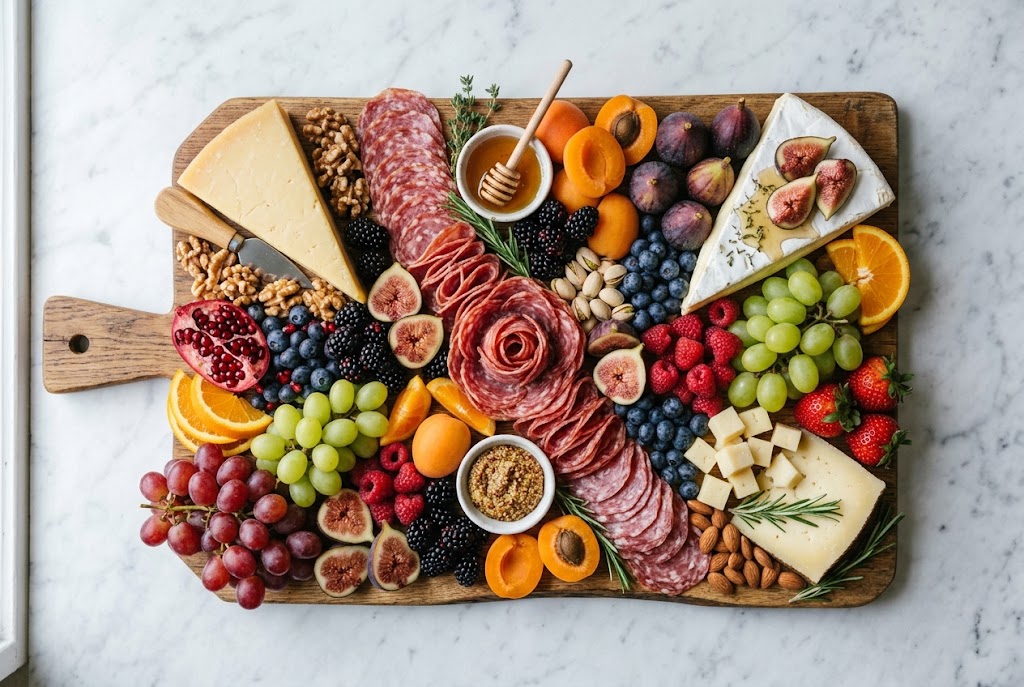
Step 1: Cheese anchors. Place the cheese first — in corners, quadrants, or at intervals across the board depending on the board's shape. These are the structural anchors from which everything else radiates. Use the largest or most visually interesting cheese as a centerpiece if the board is round.
Step 2: Condiment bowls. Place small ramekins or bowls adjacent to the cheese they pair with. The condiment bowl's position is a pairing signal — honey next to the blue cheese, mustard near the aged cheddar. The bowls also create height variation.
Step 3: Meats. Drape, fold, and arrange meats between and around the cheese anchors. Each meat type should have a cluster, not be scattered across the board. Prosciutto loose and draped; salami fanned or shingled; coppa in loose waves.
Step 4: Fillers. Fill the remaining visual gaps with olives, nuts, dried fruit, fresh fruit, and any additional small elements. These are what make the board look dense and abundant — without fillers, the board looks sparse even when the quantities are correct.
Step 5: Garnish. Fresh herbs (rosemary sprigs, thyme, fresh dill), edible flowers if seasonal, and any remaining visual elements.
Step 6: Crackers and bread, last. Immediately before service. Standing crackers upright in clusters creates height. Bread sliced and fanned. Never lay crackers flat across the board an hour early — they soften and look deflated.
Meat Folding Techniques
How meat is arranged is as important as what meat is used.
Prosciutto: Drape loosely in irregular, organic folds. Do not roll into tight tubes — rolled prosciutto looks compressed and is harder to pick up. The loose drape reads as abundance.
Salami: Fan technique — fold each slice in half, then half again into a quarter, and arrange in an overlapping fan. Alternatively, shingle flat slices in an overlapping row. Both techniques create visual rhythm.
Coppa: Loose rosette technique — fold into a half-moon, then roll loosely. The result is a soft flower shape that adds visual interest.
Bresaola: Drape in rough quarter-folds over itself. The deep garnet color is the feature — let it show.
Mortadella: Drape loosely; the white fat cubes are the visual interest. Fold in quarters or half-moons.
Cheese Preparation
Aged hard cheeses (cheddar, gouda, Parmigiano): Pre-cut two to three slices and fan them slightly in front of the intact block. This signals how to serve and reveals the interior texture.
Soft cheeses (brie, Camembert): Score the rind in a crosshatch pattern. Leave the cheese whole — the scored top signals that guests should scoop from the center.
Blue cheeses: Crumble loosely rather than slicing. A pile of crumbled Stilton or Gorgonzola looks more naturally abundant than precisely cut wedges.
Semi-firm cheeses (manchego, Gruyère): Slice into thin triangles or rectangles and fan slightly.
Color Distribution
Color should be distributed across the board, not clustered. The red of dried cranberries or cornichons appears in multiple spots; the green of herbs and olives recurs across different sections; the gold of crackers and honeycomb appears at several points.
The eye reads a board as abundant when color variation is dense and distributed. A board where all the red elements are in one corner and all the green elements are in another reads as sparse even when quantities are generous.
High-contrast placement: Put a dark element (black olives, dried cranberries) adjacent to a light element (white brie, pale crackers). Adjacent contrast makes both elements read more vividly.
Height Variation
Flat boards look less abundant than boards with varied heights. Create height through:
- Crackers standing upright in clusters (leaning against cheese or against each other)
- Condiment ramekins elevating above the flat surface
- Folded meats creating peaks and valleys
- Cheese wedges propped at angles
- Honeycomb or small fruit bowls as raised visual anchors
Common Mistakes
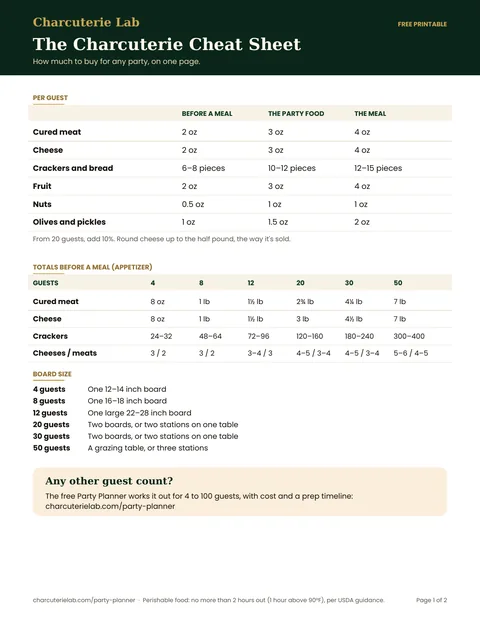
Using a board that's too large. The most common visual problem. A 16-inch board with an appetizer portion for 4 people looks sparse regardless of how well it's arranged. Size the board to the quantity — small boards look full; large boards look empty.
Geometric precision. Perfectly spaced, symmetrically arranged elements look like a design exercise, not like food. Organic, irregular placement reads as more inviting and authentic.
Not filling the gaps. Empty board surface is the enemy. Every visual gap should have an olive, a nut, a dried fruit, or an herb sprig filling it.
Crackers too early. Crackers added 30–60 minutes before service are soft and flat by the time guests arrive. Add them last.
Building more boards? The Charcuterie Lab ebook walks through 50 boards across every occasion — each one with exact quantities, a shopping list, and the science behind why it works.
The Charcuterie Lab Takeaway
Charcuterie board presentation follows a sequence: cheese anchors first, condiment bowls second, meats third, fillers fourth, garnish fifth, crackers last. Fold meat organically, distribute color across the board, create height variation, and fill every visual gap. Use a board sized to your quantity — a small board that looks full beats a large board that looks sparse every time. Presentation makes the board's flavor logic accessible; guests discover the pairings you've built when the board invites them in visually.
FAQ
What is the best way to arrange a charcuterie board?
Place cheese anchors first in corners or quadrants, add condiment bowls adjacent to their paired cheeses, drape and fold meats between the cheese clusters, fill gaps with olives, nuts, and dried fruit, garnish with fresh herbs, and add crackers and bread last. This sequence — anchors, condiments, meats, fillers, crackers — produces a board that looks full and intentional rather than randomly piled.
How do you make a charcuterie board look full?
Use the board size that matches your quantity (a 10-inch board looks full with 4 oz of cheese; a 16-inch board with the same amount looks sparse), fill every visual gap with nuts, olives, dried fruit, or fresh herbs, and vary the height by folding meats and stacking crackers. The eye reads abundance from density and variety, not from raw quantity.
How do you fold meat for a charcuterie board?
Prosciutto: drape loosely in irregular folds rather than rolling into tight tubes. Salami: fold in half, then half again into quarters (creates a fan effect) or shingle in overlapping rows. Coppa: fold into loose rosettes or gentle waves. The goal is irregular, organic-looking placement — not geometric precision. Irregular folds look more abundant than neat arrangements.
Should cheese be sliced before putting on a charcuterie board?
Partially. Pre-cut two or three slices from each hard cheese and leave the rest intact — this signals to guests how to serve themselves and creates visual interest (the cut surface is more textured than the block exterior). Leave soft cheeses (brie, Camembert) whole with just a scored rind. Crumble blue cheese loosely rather than slicing.
What makes a charcuterie board look professional?
Consistent application of a few principles: varied heights (crackers standing upright, meats folded, cheese at different levels), color distribution (spread color across the board rather than clustering), organic rather than geometric arrangements, every gap filled with something edible, and temperature-appropriate service (cheese at room temperature, not sweating or dried out).