Condiments are the least discussed and most essential component of a charcuterie board. They're not garnish. They're not decoration. They're the flavor infrastructure that makes cheese and meat work together — the bridges that connect bold elements, the acid that cuts through richness, the sweetness that moderates intensity.
A board without good condiments is a collection of ingredients. A board with the right condiments is a composed experience.
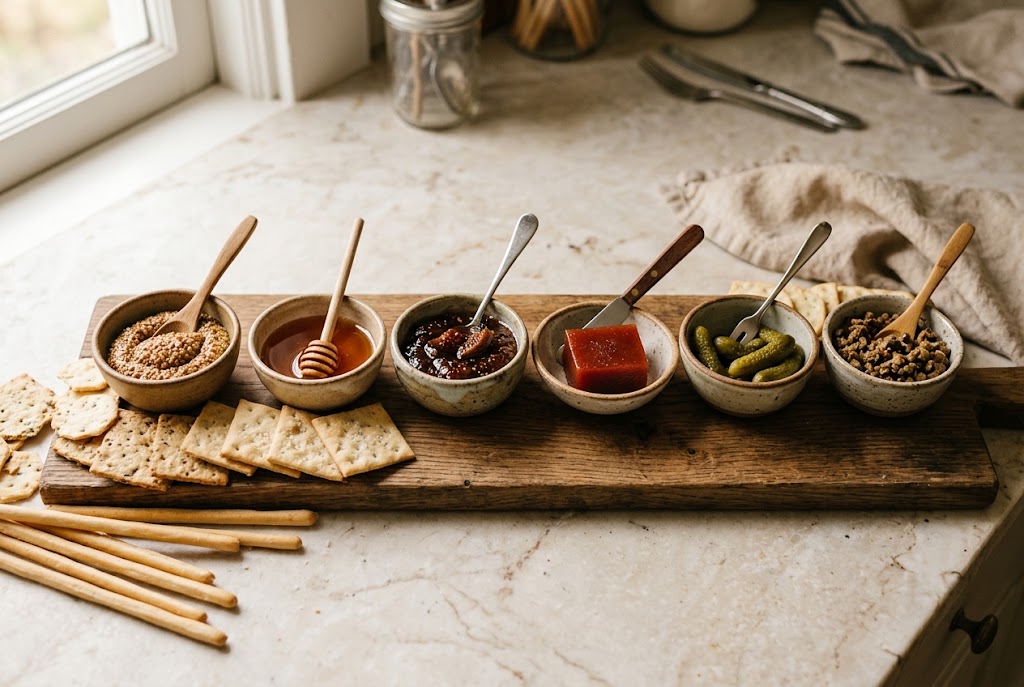
Quick Answer: The essential condiment lineup is: one mustard (whole-grain or Dijon), one fruit preserve (fig jam or quince paste), honey (wildflower or chestnut), and one acidic element (cornichons, olives, or pickled grapes). These four cover every flavor role a condiment needs to fill. Add a fifth — hot sauce, tapenade, or a spiced nut — if the board has room and a specific pairing need.
The Five Condiment Roles
Every condiment on a board fills one of five flavor roles. Build your selection so at least the first four are covered:
1. Sweet bridge — connects savory cheese to sweet or neutral crackers, and moderates intensely flavored elements. Filled by: fig jam, quince paste, honey, fruit compote.
2. Acid cut — cuts through fat and richness, refreshes the palate between bites. Filled by: whole-grain mustard, Dijon mustard, cornichons, pickled grapes, caperberries.
3. Savory amplifier — deepens umami and adds salt complexity. Filled by: olive tapenade, anchovy paste, miso mustard, aged balsamic.
4. Aromatic accent — adds herbal or spiced character that complements specific meats or cheeses. Filled by: whole-grain mustard with herbs, spiced walnuts, Calabrian chile oil, rosemary honey.
5. Textural contrast — provides crunch or density where the board is otherwise soft. Filled by: cornichons, olives, Marcona almonds, spiced nuts.
The Essential Condiments
Mustard. Non-negotiable. Mustard's acidity and sharpness are the primary fat-cutting agent on a board — without it, aged cheese and prosciutto create a richness that becomes monotonous. Whole-grain mustard is more versatile (its texture adds visual interest and the whole seeds moderate its sharpness). Dijon is sharper and better for aged cheddar and coppa. Use one or both. Place near the aged cheddar, prosciutto, and coppa.
Fig jam. The most versatile fruit preserve for a charcuterie board. Fig's natural tannins interact with cheese fat in the same way wine tannins do — they reduce the coating sensation and clean the palate. Its sweetness bridges aged, sharp cheeses toward milder accompaniments. Place in the center of the board where it serves multiple cheeses.
Honey. Honey's fructose compounds suppress bitter receptor sensitivity — this is why honey with blue cheese reduces the perceived harshness of the blue without eliminating its character. Use chestnut or buckwheat honey for blues, wildflower or acacia for milder aged cheese and brie. Place adjacent to the boldest cheese on the board.
Cornichons. Small French sour pickles that provide concentrated acidity in a single bite. They're the palate reset that mustard can't provide — mustard modifies flavor while cornichons actively cleanse the palate. Place near the salami and coppa.
Olives. Kalamata or Castelvetrano olives add salt, fat, and brine that complement cured meat. Castelvetrano (buttery, mild) works better on boards with delicate flavors; Kalamata (sharp, acidic) for bold boards.
Optional Additions
Quince paste (membrillo) — dense, sweet-tart, and traditional with manchego. A stronger flavor pairing than fig jam for hard Spanish cheeses.
Calabrian chile oil or nduja — for boards that want a heat element. Place near the mildest cheese so guests can choose how much heat to add.
Olive tapenade — savory amplifier for boards with a Mediterranean character.
Roasted garlic — sweet, mellow, and deeply umami when roasted. Works with aged cheddar and crusty bread.
Spiced nuts — toasted almonds or walnuts with rosemary and sea salt fill the textural contrast role while adding flavor complexity.
Placement Logic
Condiment placement guides guests toward correct pairings without requiring instruction:
- Honey → adjacent to the boldest cheese (blue or very aged)
- Fig jam → center of the board, accessible from multiple cheeses
- Mustard → near aged cheddar, coppa, and prosciutto
- Cornichons → near salami and coppa
- Quince paste → immediately beside manchego or aged Spanish cheese
- Olives → near cured meats, away from mild soft cheeses they'd overwhelm
Do not cluster all condiments in one corner. Guests will use what's adjacent to what they're eating. Position dictates behavior.
Vessel Selection
Small ceramic ramekins or shallow bowls for jams and honey. Use separate small spoons for each — shared spoons cross-contaminate flavors. Cornichons and olives can be placed directly on the board in a pile or in a small bowl. Mustard goes in a small dish with a spreader or small spoon.
Common Mistakes
Too many condiments. Six or more condiments creates visual noise and decision fatigue. Three to five, each with a clear role, is enough.
Clustering condiments together. If all condiments are in one corner, guests serve from that corner and ignore the pairing logic. Distribute across the board.
Using generic grape jelly. Too sweet, too simple, and it flattens everything it touches. Fig jam or quince paste add tannin structure that grape jelly doesn't have.
Forgetting mustard. Boards without acid become monotonously rich. Mustard is non-negotiable.
Building more boards? The Charcuterie Lab ebook walks through 50 boards across every occasion — each one with exact quantities, a shopping list, and the science behind why it works.
The Charcuterie Lab Takeaway
Use three to five condiments, each with a clear flavor role: one mustard, one fruit preserve, honey, and cornichons at minimum. Position each adjacent to its paired cheese or meat rather than grouped in one spot — placement guides guests toward the right combinations without instruction. The condiments are not optional extras; they're what makes the board a coherent tasting experience rather than a pile of premium ingredients.
FAQ
What condiments should go on a charcuterie board?
The essential condiments are: whole-grain or Dijon mustard (acid and bite), fig jam or another fruit preserve (sweet bridge between cheese and meat), honey (suppresses bitterness, amplifies umami), and cornichons or olives (salt, acid, and textural contrast). These four cover the major flavor roles a condiment needs to fill on a board.
How many condiments should a charcuterie board have?
Three to five condiments is the right range. Two is too few — the board lacks bridges between its elements. Six or more creates visual noise and overwhelms guests with choices. Three to five, each with a clear pairing role, is enough to cover every element on the board.
Where do you put condiments on a charcuterie board?
Place condiments in small bowls or ramekins adjacent to the cheese or meat they pair with — not clustered together in one corner. Honey goes near blue cheese or aged cheese. Mustard goes near aged cheddar and cured meats. Fig jam goes in the center where it bridges multiple elements. Placement guides guests toward the right combinations.
What is the best jam for a charcuterie board?
Fig jam is the most versatile — its natural tannins and fruit sweetness bridge aged cheese and cured meat without competing with either. Quince paste (membrillo) is the second-best choice, especially with manchego or aged cheddar. Sour cherry jam works for boards with Brie or triple-crème. Avoid overly sweet jams that flatten the board's flavor range.
Do you need both mustard and jam on a charcuterie board?
Yes — they fill opposite roles. Mustard provides acidity and sharpness that cuts through fat and richness. Jam provides sweetness that bridges the board's savory elements. Boards without mustard feel heavy and monotonous. Boards without jam feel flat and one-dimensional. Both are necessary.