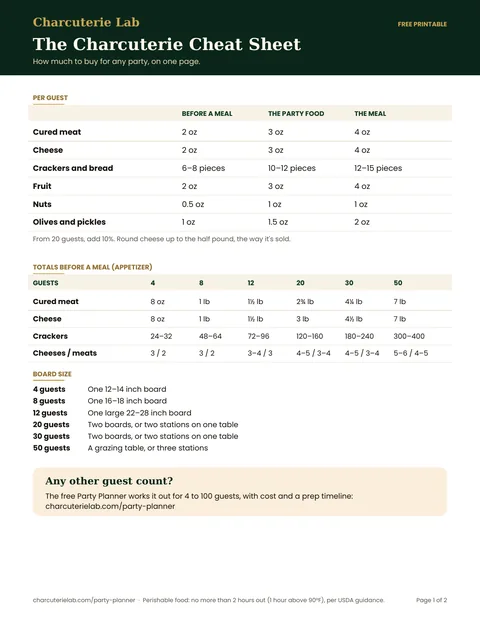
Quick Answer: A grazing table is an extended charcuterie build that covers a full table surface, built in sections for 20–100+ people. Plan 3 oz each of cheese and meat per person when the table is the party food, 2 oz each before a meal, plus 10%. Build sections with the same logic as a board — anchors first, then fill in — but treat each table section as its own independent build zone. Add fresh elements last.
For your exact guest count, the Party Planner works out meat, cheese, crackers, cost and a timeline for 4 to 100 guests.
What Is a Grazing Table?
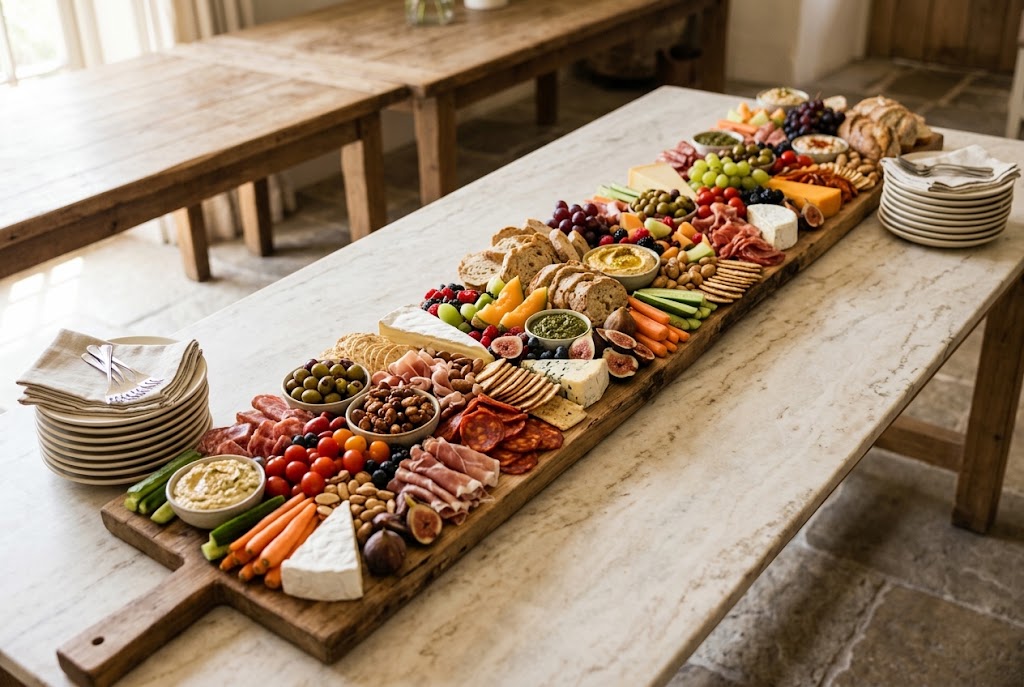
A grazing table is a large-format food spread built directly on a table surface. Instead of arranging food on a single portable board, you're working across an entire table — typically 6–8 feet of surface — covered with butcher paper, parchment, or food-safe material. The food is arranged directly on this surface in a continuous spread.
The build logic is identical to a charcuterie board: cheese anchors first, then meats, then condiments in small bowls or ramekins, then crackers, then fruit and vegetables as fill and garnish. The difference is execution — you're building multiple zones across a large surface rather than one contained unit, and you're serving 20+ people instead of 4–8.
Grazing tables are common at weddings, large holiday gatherings, baby showers, and corporate events where a self-serve food station is more practical than plated appetizers.
How a Grazing Table Differs from a Board
For the full side-by-side, see grazing board vs. charcuterie board. The short version:
Scale: A standard charcuterie board serves 2–10 people. A grazing table typically serves 20–100+ from a single continuous surface.
Surface: A board is portable and bounded. A grazing table is fixed to the table and can extend to any length.
Build approach: A board is built as a single composed unit. A grazing table is built in sections (zones), each with its own cheese anchor, meats, condiments, and accompaniments. Think of it as 4–6 boards placed adjacent, each independently complete.
Replenishment: Boards are often refreshed from a kitchen reserve. A grazing table is typically built once and replenished in visible sections throughout the event — guests can see the table depleting and the host adds to specific zones as needed.
Visual impact: A grazing table has inherent visual drama from scale. A well-built grazing table is one of the most photographed elements of any event that features one.
Planning and Quantities
The quantity formula for grazing tables follows the same per-person logic as a standard board, scaled up:
As the party food (no meal following):
- Cheese: 3 oz per person
- Meat: 3 oz per person
- Crackers: 10–12 pieces per person
- Fruit and vegetables: generous — these fill space, cost less, and guests take them freely
As a pre-meal appetizer:
- Cheese: 2 oz per person
- Meat: 2 oz per person
- Crackers: 6–8 pieces per person
If the table is dinner, plan 4 oz each of cheese and meat. The Party Planner works out the totals for 20 to 100 guests.
Always build in a 10% buffer. Grazing tables at large events regularly run out of the most popular elements (prosciutto, brie, aged cheddar) while less popular elements (specific condiments, specialty crackers) remain. Knowing which elements will deplete fastest allows you to front-load quantities where they matter.
Layout Strategy
Divide the table into sections — each section anchored by a cheese.
Section anchors: Place 2–3 cheese varieties as the primary anchors for each section. Separate bold cheeses (aged cheddar, blue) from mild cheeses (brie, chèvre) into different sections. This allows guests to navigate toward their preference.
Meats adjacent to anchors: Prosciutto near the brie section; hard salami or coppa near the aged cheddar; bresaola as a lean option near a mild cheese.
Condiment ramekins embedded in sections: Each section gets its own small condiment bowl — honey near the soft cheese section, fig jam near the aged cheddar section. Avoid large central condiment stations; guests at the far end of the table won't walk to the center.
Crackers distributed throughout: Don't pile crackers at the ends. Distribute cracker clusters throughout all sections so guests don't have to reach.
Fruit and vegetables as fill: Fresh fruit, olives, nuts, and crudités fill the gaps between anchors. Arrange in clusters rather than scattered randomly — clusters of strawberries, olive clusters, grape bunches anchored at intervals.
Color distribution: Step back and assess color balance before the event. An all-beige and cream section reads as under-planned. Add fresh herbs, pomegranate arils, or bright fruit to any section that needs color.
Surfaces and Setup
Butcher paper: The standard grazing table base. Roll it out across the full table, tape the edges underneath. Provides a clean surface, protects the table, and can be written on with chalk markers for labeling. Easy cleanup — roll it up with any debris.
Multiple boards placed adjacent: An alternative to butcher paper. Five or six medium boards placed edge-to-edge creates a grazing table that's easier to break down after the event. Each board stays separate and can be refreshed independently.
Height variation: Use small wooden crates, overturned bowls, or small cutting boards as risers under cheese wedges and condiment bowls. Height variation is the most impactful visual technique on a grazing table and requires minimal additional equipment.
Labeling: At large events with guests who may have dietary restrictions, small chalk markers or folded card labels identifying each cheese variety and whether a meat contains nuts or allergens are worth the effort.
Building more boards? The Charcuterie Lab ebook covers 50 complete board and grazing builds — each with exact quantities, shopping lists, and assembly sequences from setup to service.
The Charcuterie Lab Takeaway
A grazing table is a charcuterie board at scale. The build logic is the same: anchors first, fill second, condiments embedded, fresh elements last. The differences are execution — working in sections, planning quantities for 20+ people, managing a larger surface, and building in visible replenishment throughout the event. The quantity formula (3 oz each of cheese and meat per person when the table is the party food, plus 10%) is reliable across event sizes. Put a little extra of the prosciutto and brie in the refill trays; they deplete fastest.
FAQ
What is a grazing table?
A grazing table is a large-format food spread laid out directly on a table surface — typically on butcher paper, parchment, or food-safe surfaces — rather than on a single board. It follows the same build logic as a charcuterie board (anchors, condiments, accompaniments, color distribution) but at a scale that serves 20–100+ people from a single continuous surface.
How much food do you need for a grazing table?
Plan 3 oz each of cheese and meat per person when the grazing table is the party food, and 2 oz each when a full meal follows. Add crackers at 10–12 pieces per person (6–8 before a meal). Accompaniments (fruit, vegetables, condiments) can be generous — they fill space and cost less than protein. Build in a 10% buffer.
What is the difference between a grazing table and a charcuterie board?
Scale and surface. A charcuterie board is a single portable board serving 2–10 people. A grazing table covers an entire table surface, serves 20–100+ people, and is built in sections rather than as a single composed unit. The build logic (anchors first, then fill) is the same; execution differs because you're working in multiple stations rather than one continuous surface.
How far in advance can you build a grazing table?
Non-perishable elements (crackers, nuts, condiments) can be laid out 1–2 hours ahead. Cheeses go out 45–60 minutes before guests arrive for proper tempering. Fresh fruit, vegetables, and herbs go on last — within 15–20 minutes of guests arriving. For outdoor events in warm conditions, build in 30-minute batches and replenish throughout rather than building the full table at once.
Do you need a special surface for a grazing table?
No special surface is required. Long butcher paper laid across a table is the standard base — it defines the grazing area visually, protects the table surface, and can be written on with chalk for labeling. Parchment paper works similarly. Some grazing table setups use multiple boards placed adjacent; this works well and makes the table easier to break down and store afterward.