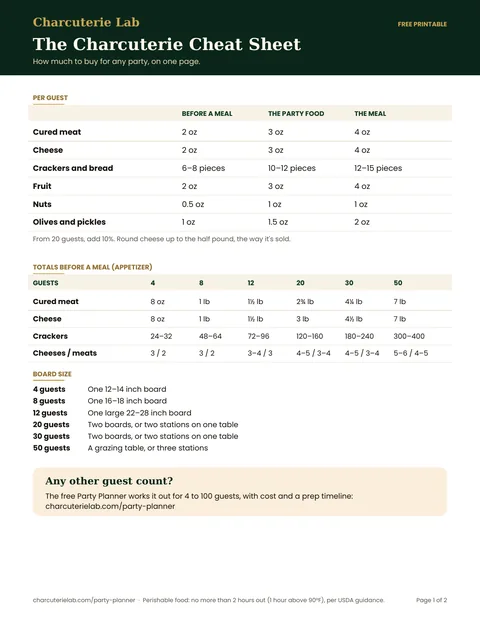
Quick Answer: Store charcuterie board leftovers by separating components first — never refrigerate an assembled board. Wrap cheese in parchment (not plastic), seal cured meats in airtight containers, and keep fruit separate. For make-ahead prep: slice cheese and portion crackers up to 24 hours ahead, assemble 1–2 hours before serving, add crackers 30 minutes before, add cut fruit no more than 2 hours ahead.
Why You Shouldn't Store an Assembled Board
The instinct after a party is to wrap the whole board in plastic and put it in the fridge. This is the worst approach for nearly every component.
An assembled board contains elements with very different storage requirements that, when stored together, actively harm each other. Soft cheese weeps and absorbs cracker moisture. Crackers go completely stale from moisture. Fruit juice seeps into cheese and condiments. The assembled board in the fridge is a uniformly worse version of every component it contained.
The correct approach is five minutes of work: separate each component type into appropriate storage before refrigerating.
Storing Leftover Cheese
Cheese is the most valuable leftover and the one most people store incorrectly.
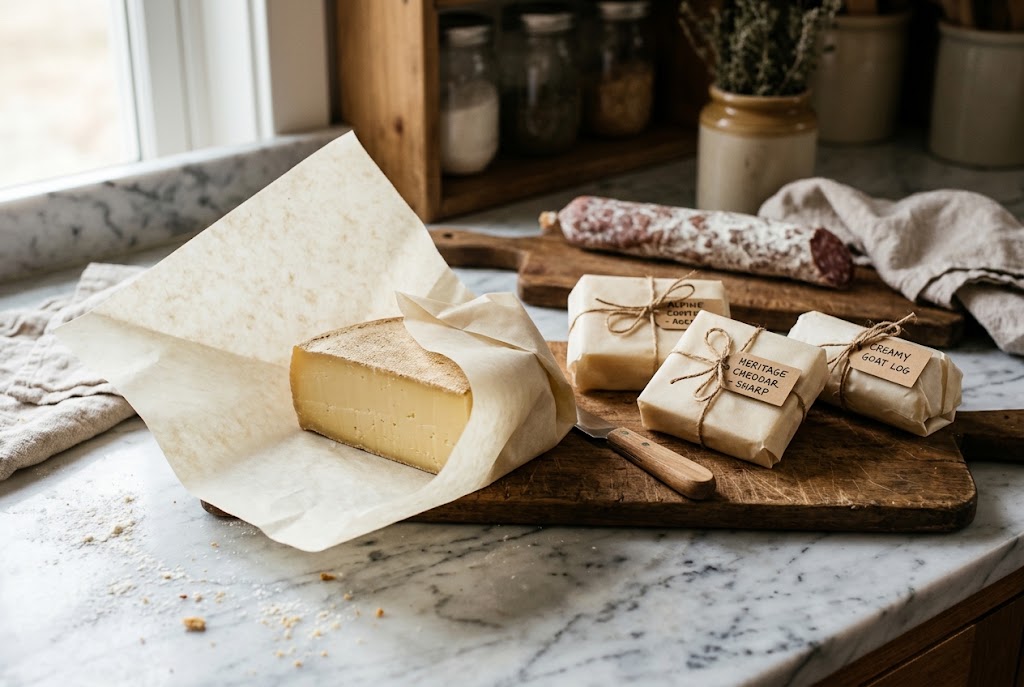
The rule: wrap in parchment, not plastic. Plastic wrap traps moisture against the cheese surface and accelerates mold growth. It also prevents the cheese from breathing, which inhibits the beneficial microbial activity that keeps it alive. Parchment or wax paper allows the cheese to breathe while protecting it from drying out.
Hard aged cheeses (Parmigiano-Reggiano, aged manchego, aged cheddar, aged gouda): keep 3–4 weeks wrapped in parchment in the refrigerator. These have the lowest moisture content and the most stable structure.
Semi-firm cheeses (Gruyère, young manchego, fontina, aged gouda at lower aging levels): keep 2–3 weeks wrapped in parchment.
Soft-ripened cheeses (brie, camembert, triple-crème): keep 1–2 weeks. These are the most perishable. Once the cut face has been exposed, the interior will continue to ripen — if it becomes ammoniated or develops an off smell beyond the usual earthiness, discard.
Fresh cheeses (chèvre log, fresh mozzarella, ricotta): 3–5 days. Highest moisture content, most perishable.
If you need to rewrap cheese mid-week, use fresh parchment each time.
Storing Leftover Cured Meats
Pre-sliced packages (prosciutto, salami, coppa): reseal as tightly as possible and refrigerate. Most packages have a zipper-seal or can be folded over and secured with a clip. Pre-sliced cured meats keep 5–7 days refrigerated once the package is opened.
Whole cured meats (unsliced salami, whole coppa): once the casing is cut, keep 2–4 weeks refrigerated. The casing is a protective barrier — once compromised, oxidation accelerates. Wrap the cut end tightly in plastic or secure with the original casing tie.
Freezing: Most cured meats freeze acceptably for 2–3 months. The texture of thin-sliced delicate cuts like prosciutto degrades notably on thawing — it becomes mushy and loses its silky quality. Salami and whole sausage freeze better than thin-sliced products. If you're going to freeze, do it with the thickest-cut, most structurally robust meats.
Storing Other Board Components
Crackers: Keep all uneaten crackers in an airtight container or sealed bag. Crackers exposed to board moisture start going stale within an hour. Sealed, they keep 2–3 weeks. If they've been on the board for more than 30 minutes, they're already partially stale — they're edible but won't be crisp.
Fruit: Transfer leftover fruit to a sealed container. Grapes keep 1–2 weeks refrigerated. Cut apple or pear will brown regardless of storage — toss in lemon juice if you plan to use the next day. Dried fruit is essentially non-perishable.
Condiments: Honey, jam, and mustard return to their original jars. These have very long shelf lives and don't require special treatment. Honeycomb exposed to air on the board will crystallize slightly — scrape it back into a container and seal.
Make-Ahead Strategy
Making a charcuterie board ahead of time is entirely possible with a component-by-component approach.
24 hours ahead:
- Slice all cheese and wrap in parchment
- Prep nuts and dried fruit into small containers
- Open and portion condiments
- Identify what's going in which section of the board
Day of, 2 hours before guests arrive:
- Remove cheese from refrigerator (60-minute rule for full temperature)
- Assemble the board: cheese anchors, meats, condiments, fruit
- Leave gaps for crackers
30 minutes before guests arrive:
- Add crackers as the final step
- Do a final gap-fill with any additional fruit or garnish
What not to prep ahead:
- Sliced apple and pear (cut max 30–60 minutes before serving and toss in lemon juice)
- Soft cheeses on the board (assemble at the 2-hour mark, not earlier)
- Crackers (always last)
Building more boards? The Charcuterie Lab ebook covers 50 boards with shopping lists and make-ahead timelines built in.
What to Save and What to Discard
Not everything on a charcuterie board is worth saving. The first decision after a board is deciding what to carry forward.
Save:
- Cheese (all types, if properly wrapped promptly)
- Unopened or lightly used cured meats
- Whole nuts (almonds, walnuts) — these are stable
- Condiments (return jams, honey, mustard to their jars)
- Any whole fruit that hasn't been cut
Discard:
- Crackers and bread that have been sitting out — these absorb humidity and go soft
- Cut fruit that sat out more than 30 minutes — oxidation and texture degradation makes them unpleasant
- Soft cheese that's been at room temperature more than 2 hours
- Any meat that dried significantly at the edges or was handled extensively
The core principle: err toward saving cheese and meats, which hold well, and err toward discarding anything starchy or fresh that was exposed to air. Anything perishable that sat out longer than 2 hours (1 hour above 90°F) goes in the bin, not the fridge. For how long each item can safely sit out, see how long a charcuterie board lasts.
What to Do With Charcuterie Board Leftovers
The best leftovers from a board have a natural second life:
Cured meats + eggs: Prosciutto, salami, or coppa in scrambled eggs or a frittata. Bresaola on toast with arugula and olive oil.
Hard cheese + pasta: Grate remaining Parmigiano or aged cheddar into pasta. Manchego melts reasonably well into quesadillas.
Soft cheese + toast: Chèvre or brie spread onto toast with leftover honey is one of the better breakfasts that comes out of board leftovers.
Mixed board leftovers: A flatbread pizza with leftover salami, cheese, and olives works with almost any combination of board leftovers. Fifteen minutes in a hot oven.
Building more boards? The Charcuterie Lab ebook covers 50 complete boards — each with exact quantities so you buy only what you need and minimize what's left over.
Common Mistakes
Storing cheese in only plastic wrap. Plastic traps moisture and creates the wrong conditions for both hard and soft cheeses. Always use parchment as the inner layer.
Refrigerating crackers. They go soft immediately. Room temperature in a sealed bag is always the correct approach.
Storing different meats together. Prosciutto will take on the flavor of spiced salami within hours. Separate containers for each meat type.
Waiting too long to wrap leftovers. Every hour a cut cheese sits uncovered accelerates dehydration and surface oxidation. Wrap within 30 minutes of finishing the board.
The Charcuterie Lab Takeaway
Store leftovers in separate components — never the assembled board. Cheese in parchment (not plastic). Cured meats sealed tightly. Crackers in an airtight container. For make-ahead prep: 24 hours ahead for slicing and portioning, 2 hours before guests for assembly, 30 minutes before for crackers. The components are more durable than the assembled board — treat them accordingly.
Sources
- USDA FSIS: Leftovers and food safety
- FoodSafety.gov: FoodKeeper app (USDA storage times)
- USDA FSIS: What is the 2-hour rule for leaving food out?
FAQ
How do you store leftover charcuterie board?
Separate each component before refrigerating — don't store the assembled board. Wrap cheese in parchment paper (not plastic wrap). Store cured meats in airtight containers or their original sealed packaging. Transfer fruit to a separate container. Most components keep 3–5 days refrigerated when stored separately.
Can you make a charcuterie board ahead of time?
Yes — with a strategic split. Prep components up to 24 hours ahead (slice cheese, portion crackers, prep fruit). Assemble the board 1–2 hours before guests arrive, but add crackers last (30 minutes before serving). Don't add cut fruit more than 2 hours ahead — it browns and weeps.
How long does cheese last after a charcuterie board?
Hard aged cheeses (manchego, aged cheddar, Parmigiano) keep 3–4 weeks wrapped in parchment in the refrigerator. Semi-firm cheeses (Gruyère, gouda) keep 2–3 weeks. Soft cheeses (brie, chèvre) keep 1–2 weeks. Always wrap in parchment or wax paper rather than plastic — plastic traps moisture and accelerates mold.
How do you store leftover prosciutto and other cured meats?
Reseal opened packages as tightly as possible or transfer to an airtight container. Pre-sliced prosciutto and salami keep 5–7 days refrigerated once opened. Whole cured meats (unsliced coppa, whole salami) keep 2–4 weeks refrigerated once the casing is opened. Don't freeze thin-sliced prosciutto — the texture degrades significantly.
Can you freeze leftover charcuterie board components?
Most cured meats freeze acceptably (2–3 months) though texture suffers on thawing for thin-sliced delicate cuts like prosciutto. Hard cheeses (Parmigiano, aged manchego) freeze reasonably well for 1–2 months though texture becomes slightly crumblier. Don't freeze soft cheeses — the fat structure breaks down on thawing and the cheese becomes watery.
How long do charcuterie board leftovers last in the refrigerator?
Hard cheeses last 3–5 days wrapped properly in parchment then plastic. Soft cheeses (brie, chèvre) are best within 2 days. Cured meats last 3–4 days in an airtight container. Fresh fruit and raw vegetables should be consumed within 1 day. Crackers don't refrigerate well — keep them at room temperature in a sealed bag.
What can you do with leftover charcuterie board ingredients?
Cured meats work well in scrambled eggs, pasta, or flatbreads. Leftover hard cheese (Parmigiano, cheddar) grates into pasta or soups. Soft cheese (chèvre, brie) spreads onto toast or melts into a simple sauce. Most leftover board elements translate well into a strong weekday breakfast or quick lunch without much additional effort.
Should you store different charcuterie items together?
No — store each element separately. Cheeses absorb odors from cured meats readily; a mild brie left in the same container as spicy salami will take on its flavors within hours. Condiments go back in their original jars. Crackers store separately from everything else at room temperature. Separation is the key rule for maximizing leftover quality.