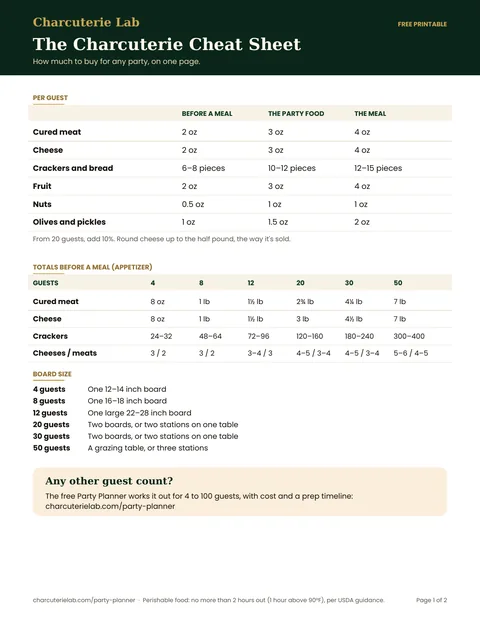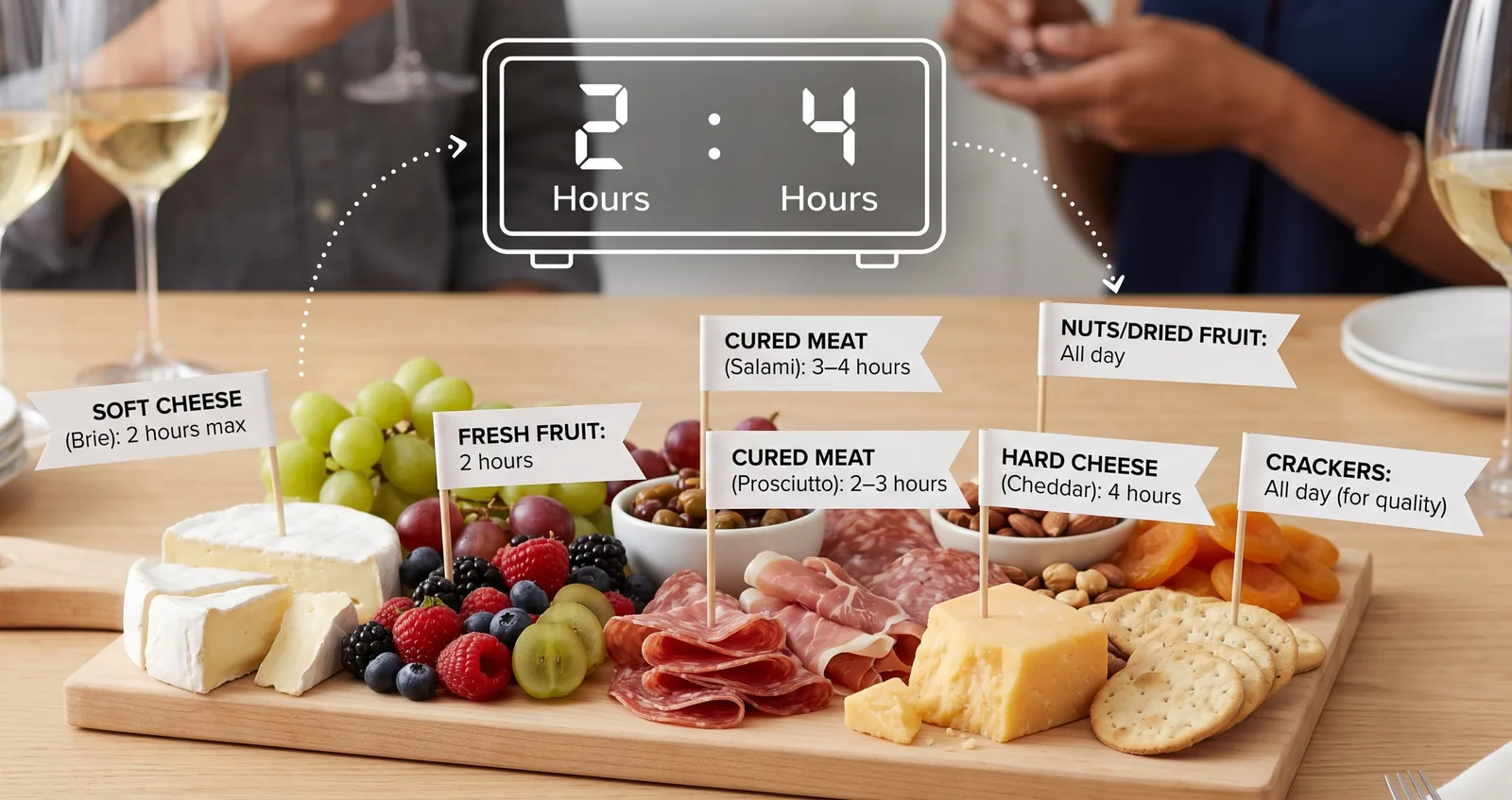
A charcuterie board is safe at room temperature for 2 hours — that's the USDA's general guideline for perishable foods in the "danger zone" between 40°F and 140°F. In practice, different elements of the board have different safe windows depending on their water content, salt content, and fat levels. Hard, aged cheeses are more forgiving. Soft cheeses and fresh items need to come off the board or get refrigerated sooner. Here's how it breaks down by ingredient.
Quick Answer: A charcuterie board can safely sit at room temperature for up to 2 hours, or 1 hour above 90°F (USDA guidance for perishable food). Aged hard cheeses and dry salami keep their quality longer than soft cheese and fresh fruit, but treat the board as a whole by the 2-hour rule: refrigerate what's left and bring out a fresh refill.
Safe Room Temperature Times by Ingredient
| Ingredient | Safe at Room Temp | Notes |
|---|---|---|
| Hard/aged cheese (cheddar, parmesan, manchego) | 2 hours on a shared board | Low moisture, high salt — more resistant |
| Semi-soft cheese (gouda, havarti, fontina) | 2–3 hours | Moderate moisture; monitor closely after 2 hours |
| Soft cheese (brie, camembert, burrata) | Up to 2 hours | High moisture; texture also degrades after 2 hours |
| Blue cheese | Up to 2 hours | Already pungent — room temp accelerates the smell |
| Fresh cheese (mozzarella, chèvre, ricotta) | 1–2 hours | High moisture, lower salt — most perishable |
| Cured whole-muscle meats (prosciutto, bresaola) | 2 hours | Dry-cured; salt provides some protection |
| Fermented salami / soppressata | 2 hours on a shared board | Low water activity from fermentation; shelf-stable sliced |
| Fresh or cooked meats (pâté, cooked ham) | 2 hours | Treat like any cooked protein |
| Fresh fruits (grapes, apple, berries) | 2–3 hours | Cut fruit degrades faster; whole grapes hold longer |
| Dried fruits (apricots, figs, cranberries) | All day | Shelf-stable |
| Nuts | All day | Shelf-stable |
| Honey / jam | All day | Shelf-stable |
| Crackers / bread | 2–3 hours before going stale | Not a food safety issue — quality issue |
The Two-Hour Rule and When to Apply It
The USDA's two-hour rule applies to perishable foods at room temperature between 40°F and 140°F — the temperature range where bacteria multiply rapidly. At room temperature (68–72°F), most perishable foods enter this zone the moment they leave the refrigerator.
The rule is conservative by design. For a casual party where the board is refreshed and guests are actively eating, many elements will be consumed well before the two-hour mark anyway. The primary concern is any element that sits untouched for extended periods — especially soft cheeses, fresh cheeses, and cooked or fresh meats.
One practical guideline: If your room is warmer than 75°F, cut all times above by roughly half. Heat accelerates bacterial growth significantly.
Can You Make a Charcuterie Board Ahead of Time?
Yes — with a clear distinction between what to prep and what to hold.
Prepare up to 24 hours ahead:
- Slice and cube hard and semi-soft cheeses. Wrap tightly in cheese paper or plastic wrap and refrigerate.
- Slice cured meats and store covered in the refrigerator.
- Wash and dry fresh fruits; cut nothing until close to serving time.
- Fill condiment dishes and wrap them.
- Toast crostini; store in an airtight container at room temperature.
Prepare 1–2 hours before serving:
- Arrange the board (cheese, meats, condiment dishes, nuts, dried fruit).
- Cover with plastic wrap and refrigerate until 30–45 minutes before guests arrive.
Last 30–45 minutes before serving:
- Remove from refrigerator to allow cheeses to come to room temperature — critical for flavor.
- Add fresh fruits, fresh herbs, and any cut items at this point.
How to Tell If Something on Your Board Has Gone Too Long
Soft cheese: The texture becomes runny or soupy rather than yielding. The aroma shifts from earthy to ammoniated or sour. If brie has been at room temperature for more than two hours and smells aggressively of ammonia, it's past its serving window.
Fresh cheese (mozzarella, burrata): Looks wet and slightly collapsed; may develop a sour smell.
Fresh fruit: Cut fruits begin to brown and soften. This is an aesthetic issue as much as a safety one — oxidized apple slices don't look or taste good.
Meats: Prosciutto and sliced salami will begin to dry out and lose their translucency after 2–3 hours. This is mostly a quality issue for cured meats; food safety risk is low due to their salt content.
Board Safety at Different Occasions
Cocktail party (2–3 hours): Plan for one board per 60–90 minutes of service. Refresh or replace the board at the 90-minute mark, especially soft cheeses and fresh items.
Sit-down dinner as appetizer (45–60 minutes): Standard room-temperature window is fine for all elements.
Outdoor summer event: Above 90°F, the USDA limit drops from 2 hours to 1 hour. Keep a cooler nearby for soft cheeses and fresh meats, bringing them to the table in small quantities.
Wedding or large party (4+ hours of service): Use a grazing table approach — start with hard cheeses and cured salamis (most stable), and replenish soft cheeses and fresh items every 60–90 minutes from refrigerated reserve portions.
Sources
- USDA FSIS: What is the 2-hour rule for leaving food out?
- USDA FSIS: Does all cheese need to be refrigerated?
- USDA FSIS: Leftovers and food safety
FAQ
Can you refrigerate a half-eaten charcuterie board?
Yes — provided the board has not been out longer than 2 hours for soft items. Remove soft cheeses, fresh fruits, and cured meats from the board and store separately in covered containers in the refrigerator. Hard cheeses and shelf-stable items (honey, jam, nuts, dried fruit) can stay on the board covered with plastic wrap.
How long does a charcuterie board last in the refrigerator?
Assembled (covered): 24 hours before quality degrades. Individual components stored separately: hard cheeses 5–7 days; soft cheeses 3–5 days; sliced cured meats 3–5 days; fresh fruits 1–2 days (cut fruit browns).
Is it safe to eat cheese that's been out overnight?
Hard and aged cheeses left out overnight in a cool room may be safe to eat, but the quality has almost certainly degraded. Soft cheeses, fresh cheeses, and any item with high moisture should be discarded after 2 hours at room temperature.
The Bottom Line
The simple version: 2 hours for everything perishable on the board, 1 hour above 90°F. Hard cheeses and dry salami hold their quality longer, but by then they've been handled alongside soft cheese and fruit, so refrigerate and replenish. When in doubt, refrigerate and replenish. The board will look better and taste better for the refresh — and your guests will thank you.
Building a board for a party? Subscribe to the Charcuterie Lab Report for weekly guides, ingredient deep dives, and board-building science delivered to your inbox.