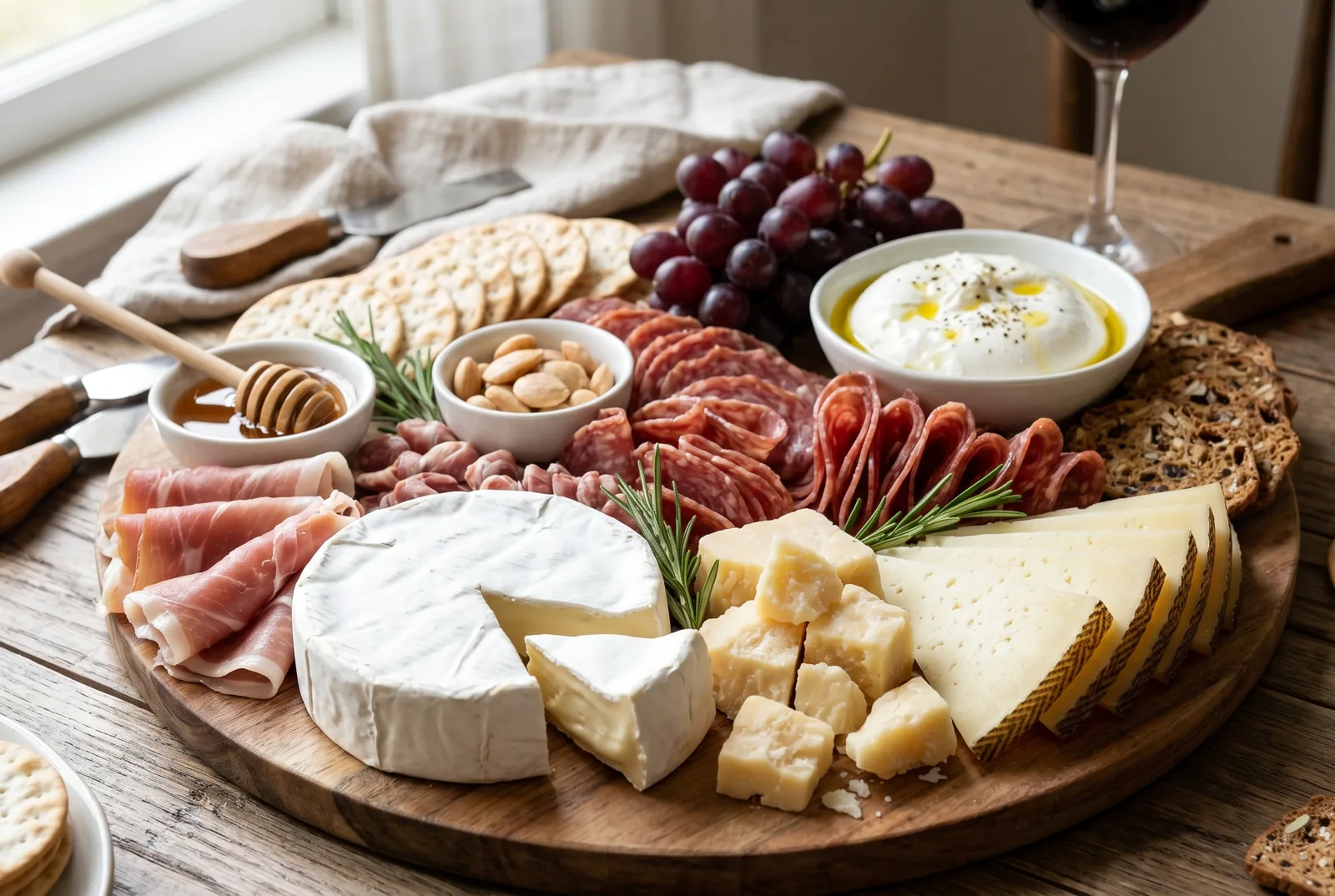
What Cheese Goes on a Charcuterie Board? (The Complete Answer)
The 3-Cheese Framework
The goal of cheese selection is range, not repetition. Three cheeses covering different texture categories ensure every guest finds something they like and every bite tells a different story.
Category 1: Soft Cheese (1 choice)
Soft cheeses are creamy, spreadable, and mild-to-tangy. They're the most approachable cheeses on the board and often the first thing guests reach for.
Best options:
- Brie de Meaux or triple-cream Brie — buttery, mushroomy, mild; the universal crowd-pleaser
- Chèvre (fresh goat cheese) — bright, lactic, tangy; the lighter option
- Burrata — mozzarella shell with cream-and-curd filling; dramatic presentation, mild flavor
- Camembert — similar to Brie but more assertive rind character
- Époisses — for adventurous boards; intensely pungent washed-rind
How to serve: Score the top of Brie to suggest the first cut. Crumble chèvre from a log. Place burrata whole in a shallow bowl and let guests break it. Keep soft cheese near neutral water crackers.
Quantity: One soft cheese is enough for most boards. It's the entry point — you want guests to eat some and move on, not fill up on one element.
Category 2: Semi-Firm Cheese (1 choice)
Semi-firm cheeses have moderate moisture, slice cleanly, and carry more complex flavor than soft cheese without the intensity of aged hard cheese. They're the board's workhorse — pairs well with everything.
Best options:
- Manchego Curado — sheep's milk, grassy and slightly waxy, the Spanish standard; pairs with quince paste
- Gruyère or Comté — alpine cow's milk, nutty, sweet, slightly caramel; the most versatile pairing cheese on the board
- Havarti — very mild and creamy; best for crowd-pleaser boards
- Fontina Val d'Aosta — buttery and mild with a slight earthiness
- Aged Provolone — more assertive than Havarti; slight tangy edge
How to serve: Fan slices or irregular chunks. Semi-firm cheese holds shape well and can be pre-cut without drying out too quickly. Serve near seeded crispbreads.
Quantity: Typically the largest portion of the three cheeses — it's the most versatile and guests will return to it.
Category 3: Aged Hard Cheese (1 choice)
Aged hard cheeses are dense, granular, and intensely flavored. They have the highest umami content on the board and benefit from the longest time at room temperature before serving. They're the flavor anchor — the cheese that rewards attention.
Best options:
- Parmigiano-Reggiano (24+ months) — the umami benchmark; crystalline, nutty, slightly fruity; tyrosine crystals visible
- Aged Gouda (18+ months) — butterscotch, caramel, Maillard depth; the most approachable aged hard cheese for newcomers
- Aged Cheddar (12–24 months) — tangy, sharp, slightly crumbly; the most familiar to American guests
- Pecorino Romano — sheep's milk, sharp and salty; very assertive; use in smaller quantity
- Aged Manchego (Viejo) — more intense sheep character than Curado; good if you want Spanish-only cheeses
How to serve: Break into irregular chunks rather than uniform slices — the craggy texture shows the aged quality and looks more premium. Serve near honey (drizzle directly) and marcona almonds. Allow 45–60 minutes at room temperature before serving.
Quantity: Smallest portion of the three — the intense flavor means guests take smaller pieces. 1–1.5 oz per person is usually sufficient.
Category 4: Blue Cheese (optional, 1 choice)
Blue cheese is optional — not every board needs one, and not every guest will eat it. Add it when you want a full flavor spectrum or when the guest list includes adventurous eaters.
Best options:
- Gorgonzola Dolce — mild, creamy, the introductory blue; good if guests are unfamiliar with blue
- Gorgonzola Piccante — firm, crumbly, intensely sharp; for guests who love blue
- Stilton — British, complex, slightly nutty in addition to the blue notes; the classic holiday board blue
- Roquefort — French sheep's milk blue; intensely pungent; reserve for serious blue cheese lovers
- Gorgonzola + honey + walnuts is the essential pairing combination regardless of which blue you choose
Position on the board: In its own corner, away from mild cheeses. The volatile aromatic compounds from blue cheese will overpower delicate neighbors.
Quantity: 1–1.5 oz per person; blue is a small-portion cheese.
Quick Cheese Selection by Board Type
| Board Type | Soft | Semi-Firm | Aged Hard | Blue |
|---|---|---|---|---|
| Classic / crowd-pleaser | Brie | Havarti or Gouda | Aged Cheddar | Skip or Gorgonzola Dolce |
| Italian-focused | Burrata | Fontina or Provolone | Parmigiano-Reggiano | Gorgonzola |
| Spanish-focused | Fresh Manchego Fresco | Manchego Curado | Manchego Viejo | Skip |
| Date night (for 2) | Brie (small piece) | Comté or Manchego | — | Skip |
| Adventurous | Époisses | Aged Gruyère | Parmigiano | Roquefort |
| Budget-friendly | Camembert | Havarti | Aged Cheddar | Skip |
How Much Cheese to Buy
Per person — appetizer board (30–60 min before dinner):
- Soft cheese: 0.75–1 oz
- Semi-firm: 1–1.5 oz
- Aged hard: 0.75–1 oz
- Blue (if using): 0.5–0.75 oz
- Total: 2–3 oz per person
Per person — meal or main event board (2+ hours, no other food):
- Total: 4–5 oz per person
Practical purchase guide by headcount:
| Guests | Soft cheese | Semi-firm | Aged hard |
|---|---|---|---|
| 2–4 | 4 oz | 6 oz | 4 oz |
| 6–8 | 8 oz | 12 oz | 6 oz |
| 10–12 | 12 oz | 16 oz | 8 oz |
Always buy slightly more than you need. A generous board looks better than a sparse one, and leftovers keep (cheese wrapped in parchment, 3–5 days for most types).
What to Avoid
Avoid more than one cheese in the same category without a clear reason. Two soft cheeses crowd each other and give guests repetition rather than range. Two aged hard cheeses with similar profiles (two different aged Cheddars, for example) waste the board's limited real estate.
Avoid strong cheeses without contrast. If you're serving Époisses or Gorgonzola Piccante, make sure there's a mild cheese elsewhere on the board. Not everyone will want to start with the most intense element.
Avoid pre-cubed or pre-sliced packaged cheese if quality matters. Whole wedges from a cheese counter are almost always better — less oxidation, fresher cut, and you can ask for the age and origin.
Temperature Rules (The Most Skipped Step)
Whatever cheeses you choose, the most important thing you can do for the flavor is pull them from the refrigerator early enough:
- Aged hard cheese: 45–60 minutes before serving
- Semi-firm cheese: 30–45 minutes
- Soft cheese (Brie, chèvre): 20–30 minutes
- Burrata: 20–25 minutes
Cold cheese mutes flavor. The aromatic compounds in Comté that make it smell like hazelnuts don't volatilize at refrigerator temperature. The silky quality of Brie requires the fat to be warm enough to flow. Temperature is the single most impactful change most people can make to their cheese experience.
For more: see our full how many cheeses guide and easy board-building guide. Subscribe to the Charcuterie Lab Report for weekly cheese and pairing guides.
FAQ
What types of cheese go on a charcuterie board? A well-built board includes three distinct cheese types: a soft or fresh cheese (brie, camembert, chèvre, burrata), a semi-firm or aged cheese (aged cheddar, Gruyère, Manchego, Gouda), and a bold or distinctive cheese (Gorgonzola, Stilton, Époisses, or extra-aged Parmigiano). Each type fills a different flavor and texture role on the board.
What is the most popular cheese for a charcuterie board? Aged cheddar is the most universally chosen cheese for charcuterie boards — its familiar flavor, firm texture that's easy to cut and serve, and availability at every grocery store make it the standard. Brie is the second most popular — its visual appeal (a whole wheel with a cut wedge) and creamy texture make it a reliable crowd-pleaser.
What cheese goes with prosciutto on a charcuterie board? Prosciutto pairs most naturally with mild, creamy cheeses: fresh mozzarella (the classic caprese relationship), brie, burrata, or a mild ricotta. Among firmer cheeses, fresh Parmigiano-Reggiano shaved over prosciutto is a traditional Italian combination. Avoid very bold cheeses (blue, washed-rind) with prosciutto — their intensity overwhelms prosciutto's delicate flavor.
What cheese goes with salami on a charcuterie board? Salami's bold, garlicky, fermented flavor pairs best with cheeses that offer genuine contrast: aged cheddar (sharp, crystalline, cuts the fat), Manchego (nutty, slightly tangy), Parmigiano-Reggiano (umami-rich, textural contrast), or Gruyère. Mild cheeses pair less interestingly with salami because there's insufficient contrast — the salami dominates.
Should I buy pre-sliced or block cheese for a charcuterie board? Block cheese, cut at home, is superior in almost every way: fresher flavor (cut surfaces don't dry out until you cut them), more control over thickness, better visual presentation, and typically lower cost per pound. Pre-sliced cheese is more convenient but oxidizes faster. For a serious board, buy blocks and slice yourself. For a quick casual board, pre-sliced is perfectly acceptable.