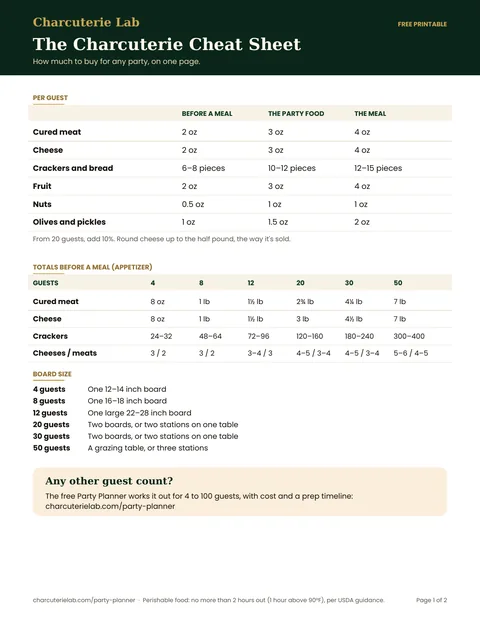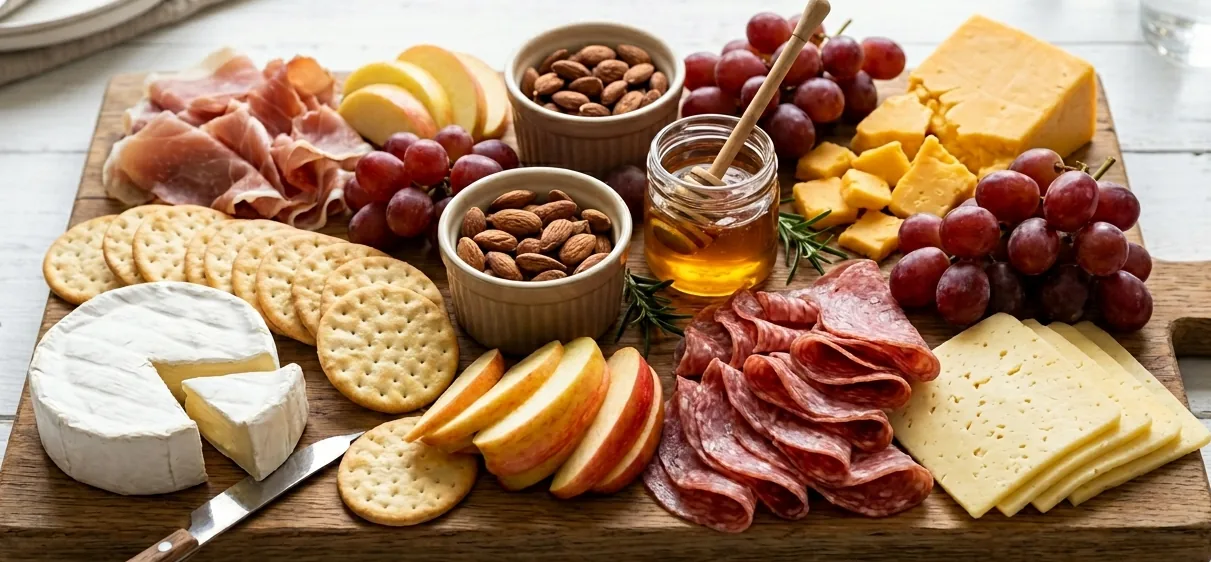
You don't need a specialty cheese shop or an hour of prep time to build a board that looks impressive and tastes great. This guide gives you a specific, replicable system: what to buy at a standard grocery store, how much of each item, how to arrange it in 15 minutes, and why the ingredient choices work from a flavor perspective.
Total cost: $25–35 depending on your grocery store and market conditions.
Quick Answer: The formula for an easy charcuterie board: one soft cheese + one firm cheese + one cured meat + crackers + one fresh fruit + one condiment. Everything is available at a standard grocery store. Arrange cheese first, add folded meat between them, fill with crackers and fruit, add condiment in a small bowl. Total time: 10 minutes.
The Quick Answer
Easy grocery store charcuterie board for 4–6 guests:
| Item | What to Buy | Amount | Approx. Cost |
|---|---|---|---|
| Meat 1 | Prosciutto (packaged, Boar's Head or similar) | 3 oz | $4–6 |
| Meat 2 | Genoa salami (deli counter or packaged) | 3 oz | $3–5 |
| Cheese 1 | Sharp cheddar (block, not pre-sliced) | 5 oz | $4–6 |
| Cheese 2 | Brie (small wheel, any brand) | 4–6 oz wheel | $5–8 |
| Cheese 3 | Havarti or Gouda (deli counter) | 3 oz | $3–4 |
| Fruit | Red grapes | 1 small bunch | $2–3 |
| Fruit | Apple (Honeycrisp or Fuji) | 1 medium | $1 |
| Crackers | Water crackers + buttery round crackers | 1 sleeve each | $4–6 |
| Nut | Almonds (cocktail or roasted) | 2 oz | $2–3 |
| Accoutrement | Honey | Small jar | $3–4 |
| Total | $31–46 |
Why These Specific Items Work
This isn't a random grocery list. Each item is chosen to cover a specific flavor and texture category — and together they hit the contrast principles that make boards satisfying.
The Meat Logic
Prosciutto is the mildest, sweetest, most universally appealing cured meat available in most grocery stores. It's also the most elegant-looking when draped loosely — you get high visual impact from a $5 package.
Genoa salami provides the contrast: firmer texture, more assertive spice, and the characteristic garlic and wine notes of Italian-style salamis. The fat marbling in the slices delivers flavor differently than the delicate prosciutto fat — salami fat is suspended in the meat matrix, prosciutto fat is in a separate pure-fat cap.
Two meats, two completely different flavor profiles. That contrast is what makes the board feel considered rather than thrown together.
The Cheese Logic
Sharp cheddar is the anchor. It's familiar, assertive, and pairs with literally everything on the board. Buy it as a block and cut irregular chunks rather than uniform slices — irregular shapes look more natural and give guests choices about portion size.
Brie is the soft, approachable contrast. Most grocery stores carry at least one small Brie wheel. Even an affordable grocery-store Brie improves dramatically if you pull it from the refrigerator 30 minutes before serving — room-temperature Brie goes from "fine" to "impressive."
Havarti or young Gouda fills the middle ground: mild, slightly buttery, universally liked. This is your accommodation cheese — for guests who find cheddar too sharp or Brie too soft.
Three cheeses covering soft/runny, firm/crumbly, and mild/creamy: every guest finds something they enjoy.
The Fruit Logic
Red grapes are the workhorse. Small clusters look great, grapes don't brown or dry out over a 2-hour window, and the malic acid refreshes the palate between bites of rich meat and cheese. Grapes alongside the cheese wedge is the default "what do I eat together" visual cue for guests who aren't sure.
Apple slices (Honeycrisp or Fuji) add crunch, sweetness, and a different fruit flavor. The fructose-glutamate sweetness interaction with aged cheddar — where apple sweetness amplifies the savory character of the cheese — is one of the most approachable pairing demonstrations you can put in front of guests. Slice right before building the board and add a squeeze of lemon juice to prevent browning.
The Cracker Logic
Water crackers are the universal neutral vehicle — their flavor doesn't compete with anything on the board. They're the default choice when guests aren't sure what to build with.
Buttery round crackers (Ritz-style) provide contrast: slightly sweet, fatty, and substantial enough to hold a proper portion. Some cheeses and meats actually pair better with a slightly sweet cracker base than with a purely neutral one.
Two cracker varieties creates choice and ensures no single cracker runs out mid-board.
The Accoutrement Logic
Honey is the single highest-ROI addition to a beginner board. One small jar costs $3–5 and instantly makes the board look more thoughtful. Place it near the sharp cheddar and blue (if you have one) — the sweet-salty compound contrast is both scientifically grounded and immediately appealing.
Almonds add crunch, protein, and a visual texture break from the smooth meats and cheeses.
The 15-Minute Build
What you need
- A cutting board (any size), slate, or large plate
- 3–4 small bowls or ramekins
- One cheese knife or regular sharp kitchen knife
- A small spoon for honey
The sequence
Minutes 1–2: Setup Place your small bowls on the board first — this anchors the zones. Put honey in one, almonds in another, and leave one empty for olives if you have them.
Minutes 3–6: Cheeses Cut the cheddar into irregular chunks. Leave the Brie wheel whole (or slice it if it's not very ripe). Place the Havarti in thin slices, fanned slightly. Position the three cheeses at different corners or zones of the board, spread apart.
Minutes 7–10: Meats Prosciutto: take individual slices and fold or drape them loosely — a gentle S-fold or a simple loose wave looks much better than flat-stacked slices. You want them to look abundant and imperfect.
Salami: lay slices in a partial overlap cascade, or fold individual slices into halves and shingle them. Fill a gap between two cheese zones.
Minutes 11–13: Fruit and crackers Place grape clusters to fill larger gaps near the cheese. Slice the apple (add lemon juice) and fan the slices near the cheddar. Fan water crackers into available spaces. Either stack buttery crackers near the Brie or create a separate basket alongside the board.
Minutes 14–15: Finish Drizzle or spoon a small amount of honey over or near the cheddar. Add a sprig of fresh rosemary or thyme if you have it — this takes 30 seconds and has an outsized visual impact. Check for obvious large empty spaces and fill with crackers or grapes.
You're done.
Tips That Actually Matter
Temperature is more important than arrangement. Pull your Brie 20–30 minutes early. The most beautifully arranged board with cold Brie will taste less impressive than an average-looking board with room-temperature cheese.
Don't pre-slice everything. Leave the cheddar in large chunks guests can break themselves, and leave grape clusters intact rather than removing individual grapes. Full clusters fill space better and look more abundant.
Two cracker varieties, not one. Running out of one type mid-party is awkward. Having two means even if one runs low, guests always have a vehicle.
The honey drizzle is optional but worth it. It takes 10 seconds and immediately elevates the visual. If you skip every other tip, don't skip pulling the Brie early and using honey.
Grocery store meat is fine. Boar's Head prosciutto and standard packaged Genoa salami from most grocery stores are genuinely good. The "you need to go to a specialty deli" advice is real for specialty products like lardo or 'nduja, but for prosciutto and salami, grocery store quality works well.
What to Skip on a Beginner Board
- Obscure cheeses: Save Taleggio, Stilton, or aged raw-milk cheeses for when you have guests who specifically want to explore
- Multiple meat types: Two is the right number for 4–6 guests; three or more creates decision fatigue and portions that are too small to notice
- Pre-made accompaniment trays: The olives-and-cornichon jars from the olive bar or specialty section are nice, but not necessary. Honey does more work per dollar for a first board.
- Expensive crackers: Water crackers and Ritz-style crackers outsell every artisan cracker variety for a reason — they work, they're familiar, and they don't get in the way.
FAQ
What is the easiest charcuterie board to make?
A three-element board is the easiest: one cheese (aged cheddar or brie from any grocery store), one meat (pre-sliced prosciutto or salami), crackers, and one or two accompaniments from your pantry (grapes, olives, or honey). This assembles in under 10 minutes and requires no special skills or specialty ingredients. It's also genuinely delicious.
What do you need from a grocery store to make a quick charcuterie board?
Everything. Modern grocery stores carry sufficient charcuterie staples: sliced prosciutto and salami (deli section or pre-packaged), brie and aged cheddar (cheese section), water crackers, grapes, and basic accompaniments like olives, honey, and mustard. A complete, impressive board can be assembled entirely from a standard grocery store visit.
How do you make a charcuterie board look good without a lot of effort?
Three principles: vary the height (stack some crackers, fold meats), group similar items in clusters rather than distributing evenly, and always add one fresh herb sprig (rosemary or thyme) for a polished touch. These three moves add apparent effort and visual structure without requiring significant time.
What are the best pre-made charcuterie shortcuts?
Pre-sliced charcuterie packs (prosciutto, salami, bresaola) eliminate slicing entirely. Pre-portioned cheese wedges require no knife work. Pre-washed grapes need only to be separated from the stem. A good-quality store-bought cracker selection eliminates the need for bread preparation. These shortcuts save 20–30 minutes without compromising quality.
Is there a formula for a foolproof easy charcuterie board?
Yes: one soft cheese + one firm cheese + one meat + crackers + one fresh fruit + one condiment. Arrange the cheeses first as anchors, add folded meat between them, fill gaps with crackers and fruit, add a small vessel of condiment, and scatter a few nuts to fill remaining space. This formula works at any scale, any budget, and any occasion.
The Takeaway
A $30–35 grocery store board built in 15 minutes can genuinely impress people when it follows the right framework: one mild and one assertive meat, three cheeses covering soft/firm/mild, two fruits providing acid contrast and sweetness, two cracker types, and honey.
The science is in the contrasts. The skill is in the temperature timing and the arrangement. Neither requires specialty ingredients or hours of prep.
More frameworks, less guessing. Subscribe to The Charcuterie Lab Report.